Updated 10 May 2026 | intercultural.info
In brief: the 2026 extraordinary regularisation opens three doors within the employment route — prior employment, a job offer or a responsible declaration of self-employed activity. If you do not satisfy the family or the vulnerability route, and you do not obtain a job offer, self-employment constitutes the only door that depends entirely on you. In this article we specify what the regulation requires, what it does not require, and we provide a free template generator so that you may prepare your declaration in your own language and then copy it in Spanish into the EX-32 form or into Mercurio.
Why does this door matter?
The Twenty-first Additional Provision of the Immigration Regulations, modified by Royal Decree 316/2026 (BOE-A-2026-8284), requires applicants to demonstrate, in addition to the general requirements, at least one of these three blocks:
- Family route: residing in Spain with minor children, adult children with a disability requiring support, or direct ascendants of the first degree.
- Vulnerability route: holding a vulnerability certificate issued by social services or by an entity registered in the Registry of Immigration Collaborating Entities (RECEX).
- Employment route: prior employment in Spain, presenting a job offer, or presenting a responsible declaration of self-employed activity.
(Source: factsheet 28 Ter of the Ministry of Inclusion, Social Security and Migration, updated 17 April 2026.)
In practice, a considerable proportion of persons in irregular administrative situation do not fit into the family route — they do not have minor children in Spain in their care or direct ascendants residing with them — and cannot obtain a vulnerability certificate, because their municipal social services or the entities of the RECEX are saturated or require prior follow-up.
Within the employment route, securing a formal job offer of ninety days or more, while still without a work permit, remains a substantial obstacle for many applicants, particularly in sectors where the offer is informal or seasonal.
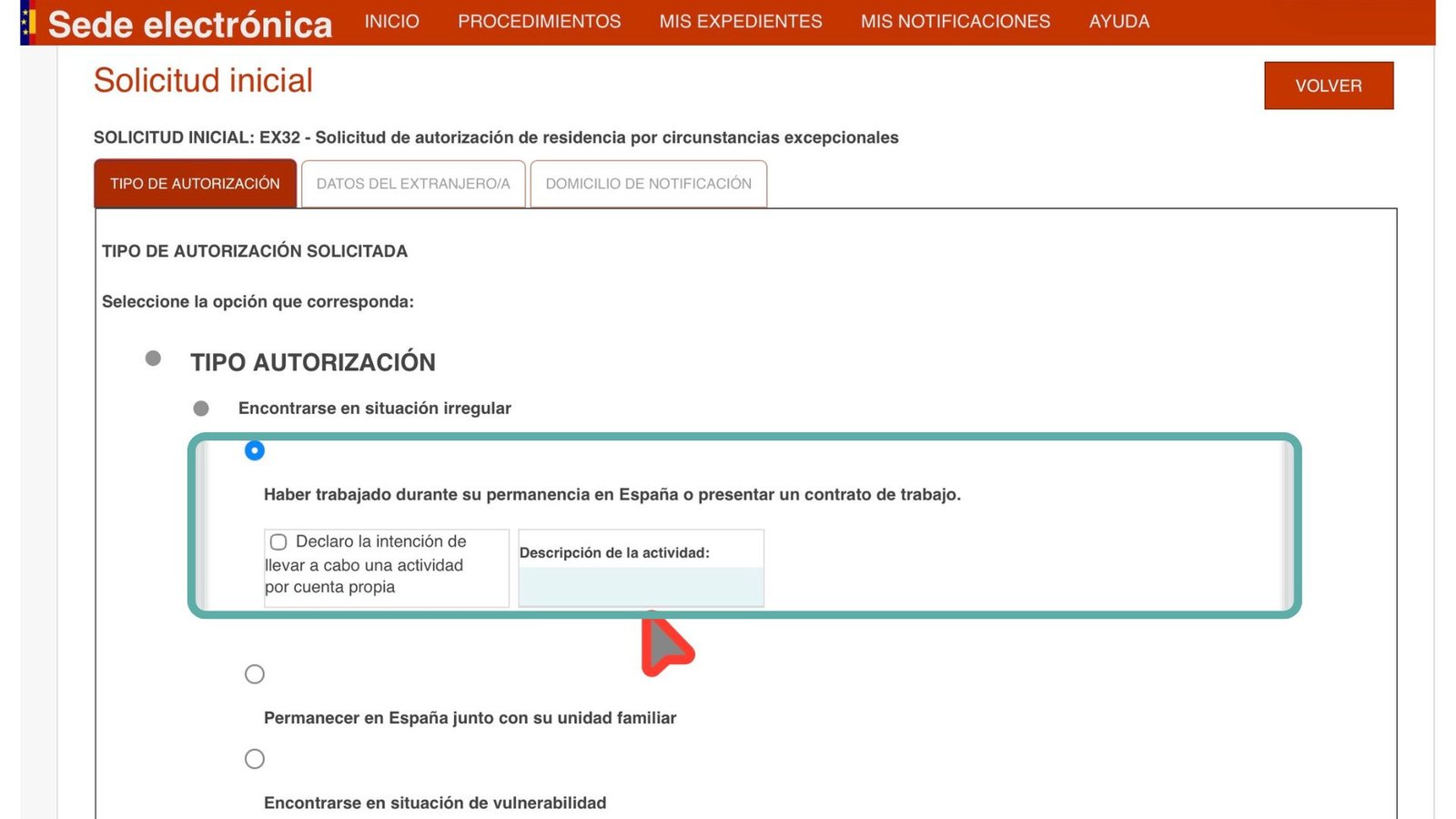
Self-employment is the only option within the employment route that does not depend on a third party. It is sustained solely by a brief text that you draft and sign, in which you declare your intention to commence an activity as a self-employed person. The Administration, at this stage, does not require you to demonstrate economic viability or prior capital.
Important precaution: the technical accessibility of this door does not render it trivial. Should the authorisation be granted to you through this route, you will be required to register with the Special Regime for Self-Employment (RETA) and effectively conduct the declared activity, at least during the first year, in order to renew your residence permit. We explain this in detail further below.
What the regulation requires — and what it does not
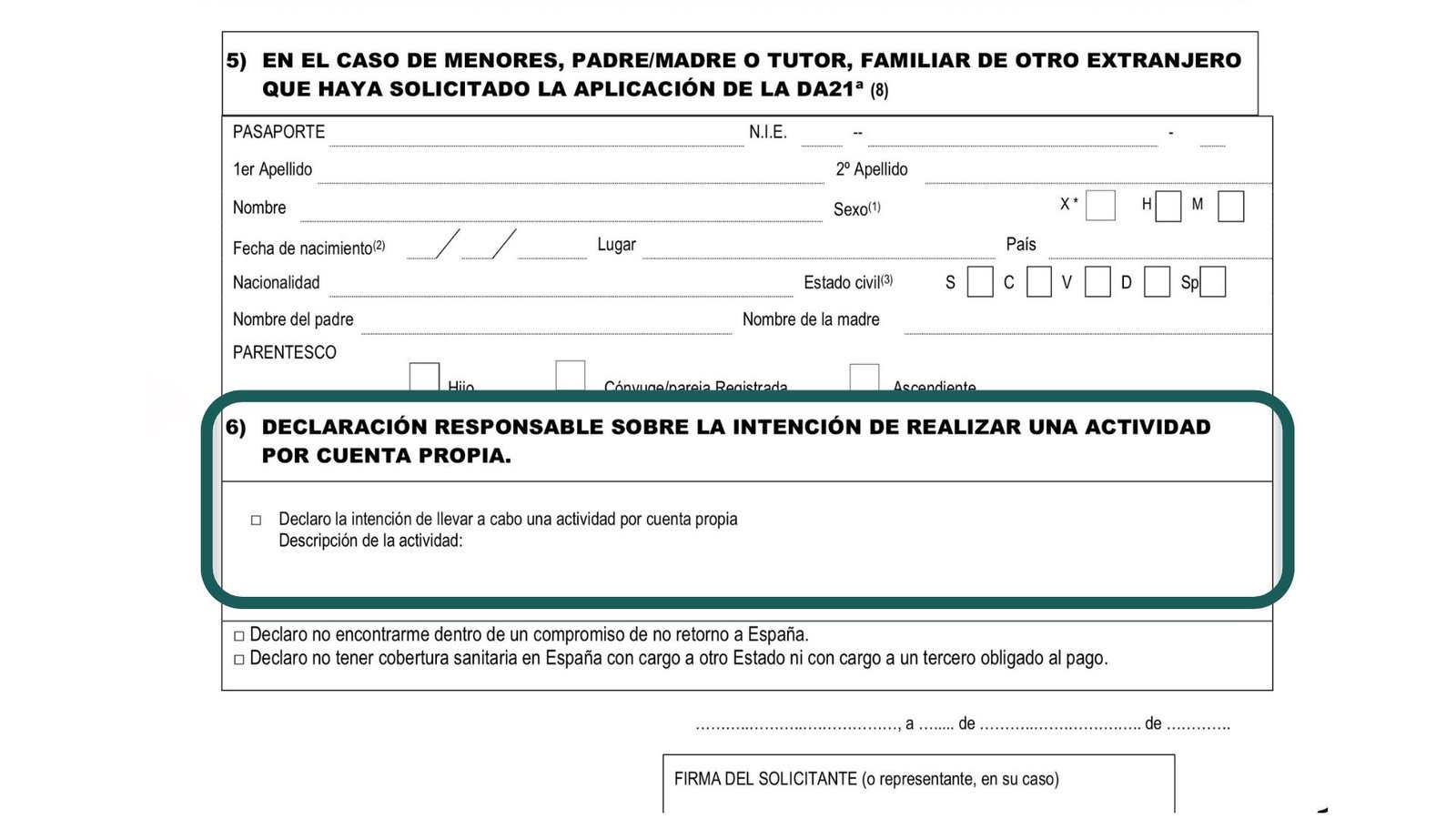
The official EX-32 form incorporates a specific section, number 6, entitled «Responsible declaration regarding the intention to conduct a self-employed activity». In that section you must:
- Tick the box «I declare my intention to conduct a self-employed activity».
- Describe the activity that you intend to perform (this is the point we shall examine in this article). The text must be drafted always in Spanish, even though you may consider it in your mother tongue while preparing it.
(The form additionally includes two further boxes that must also be ticked: «I declare that I am not bound by a non-return commitment to Spain» and «I declare that I do not have health coverage in Spain at the expense of another State or of a third party obliged to pay». These are formal declarations with no associated free text.)
The physical space for describing the activity is severely restricted: in the paper form barely a couple of lines fit, and on the Mercurio electronic platform the field is limited to approximately 470 characters. For this reason the description must be clear, specific and realistic, without expending words on generic explanations.
What the regulation does NOT require — at least not explicitly
For the purposes of this regularisation process, the Twenty-first Additional Provision does not require (source: factsheet 28 Ter, as cited):
- A detailed activity project or business plan.
- Evidence of prior capital, bank deposits or financing.
- A premises rental contract, an opening licence, or any prior administrative permits.
- A recognised qualification for professions that do not require compulsory professional registration.
- Prior formal professional experience.
This represents a radical simplification compared with the ordinary procedure for residence and self-employment authorisation, and it opens a real possibility for persons who arrive without resources or business networks.
Caution! As of now, no official source confirms that the Foreigners’ Files Processing Unit (UTEX) will demand detailed information regarding the activity that the applicant intends to develop on a self-employed basis. It is not excluded that, during processing, the office may issue a request for rectification seeking clarifications, although as of 10 May 2026 there is no public evidence that this is occurring on a systematic basis.
What happens next, if the authorisation is granted to you
This is the section that should be understood before submitting the application, not afterwards. If the Administration grants you the authorisation through this route, you implicitly assume the commitment to effectively commence the declared activity during the first year. The authorisation has an initial validity of one year and, for its renewal, you will need to demonstrate that the economic activity exists and has been developed (RD 316/2026 and the modified article of RD 1155/2024).
Registration with the RETA
Once the favourable decision is notified to you, you will need to apply for the Foreign National Identity Card (Tarjeta de Identidad de Extranjero — TIE) within one month, and register with the Tax Agency (form 036 or 037) and with the Special Regime for Self-Employment (RETA) of the Social Security.
2026 flat rate: approximately €90 per month for the first 12 months
Persons who register for the first time with the RETA during 2026 may apply for the flat rate of eighty euros per month during the first year — approximately €89 per month including the contribution corresponding to the Intergenerational Equity Mechanism (MEI, 0.9 %). It is a reduced rate specifically designed for new registrations. After the first twelve months, the flat rate may be extended for a further twelve months if your net earnings remain below the Spanish minimum wage (SMI). Once the flat-rate period is exhausted, you will move on to the general contribution system based on brackets according to actual earnings (source: Importass of the Social Security, self-employment guide).
Important, so that you are not caught by surprise: once the flat-rate period concludes (at twelve or twenty-four months, depending on the extension), the monthly contribution is calculated on actual net earnings and ranges approximately between €200 and €590 per month, distributed across fifteen brackets in force in 2026 (source: Self-employed contribution simulator — Importass, Spanish Social Security). It is advisable to project this cost into any estimate of viability for the activity.
Minimum tax obligations
As a self-employed person you will have quarterly obligations: VAT declaration (form 303) and instalment payments of personal income tax (IRPF, form 130 or 131), together with an annual IRPF declaration at year-end. For most manual and service activities, management is perfectly manageable with a basic advisory service or, indeed, with minimal training. (Source: Tax Agency — forms in force in 2026.)
If the activity does not work out
If, after a period, the declared activity proves not to be viable, the regulation itself provides alternatives. You may apply for a modification towards employed work as soon as you obtain a labour contract. Should that be the case, our recommendation is that, before taking decisions in that direction, you consult organisations and professionals working in the field of immigration. And if, when the moment of renewal arrives, your situation is one of active job-seeking, an extraordinary extension is provided which permits residence to be maintained while you seek employment, provided that you are registered with the public employment service or that you submit an integration effort report (RD 316/2026, articles modifying the extension regime).
Notice: this extraordinary extension is not 100 % guaranteed. Its grant is subject to a favourable assessment by the competent authority, who will examine your specific situation and the documentation submitted.
The point to grasp is that declaring an activity entails the commitment to attempt it seriously. It is not an empty procedural step.
Anatomy of an effective declaration
A well-constructed self-employment declaration, within the limit of approximately 450 characters, should contain five elements:
- Which specific activity you will conduct (with action verbs and an identifiable sector).
- To whom it is addressed (private clients, residents’ associations, small businesses, large companies, public institutions, fellow migrants…).
- Where it is conducted (at the client’s home, in public spaces, from your own home…).
- Why it makes sense for you (training or experience, even if informal).
- With which minimum resources you would commence (basic tools, public transport or a bicycle…).
Example of a well-constructed declaration
Inicio actividad de limpieza doméstica y de comunidades de vecinos en el área de Málaga, prestando servicio a particulares y pequeñas comunidades. Trabajo a domicilio del cliente, sin local propio, con productos y útiles propios y desplazamientos en transporte público. Cuento con cuatro años de experiencia previa en limpieza en mi país de origen. Solicitaré el alta en el RETA con tarifa plana en los primeros doce meses.
(Approximate translation: «I commence an activity in domestic cleaning and cleaning of residents’ associations in the Málaga area, providing my service to private clients and small communities. I work at the client’s home, without my own premises, with my own products and tools, travelling by public transport. I have four years of previous experience in cleaning in my country of origin. I shall apply to register with the RETA at the flat rate during the first twelve months.» The text submitted in the form must be the Spanish version.)
Fewer than 450 characters, within the Mercurio limit.
Compare it with this other version, which is markedly weaker:
Tengo intención de trabajar por cuenta propia en lo que pueda. Ya tengo experiencia.
(Approximate translation: «I intend to work on a self-employed basis in whatever I can. I already have experience.»)
Both are technically responsible declarations. However, the first describes a person with a plan; the second describes nothing at all.
Twenty realistic business ideas with low initial investment
The following list is non-exhaustive: activities that may be commenced with very few resources, without your own premises in most cases, and without recognised qualification. They are grouped by professional family in order to facilitate identification of the option that best fits your background.
Cleaning and maintenance
- Domestic cleaning for private clients.
- Cleaning of residents’ associations, offices and small premises.
- Laundry and ironing at the client’s home.
- Basic gardening and maintenance of communal green spaces.
Manual work and minor refurbishment
- Interior painting in private dwellings and residents’ associations.
- Basic plumbing (replacement of taps, repair of minor leaks, installation of sanitary fittings).
- Minor masonry (tile-laying, small repairs, retouches).
- Furniture assembly and small DIY work in homes.
- Assistance with removals and local relocations within the city.
Delivery, courier and logistics without a driving licence
- Local delivery by bicycle or electric scooter (parcels, food, documents).
- Distribution of leaflets for small businesses.
- Pick-up and delivery of orders for neighbourhood retailers.
Care for persons
- Accompaniment and support for older persons at their home.
- Childminding and care of minors on an occasional or regular basis.
Cooking, sewing and «manual» trades
- Cooking at the client’s home or small catering, specialising in the cuisine of your country of origin.
- Sewing, clothing alterations and small bespoke tailoring.
- Hairdressing and personal grooming at the client’s home (haircuts, depilation, manicure).
Accessible services for applicants with general training
- Private tuition in various subjects and languages (your mother tongue, particularly Arabic or African languages, for which demand in Spain is increasing).
- Community translation and interpreting for private clients, small offices and social services.
- Basic digital support for older persons or neighbours (mobile phone configuration, email, Cl@ve, digital certificate, online procedures).
For qualified applicants: five further ideas
Not all persons in irregular administrative situation come from low-qualification professions. A proportion of our audience arrive with technical or university training, or with qualified professional experience in their country of origin — in new technologies, communication, engineering, sport or hospitality and tourism, among many others. Self-employment also serves these applicants, provided that the chosen activity may be performed as self-employed work and does not require professional registration or regulated authorisation that cannot be obtained at this stage.
- Freelance web, graphic or digital design. Construction of web pages, visual identity for small businesses, templates for social media, social media management for neighbourhood enterprises. Without premises, from home, with basic computer equipment.
- Repair of mobile phones, computers and small electronic devices. At the client’s home or in a small workshop. Notice: the handling and final disposal of batteries and electronic waste may require registration as a manager of waste electrical and electronic equipment (WEEE / RAEE) in certain cases. For occasional repairs and replacement of screens or components, registration as a self-employed worker may be sufficient. (Notice: consult a person qualified in the field.)
- Photography and video for events, portraits and products. Weddings, communions, community events, commercial photography for small businesses, video editing for social media. A modest set of equipment is sufficient to commence.
- Personal training, fitness instruction or yoga and pilates teaching. Important notice: in order to deliver physical-sporting activity in gyms and regulated environments, most autonomous communities require specific qualification (Sports Technician, TAFAD / CAFD or an equivalent recognised qualification). For private classes in the open air or at the client’s home, regulation is less strict, although the regional rules of your autonomous community should be verified before declaring the activity.
- Services for non-regulated hospitality and tourism. Cooks or pastry-makers at the client’s home specialising in the cuisine of the country of origin, small catering services, cultural entertainment for events, translation for tourist groups, tourist photography. Notice: the management of tourist accommodation (apartments, holiday lets), as with other activities in the tourism sector, requires a regional licence and therefore does not fit within a simple responsible declaration. Before taking a decision, consult the competent authorities.
General notice on regulated professions. Certain fields require compulsory professional registration or an officially recognised qualification in order to be practised in Spain: senior engineering with stamped projects, architecture, healthcare professions (medicine, nursing, physiotherapy, clinical psychology) or law, among others. If your background is in one of these and you do not yet hold a recognised qualification, self-employment does not resolve the question of professional authorisation, although it may serve for related, non-regulated activities while you process the recognition. For the recognition of foreign university qualifications, consult the official portal Valida-TE of the Ministry of Science, Innovation and Universities and the information regarding recognition with official qualifications. For the recognition of non-university qualifications (secondary education, baccalaureate, vocational training), consult the official information of the Ministry of Education, Vocational Training and Sport.
The ideas above are examples. What matters is that the activity you choose should be consistent with your background, manageable with minimum resources and honestly achievable during the first year. The interactive generator assists you in drafting the declaration for any of these activities, or for a different one that you propose yourself.
Three frequent errors (and how to avoid them)
First error: generic description. «I shall work on a self-employed basis», with nothing further, weakens the file. The responsible declaration provides a margin, although it does not transform a vague intention into a sustainable strategy.
Second error: an activity inconsistent with your reality. Declaring that you will open an IT consultancy when your entire background is in construction has limited credibility. The declaration must align with who you are.
Third error: forgetting that registration with the RETA comes afterwards and demands compliance. If you declare an activity without the slightest intention of commencing it, at the moment of renewal you will not have evidence of economic activity. And if the Administration were to detect that the initial declaration was false, revocation proceedings could be initiated. This is not a procedural step without consequences.
How to use the interactive generator
The intercultural.info self-employment declaration generator enables you to prepare your text in four steps: you choose the activity from the list (or describe one of your own), you add the location and specific details, you indicate your experience and starting situation, and on pressing the Generate declaration button you obtain a template in Spanish ready to copy into the EX-32 field or into Mercurio, within the character limit.
The intention is that the declaration should reflect your actual situation, not a standard text. For this reason the generator requests specific data: city, prior training, available resources. The final output is a personalised paragraph, automatically reviewed for spelling, grammatical and editorial errors, which you may edit before copying. Remember: the text submitted on Mercurio or in the EX-32 must always be in Spanish.
→ Self-employment declaration generator
What to do now
- First read the main article on the 2026 regularisation: Extraordinary regularisation 2026 in Spain: what is known, who is eligible, and what you should do now.
- Verify that you satisfy the general requirements: continuous presence in Spain, criminal record certificate requested, identity evidenced. For this purpose, use our requirements simulator.
- If you fit better through the family or vulnerability route, prioritise those routes. Self-employment is the solution when the other two doors are closed to you.
- If self-employment is your route, use the generator and review the resulting text calmly. Edit it if necessary.
- Consider obtaining your digital certificate in order to perform any electronic procedure with the Spanish Administration: How to obtain your digital certificate in Spain: a step-by-step guide.
- Remember the deadline: applications must be submitted before 30 June 2026. Non-extendable.
Official sources and references
- BOE: Royal Decree 316/2026 of 14 April, modifying the Immigration Regulations (BOE-A-2026-8284). Full text at www.boe.es.
- Factsheet 28 Ter: Residence authorisation by extraordinary arraigo, Ministry of Inclusion, Social Security and Migration (last update: 17 April 2026).
- EX-32 form: available at inclusion.gob.es/web/migraciones/modelos-generales.
- 2026 flat rate: Importass of the Social Security, specifically the self-employment guide.
- Tax forms: Tax Agency — electronic office, with direct access to forms 036/037 (tax registration) and to form 303 (VAT).
- Recognition of foreign university qualifications: Valida-TE Portal, Ministry of Science, Innovation and Universities.
- Recognition of foreign non-university qualifications: Ministry of Education, Vocational Training and Sport.
- Regularisation portal: inclusion.gob.es/regularizacion.
- Official telephone 060: queries and appointment booking, Monday to Friday from 09:30 to 14:00 and from 16:30 to 19:30.
Legal notice: This article is provided for informational purposes only and does not constitute legal advice. The definitive requirements will be confirmed by administrative practice arising from the first decisions. For individual circumstances, consult professionals working in the field of immigration or an entity registered in the Registry of Immigration Collaborating Entities (RECEX).
@intercultural-infoSubscribe for updates and video tutorials →