Categoría: English

  • Self-employment within the 2026 regularisation: how to draft your responsible declaration, with 25 realistic business ideas

    Self-employment within the 2026 regularisation: how to draft your responsible declaration, with 25 realistic business ideas

    This article is also available in: Español العربية English Français

    Updated 10 May 2026 | intercultural.info

    In brief: the 2026 extraordinary regularisation opens three doors within the employment route — prior employment, a job offer or a responsible declaration of self-employed activity. If you do not satisfy the family or the vulnerability route, and you do not obtain a job offer, self-employment constitutes the only door that depends entirely on you. In this article we specify what the regulation requires, what it does not require, and we provide a free template generator so that you may prepare your declaration in your own language and then copy it in Spanish into the EX-32 form or into Mercurio.


    Why does this door matter?

    The Twenty-first Additional Provision of the Immigration Regulations, modified by Royal Decree 316/2026 (BOE-A-2026-8284), requires applicants to demonstrate, in addition to the general requirements, at least one of these three blocks:

    • Family route: residing in Spain with minor children, adult children with a disability requiring support, or direct ascendants of the first degree.
    • Vulnerability route: holding a vulnerability certificate issued by social services or by an entity registered in the Registry of Immigration Collaborating Entities (RECEX).
    • Employment route: prior employment in Spain, presenting a job offer, or presenting a responsible declaration of self-employed activity.

    (Source: factsheet 28 Ter of the Ministry of Inclusion, Social Security and Migration, updated 17 April 2026.)

    In practice, a considerable proportion of persons in irregular administrative situation do not fit into the family route — they do not have minor children in Spain in their care or direct ascendants residing with them — and cannot obtain a vulnerability certificate, because their municipal social services or the entities of the RECEX are saturated or require prior follow-up.

    Within the employment route, securing a formal job offer of ninety days or more, while still without a work permit, remains a substantial obstacle for many applicants, particularly in sectors where the offer is informal or seasonal.

    Self-employment is the only option within the employment route that does not depend on a third party. It is sustained solely by a brief text that you draft and sign, in which you declare your intention to commence an activity as a self-employed person. The Administration, at this stage, does not require you to demonstrate economic viability or prior capital.

    Important precaution: the technical accessibility of this door does not render it trivial. Should the authorisation be granted to you through this route, you will be required to register with the Special Regime for Self-Employment (RETA) and effectively conduct the declared activity, at least during the first year, in order to renew your residence permit. We explain this in detail further below.


    What the regulation requires — and what it does not

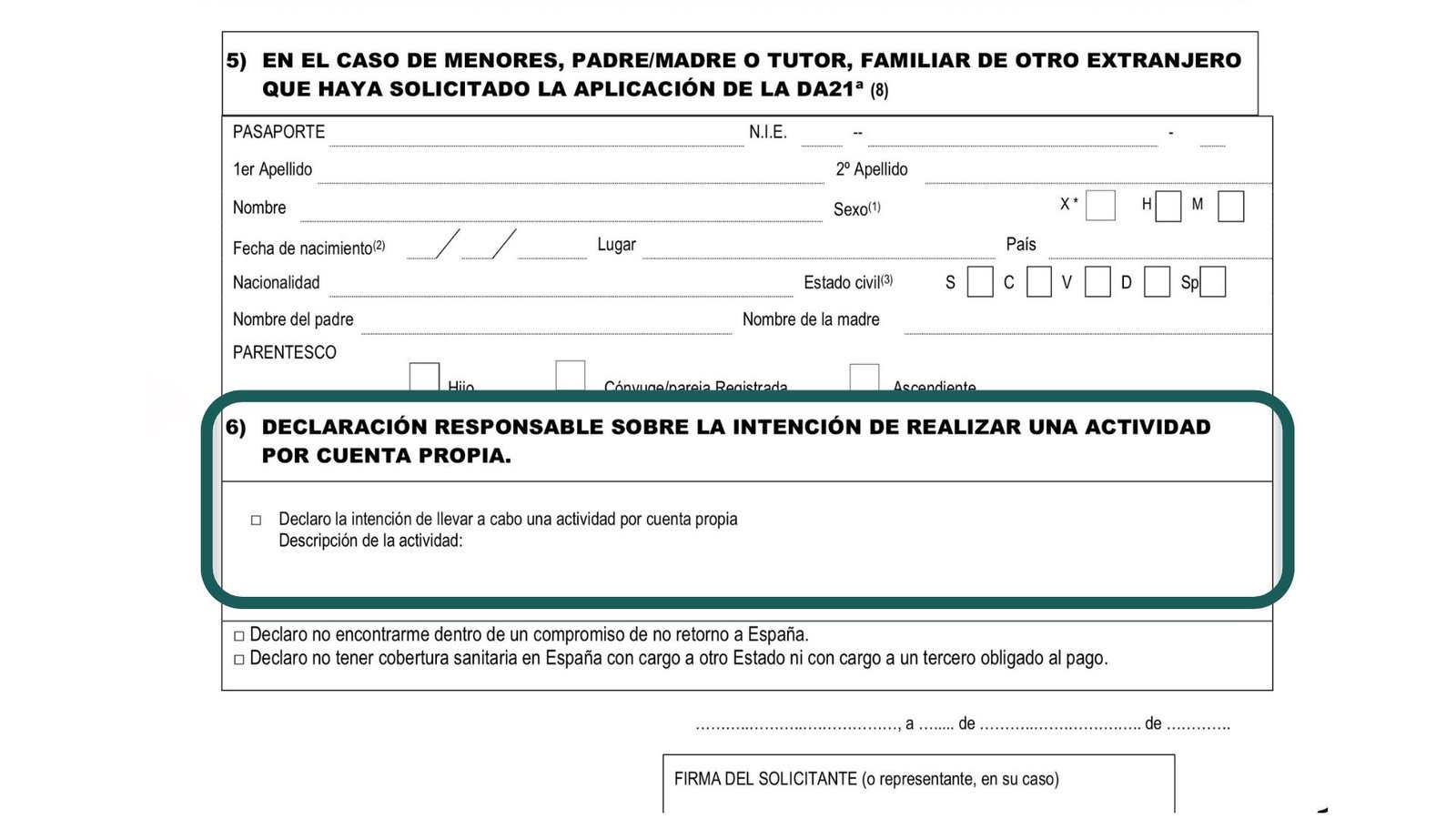
    The official EX-32 form incorporates a specific section, number 6, entitled «Responsible declaration regarding the intention to conduct a self-employed activity». In that section you must:

    • Tick the box «I declare my intention to conduct a self-employed activity».
    • Describe the activity that you intend to perform (this is the point we shall examine in this article). The text must be drafted always in Spanish, even though you may consider it in your mother tongue while preparing it.

    (The form additionally includes two further boxes that must also be ticked: «I declare that I am not bound by a non-return commitment to Spain» and «I declare that I do not have health coverage in Spain at the expense of another State or of a third party obliged to pay». These are formal declarations with no associated free text.)

    The physical space for describing the activity is severely restricted: in the paper form barely a couple of lines fit, and on the Mercurio electronic platform the field is limited to approximately 470 characters. For this reason the description must be clear, specific and realistic, without expending words on generic explanations.

    What the regulation does NOT require — at least not explicitly

    For the purposes of this regularisation process, the Twenty-first Additional Provision does not require (source: factsheet 28 Ter, as cited):

    • A detailed activity project or business plan.
    • Evidence of prior capital, bank deposits or financing.
    • A premises rental contract, an opening licence, or any prior administrative permits.
    • A recognised qualification for professions that do not require compulsory professional registration.
    • Prior formal professional experience.

    This represents a radical simplification compared with the ordinary procedure for residence and self-employment authorisation, and it opens a real possibility for persons who arrive without resources or business networks.

    Caution! As of now, no official source confirms that the Foreigners’ Files Processing Unit (UTEX) will demand detailed information regarding the activity that the applicant intends to develop on a self-employed basis. It is not excluded that, during processing, the office may issue a request for rectification seeking clarifications, although as of 10 May 2026 there is no public evidence that this is occurring on a systematic basis.


    What happens next, if the authorisation is granted to you

    This is the section that should be understood before submitting the application, not afterwards. If the Administration grants you the authorisation through this route, you implicitly assume the commitment to effectively commence the declared activity during the first year. The authorisation has an initial validity of one year and, for its renewal, you will need to demonstrate that the economic activity exists and has been developed (RD 316/2026 and the modified article of RD 1155/2024).

    Registration with the RETA

    Once the favourable decision is notified to you, you will need to apply for the Foreign National Identity Card (Tarjeta de Identidad de Extranjero — TIE) within one month, and register with the Tax Agency (form 036 or 037) and with the Special Regime for Self-Employment (RETA) of the Social Security.

    2026 flat rate: approximately €90 per month for the first 12 months

    Persons who register for the first time with the RETA during 2026 may apply for the flat rate of eighty euros per month during the first year — approximately €89 per month including the contribution corresponding to the Intergenerational Equity Mechanism (MEI, 0.9 %). It is a reduced rate specifically designed for new registrations. After the first twelve months, the flat rate may be extended for a further twelve months if your net earnings remain below the Spanish minimum wage (SMI). Once the flat-rate period is exhausted, you will move on to the general contribution system based on brackets according to actual earnings (source: Importass of the Social Security, self-employment guide).

    Important, so that you are not caught by surprise: once the flat-rate period concludes (at twelve or twenty-four months, depending on the extension), the monthly contribution is calculated on actual net earnings and ranges approximately between €200 and €590 per month, distributed across fifteen brackets in force in 2026 (source: Self-employed contribution simulator — Importass, Spanish Social Security). It is advisable to project this cost into any estimate of viability for the activity.

    Minimum tax obligations

    As a self-employed person you will have quarterly obligations: VAT declaration (form 303) and instalment payments of personal income tax (IRPF, form 130 or 131), together with an annual IRPF declaration at year-end. For most manual and service activities, management is perfectly manageable with a basic advisory service or, indeed, with minimal training. (Source: Tax Agency — forms in force in 2026.)

    If the activity does not work out

    If, after a period, the declared activity proves not to be viable, the regulation itself provides alternatives. You may apply for a modification towards employed work as soon as you obtain a labour contract. Should that be the case, our recommendation is that, before taking decisions in that direction, you consult organisations and professionals working in the field of immigration. And if, when the moment of renewal arrives, your situation is one of active job-seeking, an extraordinary extension is provided which permits residence to be maintained while you seek employment, provided that you are registered with the public employment service or that you submit an integration effort report (RD 316/2026, articles modifying the extension regime).

    Notice: this extraordinary extension is not 100 % guaranteed. Its grant is subject to a favourable assessment by the competent authority, who will examine your specific situation and the documentation submitted.

    The point to grasp is that declaring an activity entails the commitment to attempt it seriously. It is not an empty procedural step.


    Anatomy of an effective declaration

    A well-constructed self-employment declaration, within the limit of approximately 450 characters, should contain five elements:

    1. Which specific activity you will conduct (with action verbs and an identifiable sector).
    2. To whom it is addressed (private clients, residents’ associations, small businesses, large companies, public institutions, fellow migrants…).
    3. Where it is conducted (at the client’s home, in public spaces, from your own home…).
    4. Why it makes sense for you (training or experience, even if informal).
    5. With which minimum resources you would commence (basic tools, public transport or a bicycle…).

    Example of a well-constructed declaration

    Inicio actividad de limpieza doméstica y de comunidades de vecinos en el área de Málaga, prestando servicio a particulares y pequeñas comunidades. Trabajo a domicilio del cliente, sin local propio, con productos y útiles propios y desplazamientos en transporte público. Cuento con cuatro años de experiencia previa en limpieza en mi país de origen. Solicitaré el alta en el RETA con tarifa plana en los primeros doce meses.

    (Approximate translation: «I commence an activity in domestic cleaning and cleaning of residents’ associations in the Málaga area, providing my service to private clients and small communities. I work at the client’s home, without my own premises, with my own products and tools, travelling by public transport. I have four years of previous experience in cleaning in my country of origin. I shall apply to register with the RETA at the flat rate during the first twelve months.» The text submitted in the form must be the Spanish version.)

    Fewer than 450 characters, within the Mercurio limit.

    Compare it with this other version, which is markedly weaker:

    Tengo intención de trabajar por cuenta propia en lo que pueda. Ya tengo experiencia.

    (Approximate translation: «I intend to work on a self-employed basis in whatever I can. I already have experience.»)

    Both are technically responsible declarations. However, the first describes a person with a plan; the second describes nothing at all.

    📷 Pending insertion of the screenshot of section 6 of the EX-32 form (the same image used in the requirements article), showing the responsible declaration tickbox.


    Twenty realistic business ideas with low initial investment

    The following list is non-exhaustive: activities that may be commenced with very few resources, without your own premises in most cases, and without recognised qualification. They are grouped by professional family in order to facilitate identification of the option that best fits your background.

    Cleaning and maintenance

    1. Domestic cleaning for private clients.
    2. Cleaning of residents’ associations, offices and small premises.
    3. Laundry and ironing at the client’s home.
    4. Basic gardening and maintenance of communal green spaces.

    Manual work and minor refurbishment

    1. Interior painting in private dwellings and residents’ associations.
    2. Basic plumbing (replacement of taps, repair of minor leaks, installation of sanitary fittings).
    3. Minor masonry (tile-laying, small repairs, retouches).
    4. Furniture assembly and small DIY work in homes.
    5. Assistance with removals and local relocations within the city.

    Delivery, courier and logistics without a driving licence

    1. Local delivery by bicycle or electric scooter (parcels, food, documents).
    2. Distribution of leaflets for small businesses.
    3. Pick-up and delivery of orders for neighbourhood retailers.

    Care for persons

    1. Accompaniment and support for older persons at their home.
    2. Childminding and care of minors on an occasional or regular basis.

    Cooking, sewing and «manual» trades

    1. Cooking at the client’s home or small catering, specialising in the cuisine of your country of origin.
    2. Sewing, clothing alterations and small bespoke tailoring.
    3. Hairdressing and personal grooming at the client’s home (haircuts, depilation, manicure).

    Accessible services for applicants with general training

    1. Private tuition in various subjects and languages (your mother tongue, particularly Arabic or African languages, for which demand in Spain is increasing).
    2. Community translation and interpreting for private clients, small offices and social services.
    3. Basic digital support for older persons or neighbours (mobile phone configuration, email, Cl@ve, digital certificate, online procedures).

    For qualified applicants: five further ideas

    Not all persons in irregular administrative situation come from low-qualification professions. A proportion of our audience arrive with technical or university training, or with qualified professional experience in their country of origin — in new technologies, communication, engineering, sport or hospitality and tourism, among many others. Self-employment also serves these applicants, provided that the chosen activity may be performed as self-employed work and does not require professional registration or regulated authorisation that cannot be obtained at this stage.

    1. Freelance web, graphic or digital design. Construction of web pages, visual identity for small businesses, templates for social media, social media management for neighbourhood enterprises. Without premises, from home, with basic computer equipment.
    1. Repair of mobile phones, computers and small electronic devices. At the client’s home or in a small workshop. Notice: the handling and final disposal of batteries and electronic waste may require registration as a manager of waste electrical and electronic equipment (WEEE / RAEE) in certain cases. For occasional repairs and replacement of screens or components, registration as a self-employed worker may be sufficient. (Notice: consult a person qualified in the field.)
    1. Photography and video for events, portraits and products. Weddings, communions, community events, commercial photography for small businesses, video editing for social media. A modest set of equipment is sufficient to commence.
    1. Personal training, fitness instruction or yoga and pilates teaching. Important notice: in order to deliver physical-sporting activity in gyms and regulated environments, most autonomous communities require specific qualification (Sports Technician, TAFAD / CAFD or an equivalent recognised qualification). For private classes in the open air or at the client’s home, regulation is less strict, although the regional rules of your autonomous community should be verified before declaring the activity.
    1. Services for non-regulated hospitality and tourism. Cooks or pastry-makers at the client’s home specialising in the cuisine of the country of origin, small catering services, cultural entertainment for events, translation for tourist groups, tourist photography. Notice: the management of tourist accommodation (apartments, holiday lets), as with other activities in the tourism sector, requires a regional licence and therefore does not fit within a simple responsible declaration. Before taking a decision, consult the competent authorities.

    General notice on regulated professions. Certain fields require compulsory professional registration or an officially recognised qualification in order to be practised in Spain: senior engineering with stamped projects, architecture, healthcare professions (medicine, nursing, physiotherapy, clinical psychology) or law, among others. If your background is in one of these and you do not yet hold a recognised qualification, self-employment does not resolve the question of professional authorisation, although it may serve for related, non-regulated activities while you process the recognition. For the recognition of foreign university qualifications, consult the official portal Valida-TE of the Ministry of Science, Innovation and Universities and the information regarding recognition with official qualifications. For the recognition of non-university qualifications (secondary education, baccalaureate, vocational training), consult the official information of the Ministry of Education, Vocational Training and Sport.

    The ideas above are examples. What matters is that the activity you choose should be consistent with your background, manageable with minimum resources and honestly achievable during the first year. The interactive generator assists you in drafting the declaration for any of these activities, or for a different one that you propose yourself.


    Three frequent errors (and how to avoid them)

    First error: generic description. «I shall work on a self-employed basis», with nothing further, weakens the file. The responsible declaration provides a margin, although it does not transform a vague intention into a sustainable strategy.

    Second error: an activity inconsistent with your reality. Declaring that you will open an IT consultancy when your entire background is in construction has limited credibility. The declaration must align with who you are.

    Third error: forgetting that registration with the RETA comes afterwards and demands compliance. If you declare an activity without the slightest intention of commencing it, at the moment of renewal you will not have evidence of economic activity. And if the Administration were to detect that the initial declaration was false, revocation proceedings could be initiated. This is not a procedural step without consequences.


    How to use the interactive generator

    The intercultural.info self-employment declaration generator enables you to prepare your text in four steps: you choose the activity from the list (or describe one of your own), you add the location and specific details, you indicate your experience and starting situation, and on pressing the Generate declaration button you obtain a template in Spanish ready to copy into the EX-32 field or into Mercurio, within the character limit.

    The intention is that the declaration should reflect your actual situation, not a standard text. For this reason the generator requests specific data: city, prior training, available resources. The final output is a personalised paragraph, automatically reviewed for spelling, grammatical and editorial errors, which you may edit before copying. Remember: the text submitted on Mercurio or in the EX-32 must always be in Spanish.

    Self-employment declaration generator


    What to do now

    1. First read the main article on the 2026 regularisation: Extraordinary regularisation 2026 in Spain: what is known, who is eligible, and what you should do now.
    2. Verify that you satisfy the general requirements: continuous presence in Spain, criminal record certificate requested, identity evidenced. For this purpose, use our requirements simulator.
    3. If you fit better through the family or vulnerability route, prioritise those routes. Self-employment is the solution when the other two doors are closed to you.
    4. If self-employment is your route, use the generator and review the resulting text calmly. Edit it if necessary.
    5. Consider obtaining your digital certificate in order to perform any electronic procedure with the Spanish Administration: How to obtain your digital certificate in Spain: a step-by-step guide.
    6. Remember the deadline: applications must be submitted before 30 June 2026. Non-extendable.
    Official sources and references


    Legal notice: This article is provided for informational purposes only and does not constitute legal advice. The definitive requirements will be confirmed by administrative practice arising from the first decisions. For individual circumstances, consult professionals working in the field of immigration or an entity registered in the Registry of Immigration Collaborating Entities (RECEX).

  • Extraordinary Regularisation 2026 Spain: Full Requirements

    Extraordinary Regularisation 2026 Spain: Full Requirements

    This article is also available in: Español العربية English Français

    25 April 2026 | intercultural.info

    ✅ Published in the Official State Gazette (BOE): Royal Decree 316/2026, dated 14 April (BOE-A-2026-8284), entered into force on 16 April 2026. The information in this article reflects the official published text, supplemented by the Interpretive Guidelines of the DGGM (22 April 2026), Information Sheet 28 Ter (DA 21ª) and Information Sheet 28 bis (DA 20ª) — both updated on 17 April 2026.

    Two pathways, one outcome

    The 2026 extraordinary regularisation offers two access pathways, regulated by Royal Decree 316/2026, dated 14 April:

    Pathway 1 — Additional Provision Twenty (DA 20ª): for persons who submitted an international protection application in Spain before 1 January 2026, regardless of the current status of that application. Eligible persons include those whose:

    • international protection application remains pending,
    • international protection application was withdrawn,
    • administrative or judicial review appeal against a rejection decision was withdrawn,
    • application or appeal received a rejection decision, or
    • administrative or judicial review appeal remains in progress.

    The application is submitted using form EX-31 →.

    Pathway 2 — Additional Provision Twenty-First (DA 21ª), arraigo (community-integration residence permit) extraordinario: for persons in an irregular situation who did not apply for asylum, or who applied after 1 January 2026. The application is submitted using form EX-32 →.

    Both pathways lead to the same outcome: a one-year residence and work permit.

    💡 Not sure which pathway applies to you? Use our eligibility simulator → and obtain personalised guidance in a few minutes.
    🧭

    Do you qualify? Find out now

    Answer a few questions and discover in minutes whether you can apply for the regularisation and through which pathway.

    Go to the simulator →

    Requirements common to both pathways

    ⚠️ These requirements are cumulative: all must be satisfied simultaneously, regardless of the pathway through which you apply. If you fail to satisfy any one of them, this regularisation does not apply to your situation — at least for the moment.

    👤 Legal majority

    The person who submits the application must be of legal age at the time of submission. Minors may benefit from this regularisation, but through the application submitted by their parent or legal guardian. If you have minor children, or adult children with a disability, consult the section on special circumstances.

    📅 Presence in Spain before 1 January 2026

    You must have been present in Spain before that date and be able to demonstrate it with relevant evidence. If you arrived after 31 December 2025, this regularisation does not apply to your situation.

    📍 Present in Spain at the time of submission

    You must be physically present in Spain at the time of submitting your application.

    🚫 No valid or pending stay or residence permit

    You must not hold any valid stay or residence permit, nor have any application of this type under examination — this includes:

    • initial grants, extensions, renewals or modifications of any type of permit
    • stays for study purposes or non-profit residence

    Stateless persons are also excluded, as they are governed by specific legislation.

    🔎 If you have a pending arraigo or other exceptional circumstances authorisation, consult the section on special circumstances — you may not need to take any additional action.

    🇺🇦 Not a beneficiary of Ukrainian temporary protection

    Persons with this protection are covered by a separate procedure and must not apply for this regularisation.

    🗓️ Five months of uninterrupted presence

    You must have remained in Spain without interruption for the five months prior to the date on which you submit your application. This is not the five months prior to 1 January 2026: it is the five months prior to the date of submission.

    ⚠️ Leaving Spain before submitting your application will interrupt this continuity.

    This may be evidenced by any legally valid document containing personal data. Several documents may be combined:

    • padrón (municipal register) or empadronamiento (municipal residence registration) history
    • medical or healthcare records
    • employment contracts or payslips
    • utility bills (water, electricity, telephone)
    • bank transfers or statements
    • public transport cards or tickets bearing your personal details
    💡 The empadronamiento is an important document but is not mandatory if you hold other valid documentation.

    ⚖️ No criminal record

    You must have no criminal record in Spain or in the countries where you resided during the five years prior to your entry into Spain.

    Note that:

    • Expungable offences in Spain are not taken into consideration.
    • The existence of entries in the police report does not constitute automatic rejection: each case is assessed individually.

    If you do not yet have the certificate: its absence does not prevent you from submitting your application. If you requested it more than one month ago and have not received it, you may submit Anexo I-1 (a statutory declaration in lieu of the certificate) or Anexo I-2 (an authorisation for the Spanish authorities to request it through diplomatic channels). Both documents are included in forms EX-31 → and EX-32 →.

    ⚠️ If your country of origin does not respond within three months, the Administration will request the certificate from you and you will have 15 days to provide it. It is therefore advisable to request it independently at the same time, as a precaution.

    🔒 Not representing a threat to public order, public security or public health

    🌍 Not listed as inadmissible and not subject to a return commitment period

    You must not be listed as inadmissible in countries with which Spain has signed a relevant agreement, nor be within a commitment period not to return to Spain.

    💶 Processing fee

    Once you are notified that your application has been accepted for examination, you will be required to pay a fee of €38.28 via Modelo 790, code 052, section 2.3.1 →.

    Additional evidence required for Pathway 2 (if you did not apply for asylum)

    If you are applying via Pathway 2 (arraigo extraordinario, DA 21ª), in addition to all the above requirements, you must demonstrate at least one of the following three grounds.

    ✅ Only one of the three needs to be satisfied.

    Ground 1 — Employment or intention to work

    Having worked in Spain or demonstrating the intention to do so. The following situations are valid:

    • Having been employed or self-employed in Spain before submitting the regularisation application.
    • Intention to work as an employee: a job offer is submitted. The contract resulting from that offer must exceed 90 days in one year.

      💡 From the moment you are notified of the initiation of the procedure, you are authorised to work throughout the national territory and in any sector of activity.
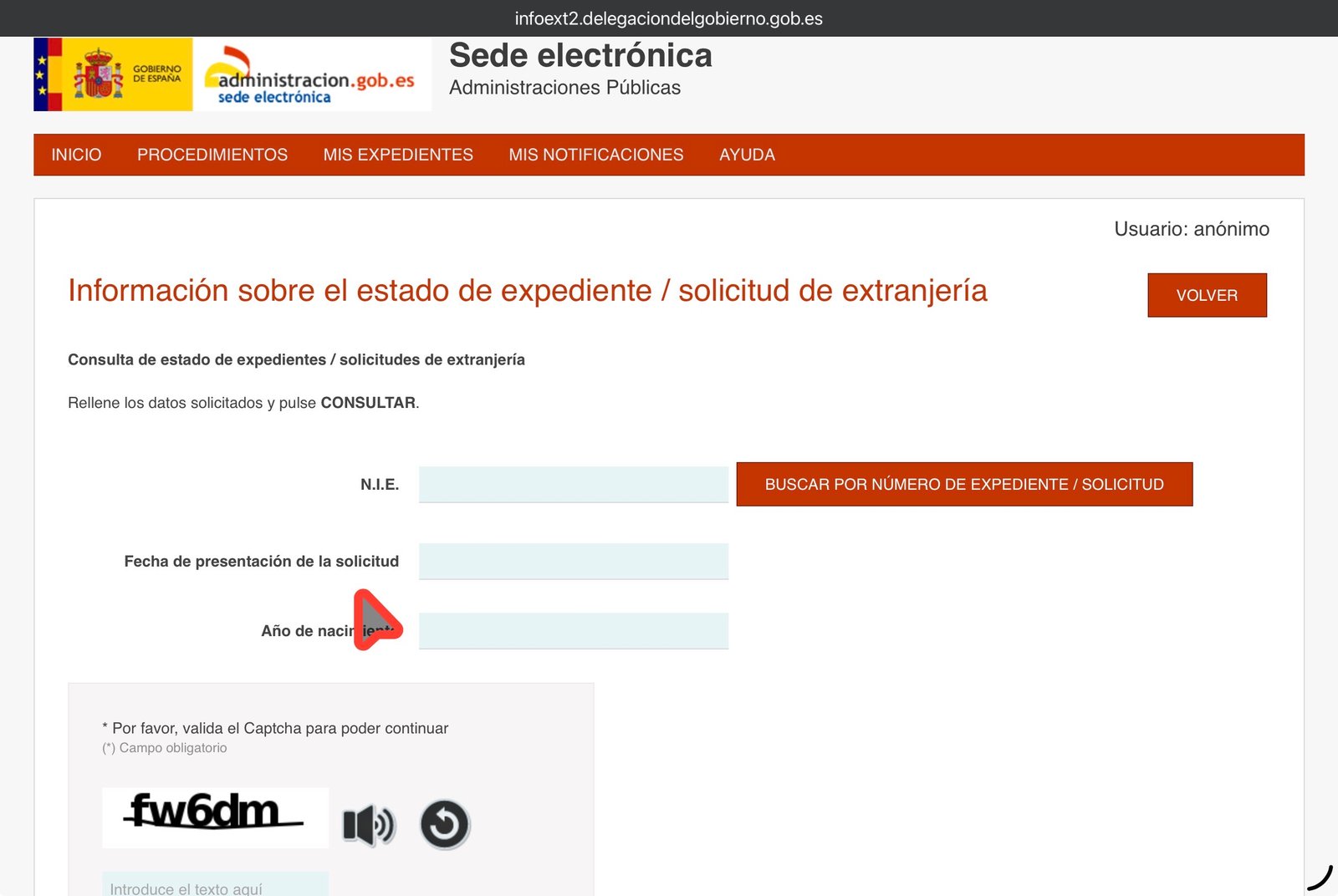
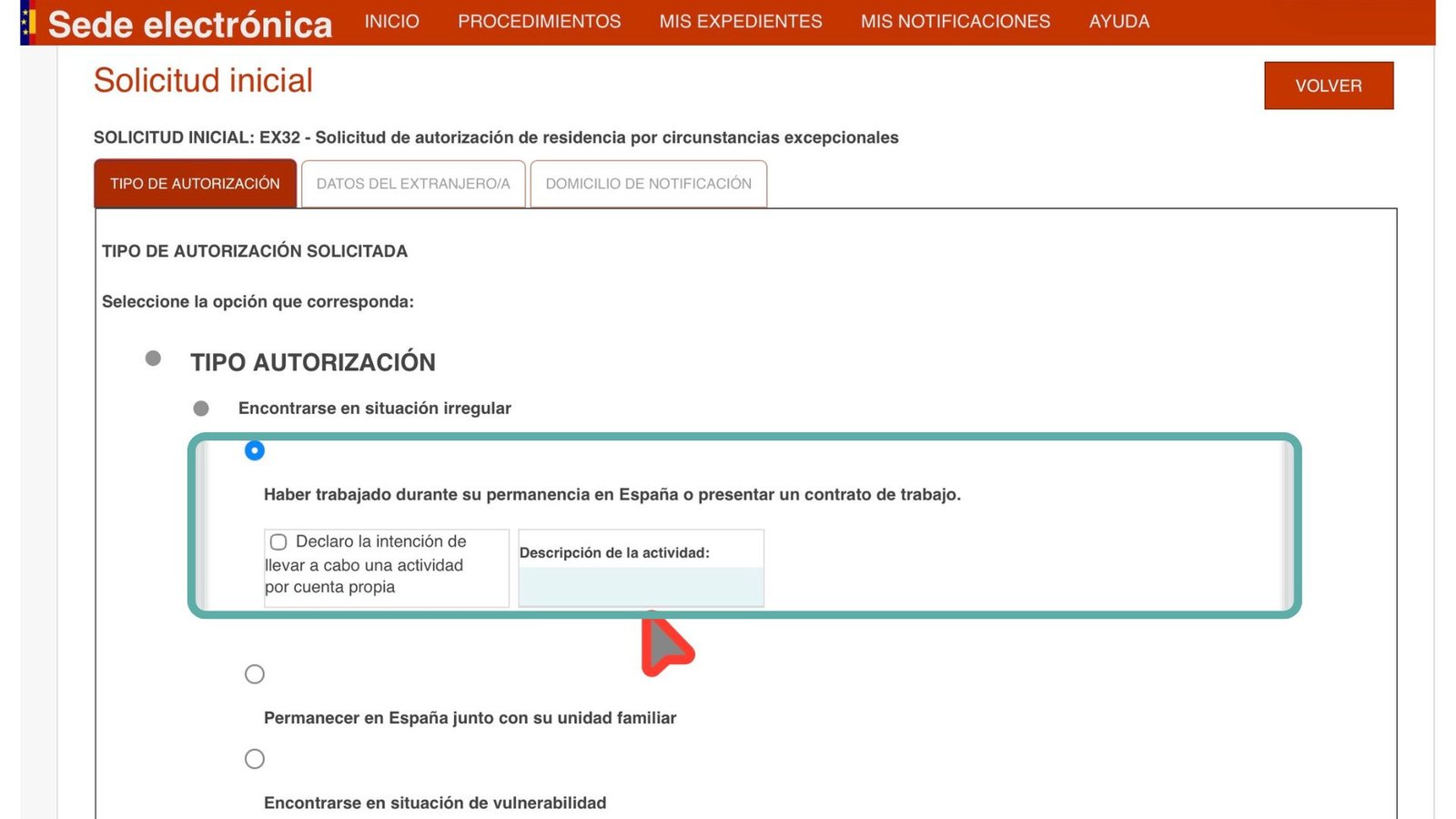
    • Intention to work as self-employed: a statutory declaration with a description of the intended activity is submitted. This section is completed in the Mercurio platform (electronic application) or in section 6 of form EX-32 → when the application is submitted in person.
    Screenshot of form EX-32 on the electronic platform (Mercurio): self-employed activity section
    Form EX-32 on the electronic platform (Mercurio) — self-employed activity declaration section
    Screenshot of paper form EX-32: section 6, statutory declaration on intention to carry out self-employed activity
    Paper form EX-32 — section 6: Statutory declaration on intention to carry out self-employed activity
    ⚠️ If you were employed in the past for short periods, or if you are uncertain whether your employment situation satisfies the requirements, consult a collaborating entity or a qualified immigration professional before submitting your application.

    Ground 2 — Cohabitation with family unit

    Residing in Spain with your family unit, provided it comprises:

    • minor children, or
    • adult children with a disability requiring support, or who are objectively unable to provide for their own needs, or
    • direct ascendants of the first degree (parent) with whom you reside.
    ℹ️ Cohabitation with a partner, siblings or other family members does not satisfy this ground on its own — although they may submit their own applications at the same time if they form part of your household unit and satisfy the relevant requirements. Consult the section on special circumstances.

    Ground 3 — Vulnerability

    ⚠️ Important: this certificate is only required if you are submitting your application on this ground (Ground 3). If you are applying on employment grounds (Ground 1) or family grounds (Ground 2), you do not need to provide any vulnerability certificate.

    Vulnerability is evidenced by the vulnerability certificate (Anexo II →) in the official form, issued by:

    • the social services of the competent public administration, or
    • an entity registered in the RECEX (Registry of Organisations Collaborating on Immigration Affairs).

    For the certificate to be valid, it must satisfy two formal requirements:

    • it must bear the stamp of the issuing entity, whether electronic or physical, and
    • it must indicate the file number recorded in the RECEX.

    Without these two elements, the certificate has no legal effect for the purposes of this application.

    The regulation expressly recognises that an irregular administrative situation, together with its personal, economic or social consequences, may in itself constitute vulnerability.

    💡 Use our collaborating entity finder → to locate a nearby entity that can issue the certificate. Vulnerability assessments, like any other guidance or assistance service provided by these entities in the context of the extraordinary regularisation, must be free of charge.
    ⚠️ If the 30 June deadline is approaching and you do not yet have the certificate: you may submit the application with all available documentation and include a covering note explaining that the certificate has been requested and is pending. The Administration may subsequently request that you provide it during the correction phase.
    🤝

    Find an organisation that can assist you

    Locate accredited organisations near you that provide free guidance and can submit the application on your behalf.

    Search for organisations →

    Special circumstances

    🔄 Pending arraigo or other exceptional authorisation, or appeal in progress

    If you have a pending arraigo or other exceptional circumstances authorisation submitted between 20 May 2025 and 15 April 2026 inclusive, you are not required to submit any additional application. Your file will be resolved under simplified requirements: you will not need to demonstrate employment activity, family ties or a vulnerability situation. You must still satisfy the remaining common requirements — including the absence of a criminal record under the terms of the regulation and not representing a threat to public order or public security.

    This simplified regime also applies to appeals in progress — whether administrative or judicial — against decisions on applications submitted during that same period.

    ⚠️ This simplification does not apply if your application is on humanitarian grounds (Article 128.1 of the Immigration Regulations). In that case, consult a collaborating entity →.
    🚫 Do not withdraw from or abandon that application in order to benefit from the regularisation — doing so would result in rejection.

    👨‍👩‍👧 Simultaneous applications within the same household unit

    If other persons in your household unit also wish to apply for the regularisation — including a spouse or registered civil partner, or direct ascendants of the first degree — all applications may be submitted simultaneously, both electronically and in person. Applications will be resolved collectively.

    ℹ️ Each person must independently satisfy the requirements.

    👶 Minor children and adult children with disabilities

    If you are an applicant with minor children, or adult children with a disability, you may simultaneously request a residence permit for them. Both applications are resolved collectively. Permits issued to minors will be valid for five years.

    📄 Documents from other countries: translation and legalisation

    Documents issued in other countries must:

    • be translated into Castilian by a sworn translator. Only persons who hold this official title, recognised by the Spanish authorities, produce translations that are valid for administrative purposes in Spain. A translation produced by any other person — even if bilingual or a professional translator — has no legal validity. Before engaging their services, verify that the translator is authorised or registered with the competent Spanish authorities.
    • be legalised by the Spanish consulate in the country of issue, or apostilled in accordance with the 1961 Hague Convention.

    This applies in particular to the criminal record certificate and any documentation evidencing family ties.

    What happens once your application is submitted

    ✅ Provisional work authorisation from the outset

    From the moment the Administration notifies you of the initiation of the administrative procedure, you are provisionally authorised to reside and work — both as an employee and as self-employed — throughout the national territory and in any sector of activity, while your application is under examination.

    💡 The application receipt is not the same as the notification of initiation of the procedure. The latter is a notification that the UTEX (Foreigners File Processing Unit) will send you once your application has been accepted for examination.

    ⏱️ Resolution period

    The maximum resolution period is three months from the date your application is entered in the register of the competent authority. In practice, administrative timescales may vary — for example, if the Administration requests additional documentation, the procedure may be suspended and resumed once the documentation is provided, which may extend the actual resolution time. In any event, if you receive no response within the maximum period, the application may be considered rejected by administrative silence.

    🪪 Foreigner’s Identity Card (TIE)

    Once the grant is notified, you have one month to personally request the TIE (Foreigner’s Identity Card) at the Police Station in your area of residence, with payment of the corresponding fee under Modelo 790, code 012.

    🕐 Non-extendable deadline: 30 June 2026

    ⚠️ Non-extendable deadline: The application must be submitted before 30 June 2026. This deadline is not extendable.

    Sources:

  • Extraordinary regularisation 2026 in Spain: what is known, who is eligible, and what you should do now

    Extraordinary regularisation 2026 in Spain: what is known, who is eligible, and what you should do now

    This article is also available in: Español العربية English Français

    Updated 15 April 2026 | intercultural.info

    Royal Decree 316/2026 on the extraordinary regularisation was published on 15 April 2026 in Spain’s Official Gazette (Boletín Oficial del Estado) and entered into force on 16 April. What had remained a draft for months is now an official regulation: foreign nationals residing in Spain without a valid residence permit, or who applied for asylum before 1 January 2026, may apply for a residence and work permit.

    In this article we explain the confirmed requirements, the key dates and what you need to do to submit your application.

    ✅ Published in the Official Gazette: Royal Decree 316/2026, dated 14 April, has been published in the BOE on 15 April 2026 (reference BOE-A-2026-8284). It enters into force on 16 April. The information in this article reflects the official published text.

    What is this regularisation?

    It is an exceptional, time-limited process that enables foreign nationals without a valid residence permit to obtain a residence and work permit in Spain. The Government estimates that approximately 500,000 people may benefit. It has been approved by Royal Decree — without requiring parliamentary approval — and modifies the Immigration Regulations (Royal Decree 1155/2024) by introducing two new additional provisions.

    Who is eligible?

    The Royal Decree establishes two pathways:

    Pathway 1: If you applied for asylum before 1 January 2026

    You may apply for this regularisation even if your asylum claim has been refused or remains pending. You are not required to withdraw from the asylum procedure in order to apply: you will only need to withdraw your asylum application or appeal if you receive a favourable decision on the regularisation. You are considered an international protection applicant from the moment you expressed your intention to apply.

    Pathway 2: If you are without a valid residence permit and did not apply for asylum

    In addition to the general requirements (see below), you must demonstrate at least one of the following three circumstances:

    • Employment: having been employed or self-employed during your time in Spain, or demonstrating the intention to work by presenting a job offer (a contract or combination of contracts exceeding 90 days in one year) or a responsible declaration of self-employed activity.
    • Family ties: residing in Spain with minor children, adult children with a disability requiring support, or direct ascendants of the first degree.
    • Vulnerability: a situation certified by means of a certificate — which may be downloaded from the regularisation portal — endorsed by social services or by an entity registered in the Registry of Immigration Collaborating Entities (RECEX). The regulation recognises that an irregular administrative situation, together with the personal, economic or social circumstances arising from it, may in itself constitute vulnerability.

    Persons who already hold a valid residence or stay permit — or who have a pending application for authorisation — are not eligible. Nor are beneficiaries of temporary protection from Ukraine, who are covered by a separate procedure.

    Main requirements

    These are cumulative — you must satisfy all of them:

    • You must have been present in Spain before 1 January 2026. This may be evidenced by any document bearing your name and a date: passport with an entry stamp, tenancy agreement, utility bills, medical reports, municipal registration (empadronamiento), remittance receipts, etc.
    • You must have at least 5 months of uninterrupted presence in Spain at the time of submitting your application. The term «uninterrupted» is retained in the final text.
    • You must have no criminal record in Spain or in the countries where you resided during the five years prior to your entry into Spain. You must provide the criminal record certificate from your country of origin. If you have requested it and have not received it within one month, you may submit a responsible declaration to that effect and authorise the Spanish authorities to obtain it through diplomatic channels. Expungable offences in Spain are not taken into consideration.
    • You must not represent a threat to public order or be subject to an entry ban in Spain.
    • You must pay the processing fee: €38.28.

    What will you receive?

    A one-year residence and work permit, valid for any sector and throughout Spain. From the moment the Administration notifies you that processing of your application has commenced, you will be provisionally authorised to work, both as an employee and on a self-employed basis. You will also receive a Social Security affiliation number and a health card. For your minor children, the residence authorisation is for five years.

    After the first year, you will need to apply for a modification through the standard pathways provided in the Immigration Regulations. If you are unable to obtain a modification, it is possible to request an extension by demonstrating active employment-seeking.

    The maximum period for a decision is three months. If the Administration does not issue a decision within that period, the application is deemed refused by administrative silence. Following a favourable decision, you have one month to apply for your Foreign National Identity Card (Tarjeta de Identidad de Extranjero — TIE) at the National Police.

    When and where?

    ⚠️ Non-extendable deadline: Applications must be submitted before 30 June 2026. There will be no extension.

    These are the key dates:

    • 16 April: the online application channel opens (24 hours a day, 7 days a week) together with the appointment system for in-person attendance.
    • 20 April: in-person service begins at designated offices, by appointment only.
    • 30 June: application deadline. Non-extendable.

    Applications may be submitted online (with a personal electronic certificate, through the Registry of Powers of Attorney, via a lawyer, a social affairs graduate or an administrative agent, or through entities registered in the Registry of Immigration Collaborating Entities) or in person, always by appointment, at designated Social Security offices, Correos (postal service) branches and certain immigration offices. Information will be available on the portal inclusion.gob.es/regularización from 16 April.

    Appointments may be requested through the regularisation portal (with or without Cl@ve) or by telephone on 060 (service in Spanish, Monday to Friday from 09:30 to 14:00 and from 16:30 to 19:30).

    Who can assist you?

    The Registry of Immigration Collaborating Entities (RECEX — published in the Official Gazette on 5 March 2026) enables registered trade unions and NGOs to advise you free of charge and to submit applications on your behalf. Licensed professionals may also assist you: lawyers, social affairs graduates and administrative agents.

    Important notice: cases of fraud and abuse are being detected. Nobody can «reserve a place or an appointment» for you before the system becomes operational tomorrow, 16 April. Do not pay anyone for procedures that are free of charge through collaborating entities. If you have any doubts, consult only official sources or recognised organisations.

    What to do now

    1. Gather your documents: everything that evidences your presence in Spain before 1 January 2026 and during the past 5 months. Organise them by date.
    2. Ensure you are registered at your local council (empadronamiento). Municipal registration is not mandatory for the application, but it is an extremely useful document for evidencing your presence. It is free of charge and your administrative situation is irrelevant.
    3. Request your criminal record certificate from your country of origin if you do not already have one. If you have already requested it and have not received it within one month, the regulation provides a mechanism for the Spanish authorities to obtain it through diplomatic channels.
    4. Do not leave Spain until you have submitted your application. Your presence must be uninterrupted during the 5 months preceding the application.
    5. If you have a pending arraigo application, no additional action is required. The Royal Decree provides that arraigo applications submitted since May 2025 will be determined under the requirements of this regularisation.
    6. If you intend to submit your application online, you will need an electronic certificate. We explain how to obtain one here: Digital certificate for foreign nationals in Spain. If you do not have an electronic certificate, you may submit your application in person or through a representative.
    7. Consult only reliable sources: the portal inclusion.gob.es, La Moncloa, and organisations such as CEAR, Cruz Roja (Red Cross), Accem or Red Acoge.

    Pending: the application form

    The application form and the accompanying socio-occupational questionnaire will be available for download on the regularisation portal (inclusion.gob.es) from 16 April. As soon as they are published, we will update this article with direct links.

    Summary

    The regularisation is now official. The application window opens tomorrow, 16 April, and closes on 30 June — just over two months. It is not an automatic process: you must gather documents, satisfy the requirements and submit your application on time. But it represents a genuine opportunity for hundreds of thousands of people. At intercultural.info we will follow the process closely and explain every step.

  • Tutorial: How to obtain your digital certificate in Spain: a step-by-step guide

    Tutorial: How to obtain your digital certificate in Spain: a step-by-step guide

    This tutorial is also available in: English | Español | العربية | Français

    Updated on 25 March 2026 | intercultural.info

    For whom this tutorial is intended

    This tutorial guides you step by step in order to obtain the FNMT digital certificate, issued by the Fábrica Nacional de Moneda y Timbre (FNMT, the Spanish National Mint and Stamp Factory). It is free of charge and enables you to manage immigration procedures and many other procedures with the Spanish administration online.

    If you wish to understand better what the digital certificate is, what it is for, and what relation it has with the extraordinary regularisation 2026, we recommend that you read our full article: Digital certificate for foreign nationals in Spain.

    ⚠️ Are you awaiting the extraordinary regularisation 2026?

    If the online submission route is confirmed in the BOE, you will need a digital certificate or an electronic signature system in order to submit your application through Mercurio — or for somebody to do so in your name. We explain the connection further below, in the section «And the extraordinary regularisation 2026?«.

    If you have an NIE (Número de Identidad de Extranjero/a, Foreigner Identification Number) — even if you do not have a valid residence permit or a TIE — you may obtain this certificate. Further below we explain which documents the FNMT accepts.

    And if you do not have an NIE? This tutorial also matters to you. If you have a family member, a close friend, or any trusted person with a residence permit or Spanish nationality, that person may obtain their own digital certificate and submit certain applications in your name as representative if the procedure permits it. Knowing how the process functions will help you to prepare.

    This tutorial follows the same steps explained by the Tax Agency (AEAT / Hacienda) in its official video on how to obtain an FNMT electronic certificate. Some of our screenshots are taken from that video. Administrative procedures may change over time; we have verified that this is the procedure in force on the publication date of this tutorial.

    What you need before you begin

    Before beginning the process, make sure that you have:

    • Your NIE and a document proving it (see further below the documents accepted by the FNMT), together with your passport.
    • A computer, whether PC, Mac or Linux. The complete process must be conducted from the same device, the same user account, and the same browser.
    • An email address to which you have access.
    • An updated browser: Mozilla Firefox, Google Chrome, Microsoft Edge, Opera or Safari.
    Important: do not format the computer and do not change browser or operating system user during the process. Everything must be done from the same device from beginning to end.

    The appearance of some windows may differ from the screenshots shown in this tutorial, depending on the operating system installed on your computer.

    Step 1 — Install the FNMT software

    Before applying for the certificate, you need to install a small program called Configurador FNMT-RCM. This software generates the security keys necessary for your certificate. It functions on Windows, Mac and Linux.

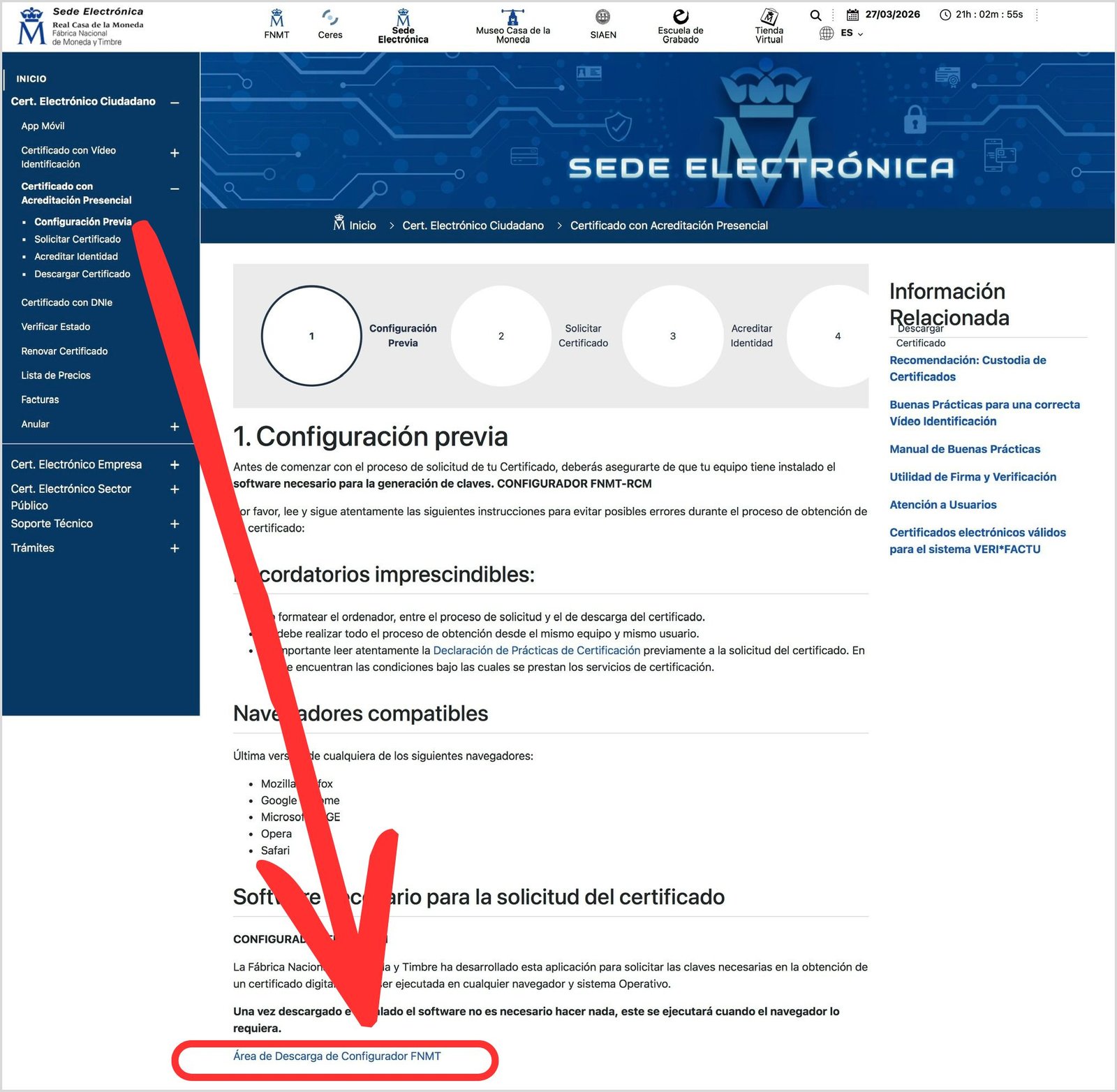
    Download it from the FNMT electronic office: sede.fnmt.gob.es › Certificados › Persona Física › Obtener Certificado Software › Configuración previa.

    FNMT preliminary configuration page on sede.fnmt.gob.es
    FNMT preliminary configuration page | Source: sede.fnmt.gob.es

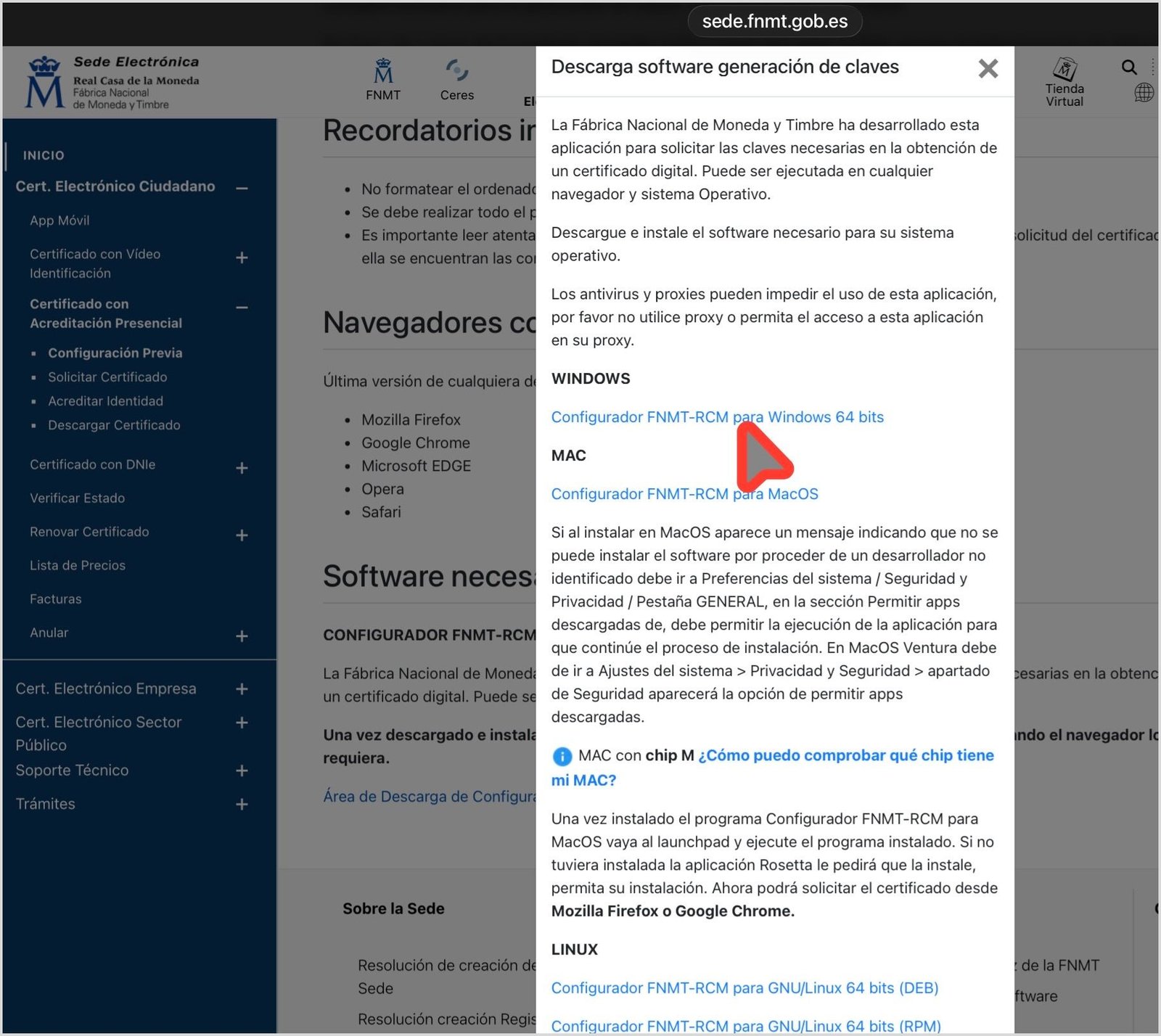
    Select the download link corresponding to your operating system — Windows, Mac or Linux — and follow the steps of the installation assistant.

    Screen for selecting the operating system to download the Configurador FNMT-RCM
    Selection of operating system for downloading the Configurador FNMT-RCM | Source: sede.fnmt.gob.es

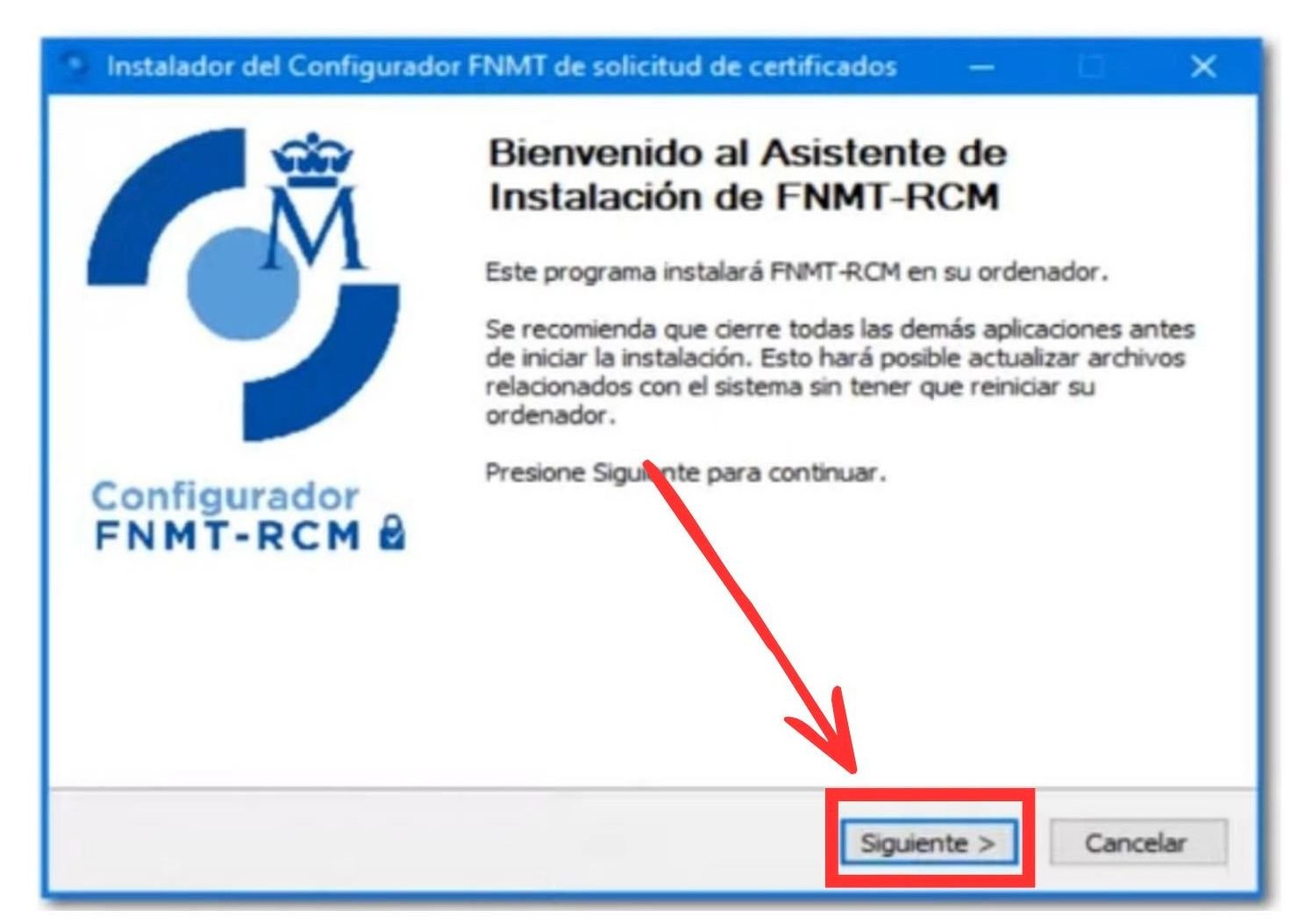
    On Mac, you may need to authorise the installation from System Settings › Privacy and Security. Once installed, you do not need to open it manually: it will run automatically when the browser requires it.

    Installation assistant for the Configurador FNMT-RCM on Windows
    Installation assistant for the Configurador FNMT-RCM (Windows) | Source: sede.fnmt.gob.es (screenshot from the AEAT tutorial video)

    We also recommend that you install the AutoFirma application, which many administration websites require in order to function with the certificate, as is the case with the Mercurio platform through which many online immigration applications are submitted. You may download it from firmaelectronica.gob.es.

    Step 2 — Apply for the certificate on the website

    Go to: sede.fnmt.gob.es › Certificados › Persona Física › Obtener Certificado Software › Solicitar Certificado.

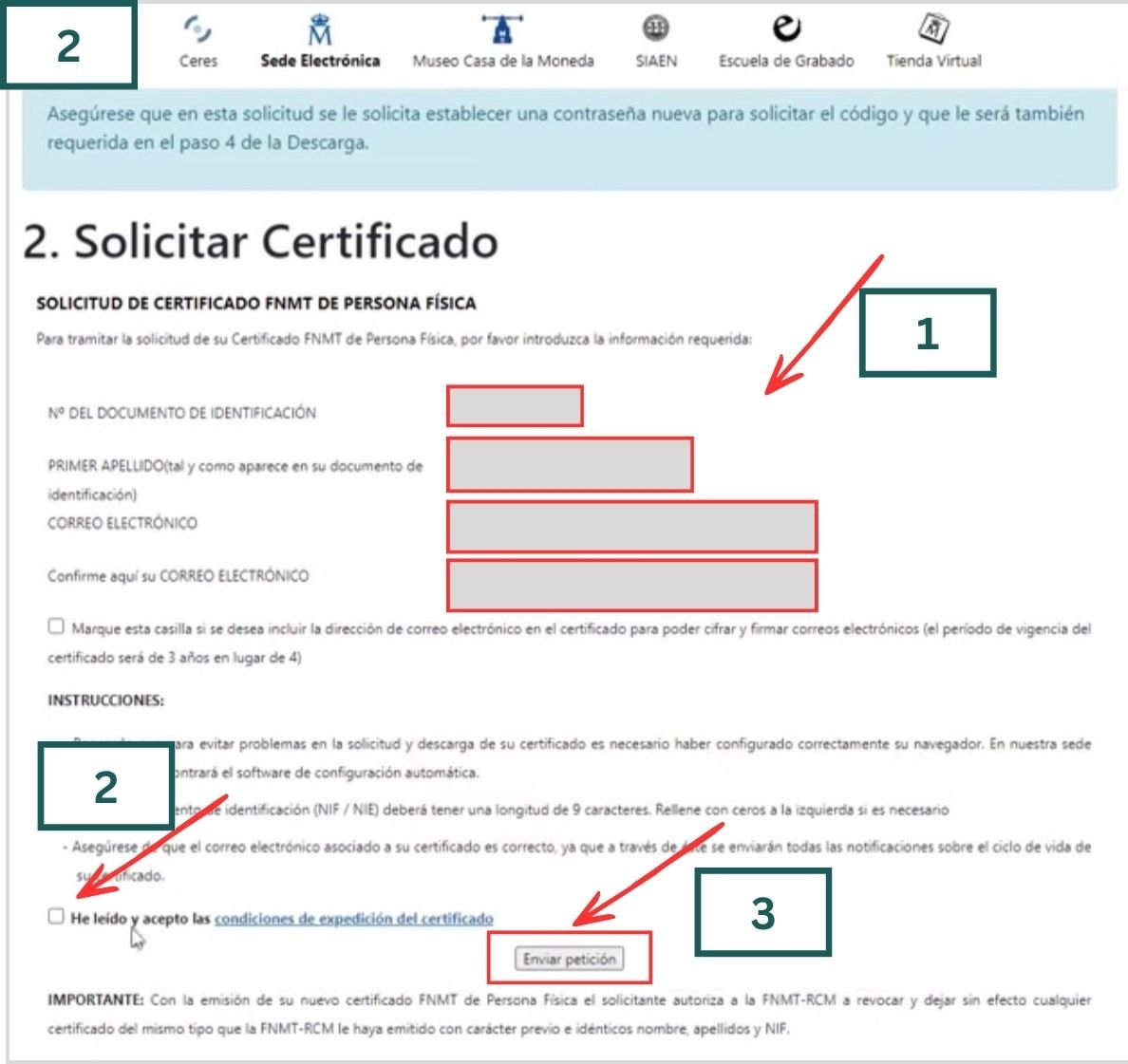
    Complete the form with:

    • Your NIE, with 9 characters, adding zeros on the left if necessary.
    • Your first surname, exactly as it appears on your identity document.
    • Your email address.
    Digital certificate application form on the FNMT electronic office
    Digital certificate application form | Source: sede.fnmt.gob.es (screenshot from the AEAT tutorial video)

    Complete the four fields in the form:

    • Field 1: identification document number — the NIE in the case of foreign nationals without Spanish nationality
    • Field 2: first surname
    • Field 3: email address
    • Field 4: repeat the same email address

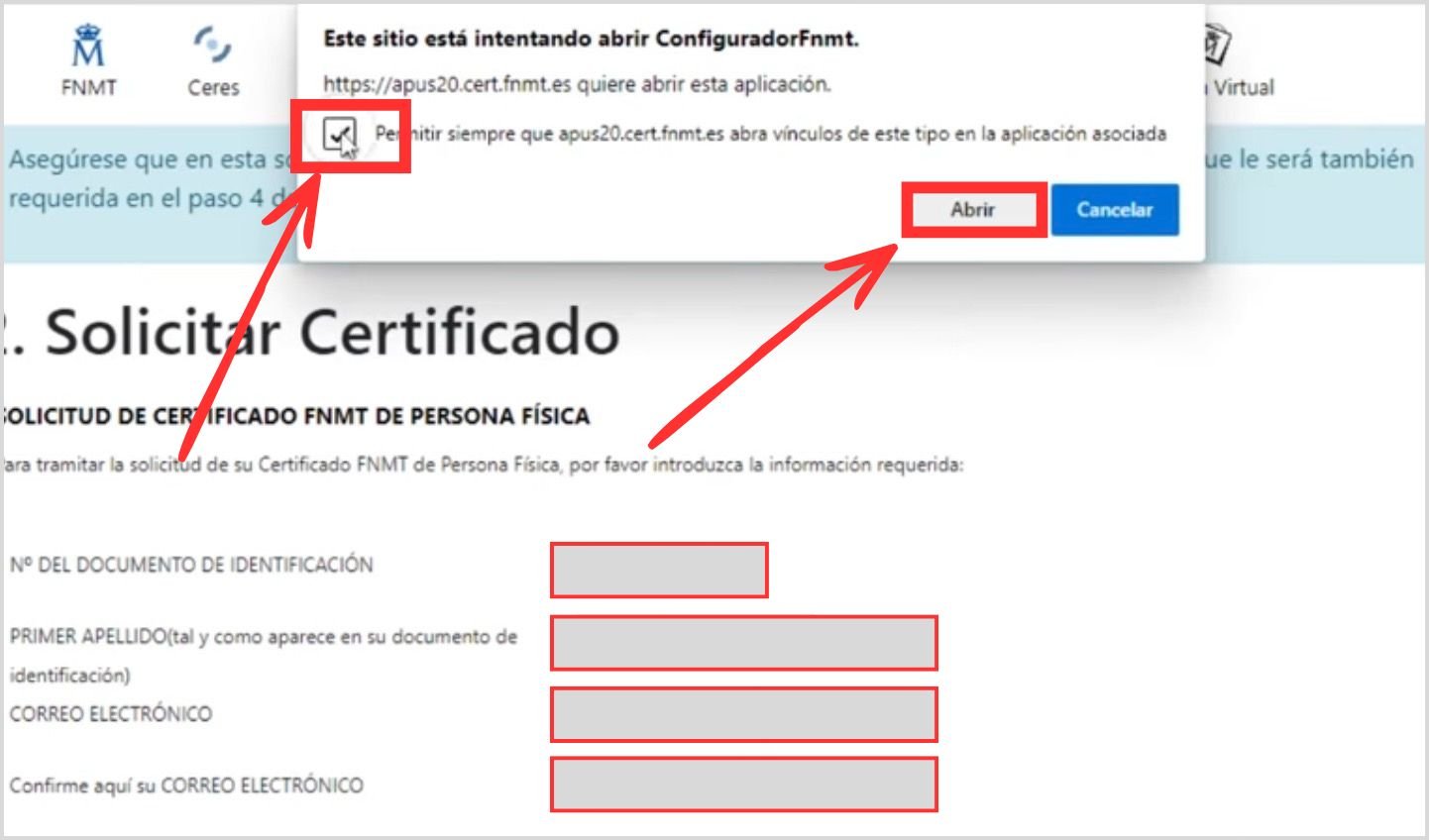
    Read and accept the conditions of use. When you click on «Enviar petición», the browser will request permission to open the Configurador FNMT-RCM. In the window that appears, click on «Abrir». If it offers you the option of always permitting access, select it.

    Browser permission dialogue to open the Configurador FNMT-RCM
    Browser permission to open the Configurador FNMT-RCM | Source: sede.fnmt.gob.es (screenshot from the AEAT tutorial video)

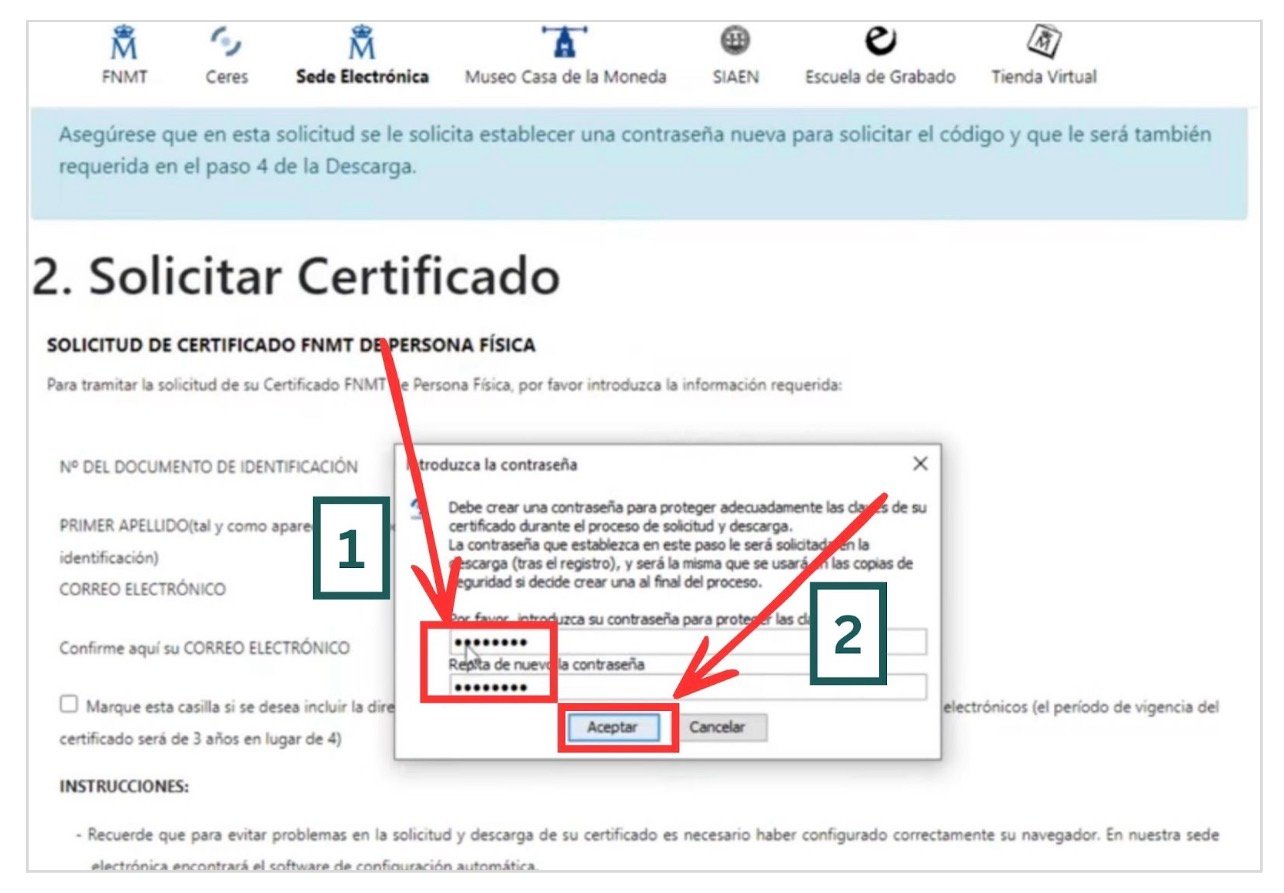
    Next, the system will ask you to create a password in order to protect the keys of your certificate. Keep it carefully: you will need it to download the certificate and it cannot be recovered. The same password will also be used for the backup copy.

    Password creation dialogue for the certificate keys
    Password creation dialogue | Source: sede.fnmt.gob.es (screenshot from the AEAT tutorial video)

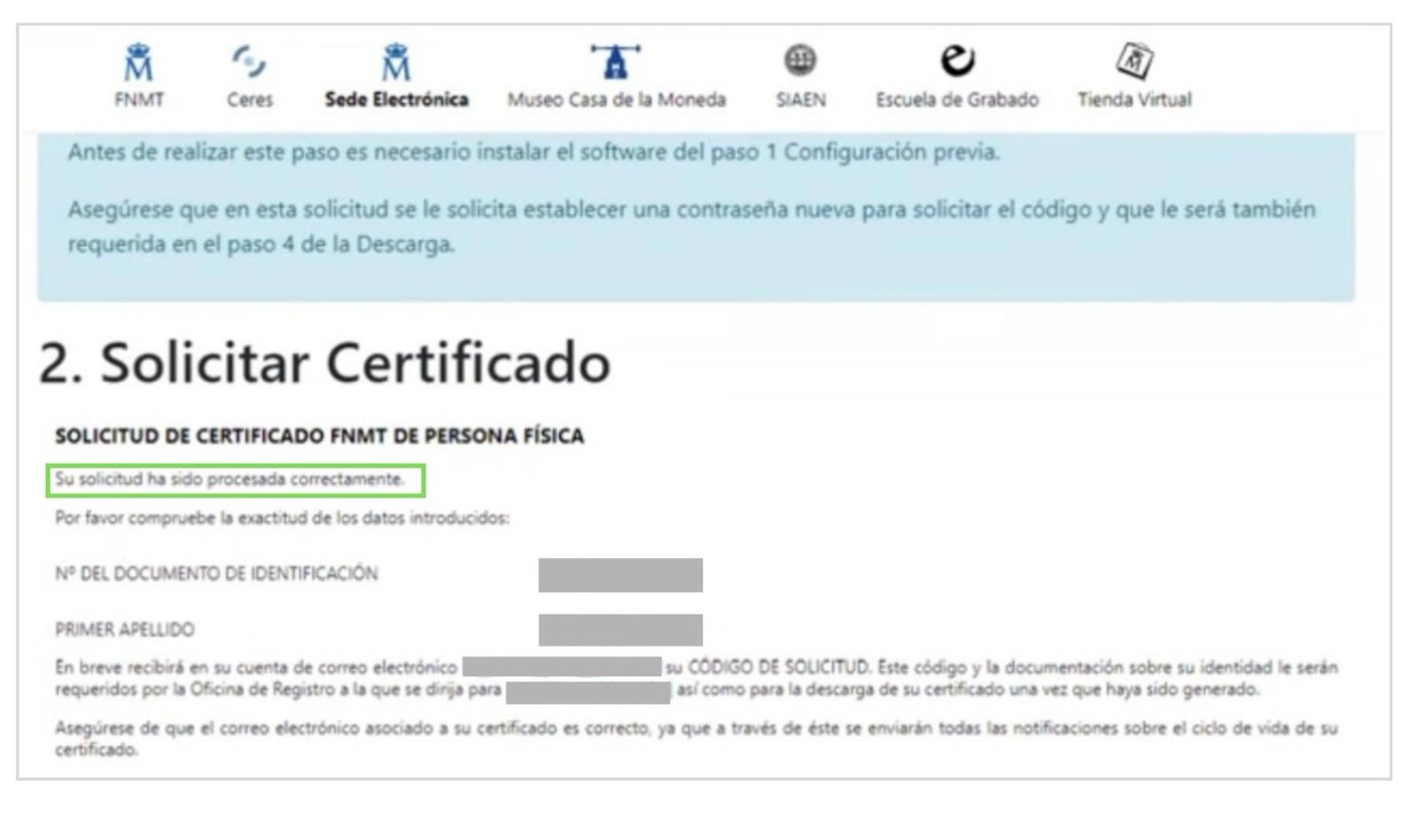
    If everything has gone well, you will see a confirmation message with your details.

    Confirmation that the application has been processed correctly
    Confirmation that the application has been processed correctly | Source: sede.fnmt.gob.es (screenshot from the AEAT tutorial video)

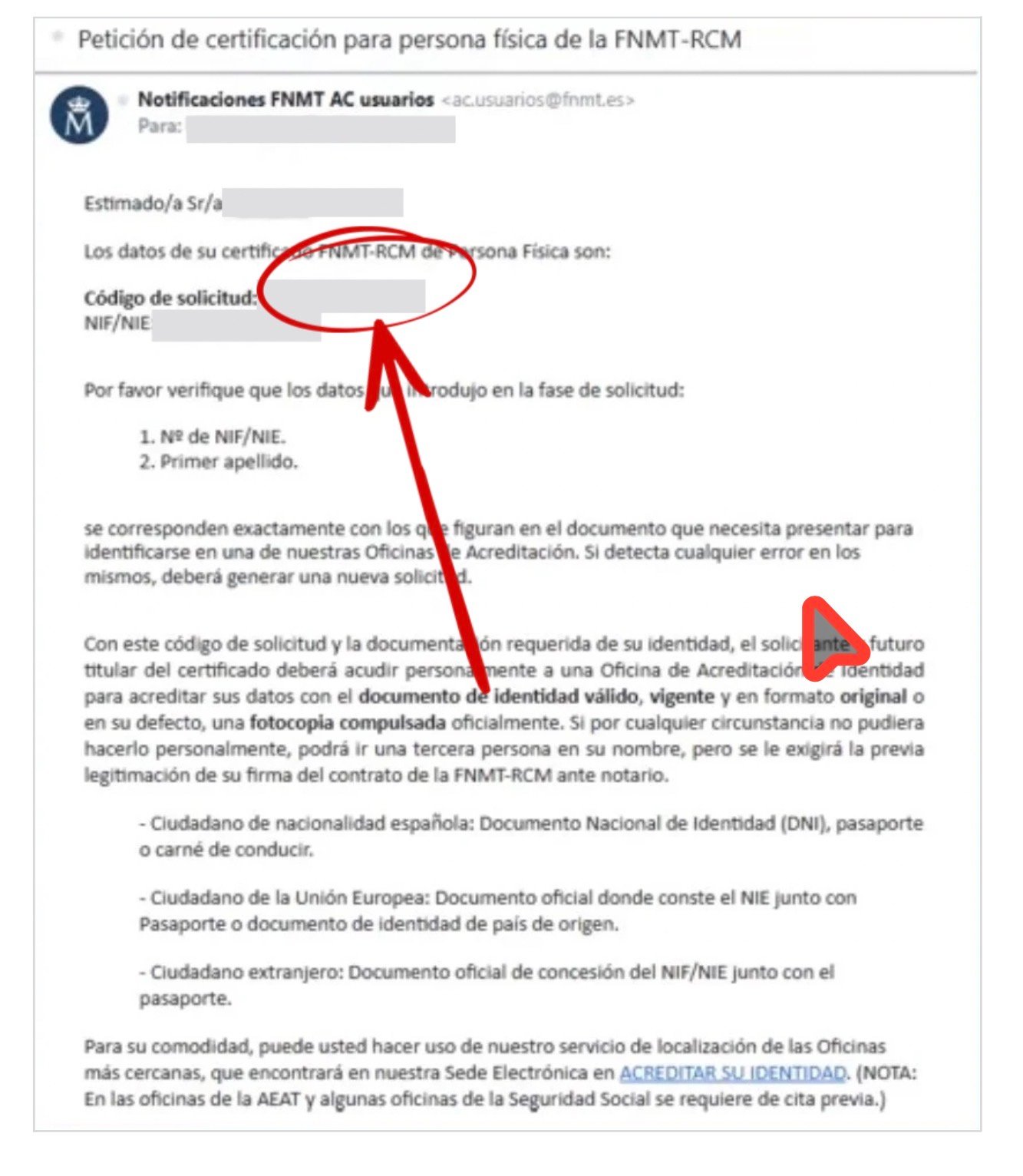
    You will receive an email with your application code. Note it or print it: you need it at the office and for the download.

    FNMT email containing the application code
    FNMT email containing the application code | Source: sede.fnmt.gob.es (screenshot from the AEAT tutorial video)

    Step 3 — Verify your identity at an office

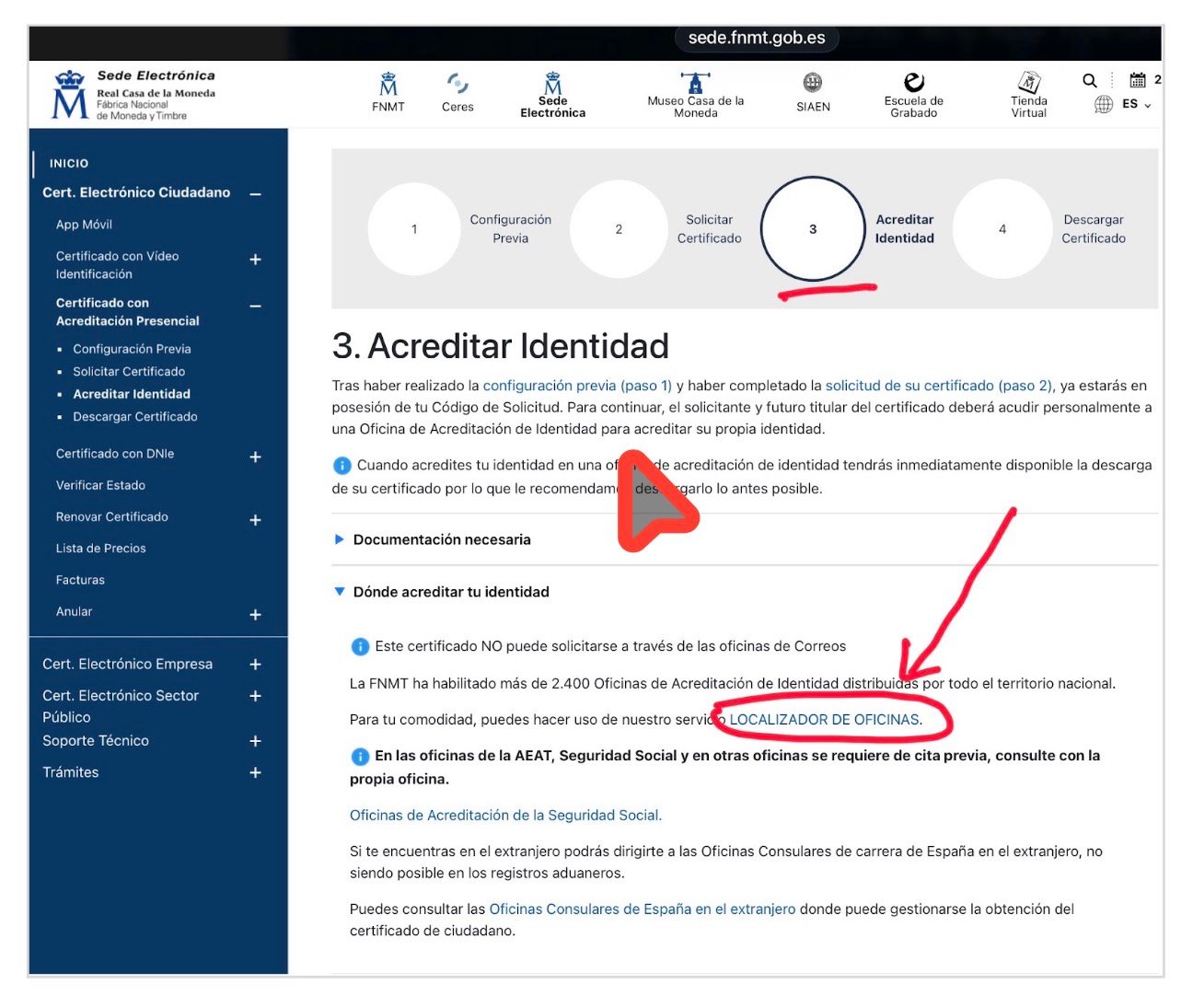
    You must now go in person to an Oficina de Acreditación de Identidad (Identity Accreditation Office) in order to verify that you are the person who submitted the application. The FNMT has more than 2,400 offices throughout Spain, including Social Security offices, Tax Agency (AEAT / Hacienda) offices, municipalities and other bodies.

    Page 3. Acreditar Identidad on the FNMT electronic office
    Page «3. Acreditar Identidad» of the FNMT electronic office | Source: sede.fnmt.gob.es

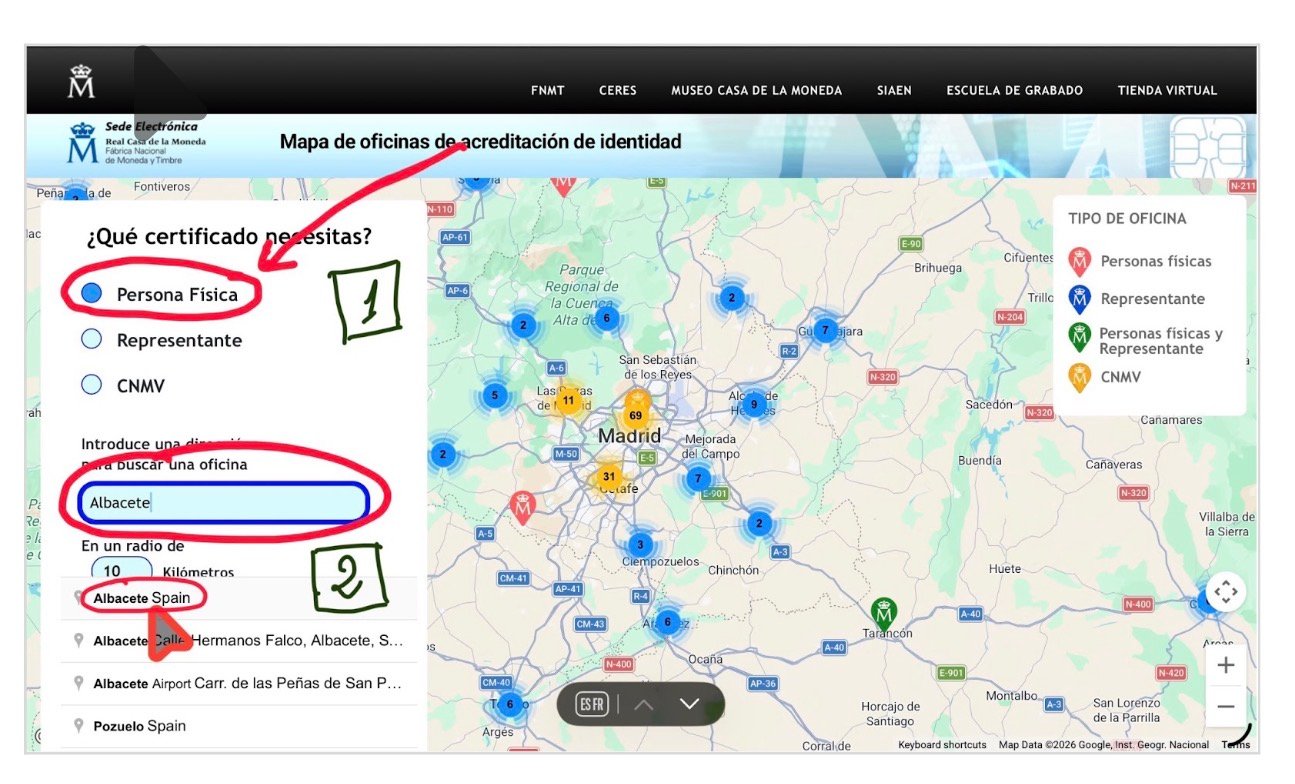
    Using the office locator, you may locate the nearest office. Enter your locality in the search field.

    FNMT identity accreditation office locator map
    Map of identity accreditation offices | Source: sede.fnmt.gob.es

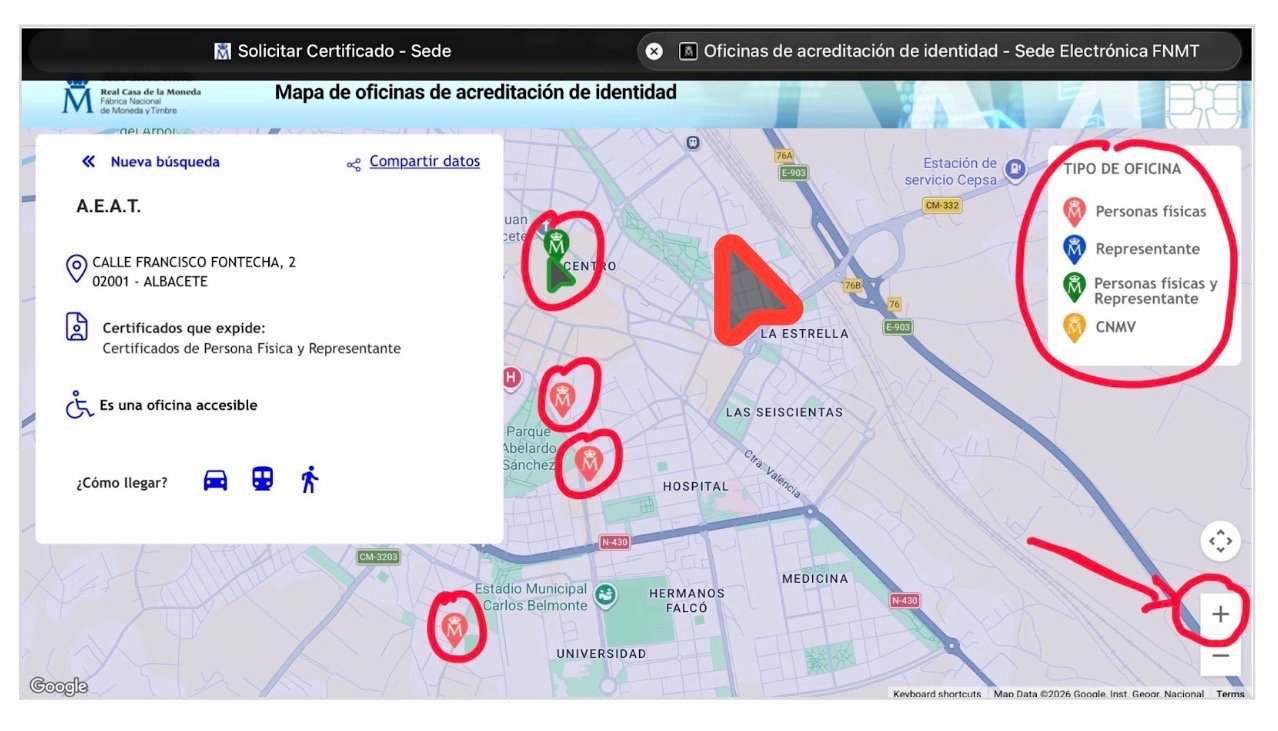
    Once the locality has been selected, the map will show the available offices. In the case of Albacete, for example, four accreditation offices appear in different locations. By clicking on each one, the specific body, its exact address, and directions are shown. Bear in mind that a prior appointment is required at AEAT and Social Security offices. Consult the office before going.

    Map of identity accreditation offices — example of the city of Albacete
    Map of identity accreditation offices — example of the city of Albacete | Source: sede.fnmt.gob.es

    Present the following at the office:

    • Your application code (the one received by email).
    • Your passport.

    And one of these documents containing your NIE:

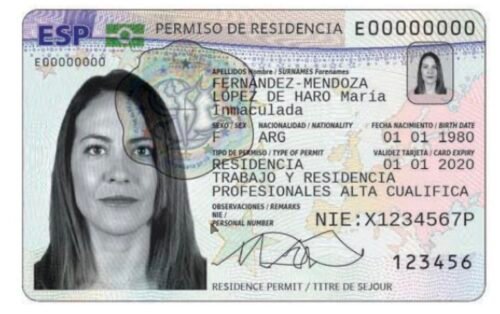
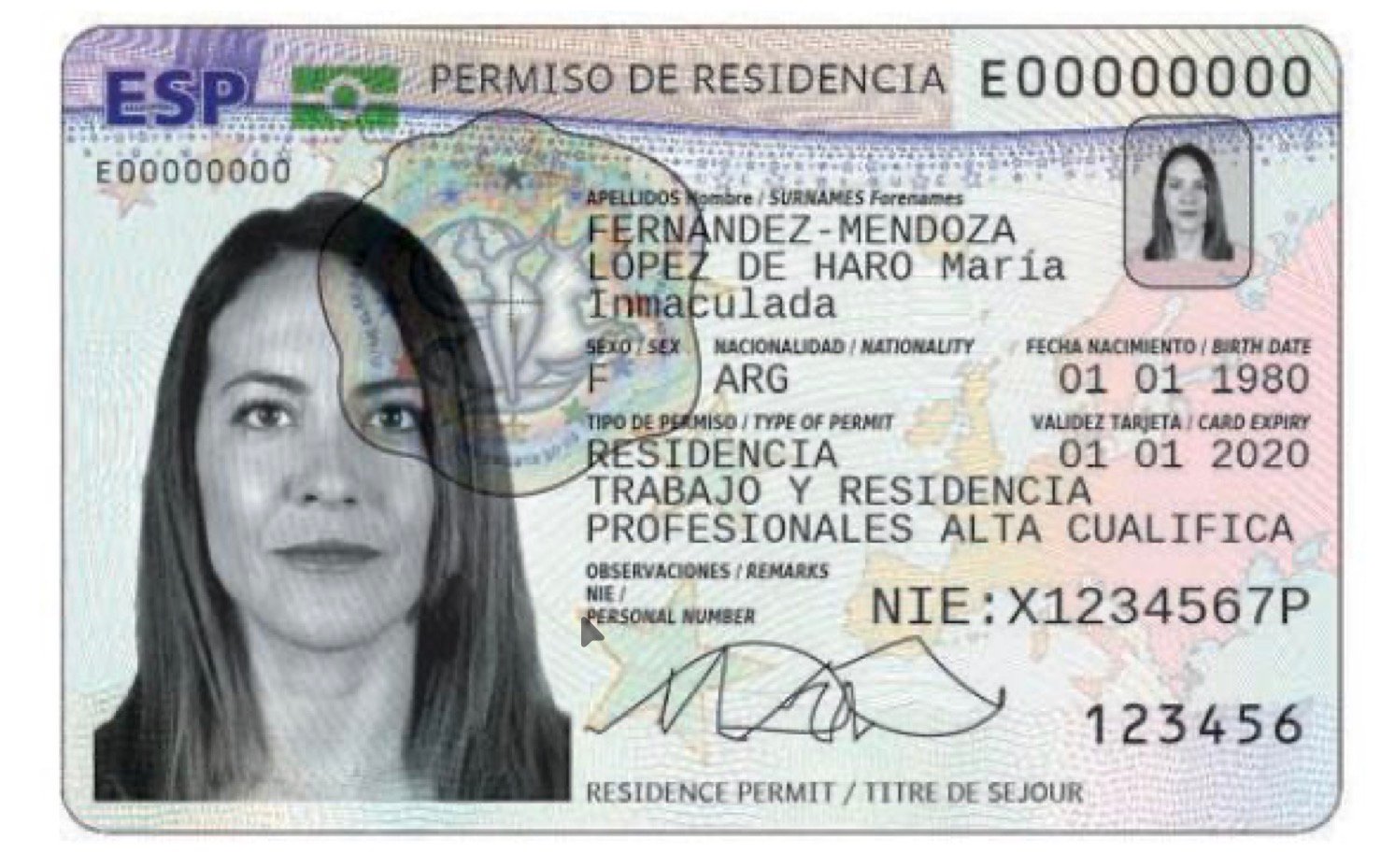
    TIE (Tarjeta de Identidad de Extranjero/a, Foreigner Identity Card).

    Example of a Tarjeta de Identidad de Extranjero/a (TIE)
    Example of TIE | Source: policia.es

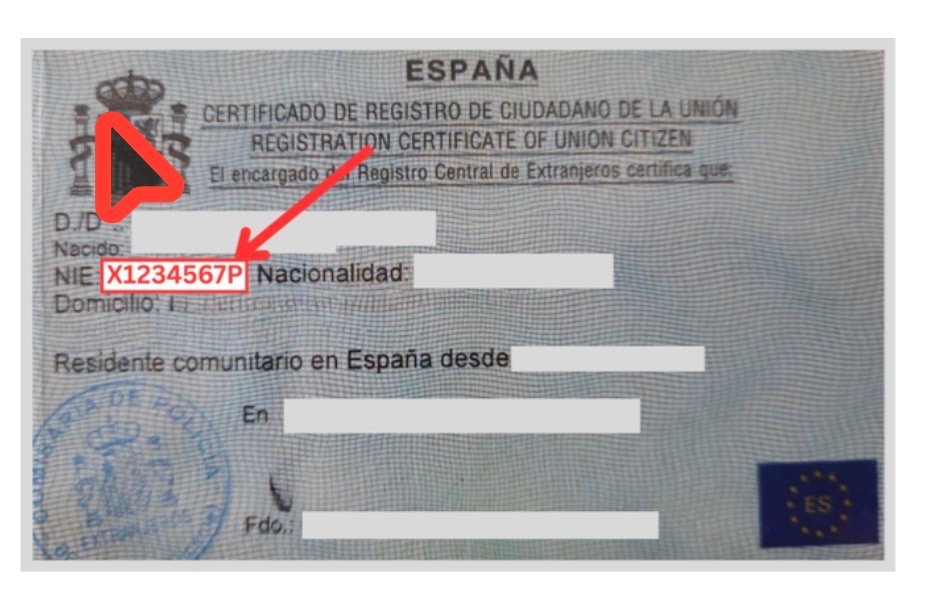
    Certificado de Ciudadano de la Unión in which your NIE appears (in the case of the British population, for example).

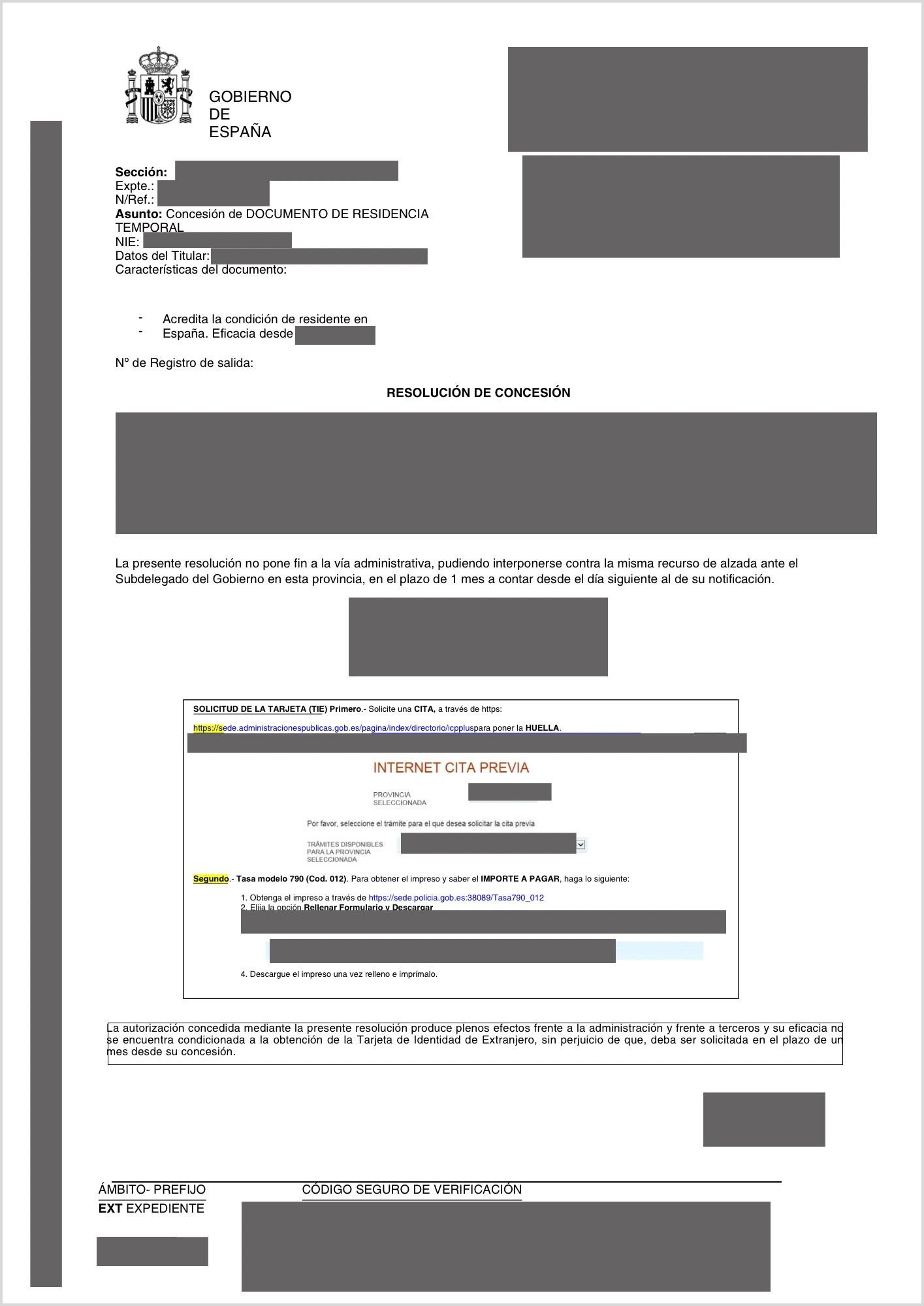
    Example of the NIE grant document (personal data anonymised)
    Example of the NIE grant document | Source: Real document, personal data anonymised by intercultural.info

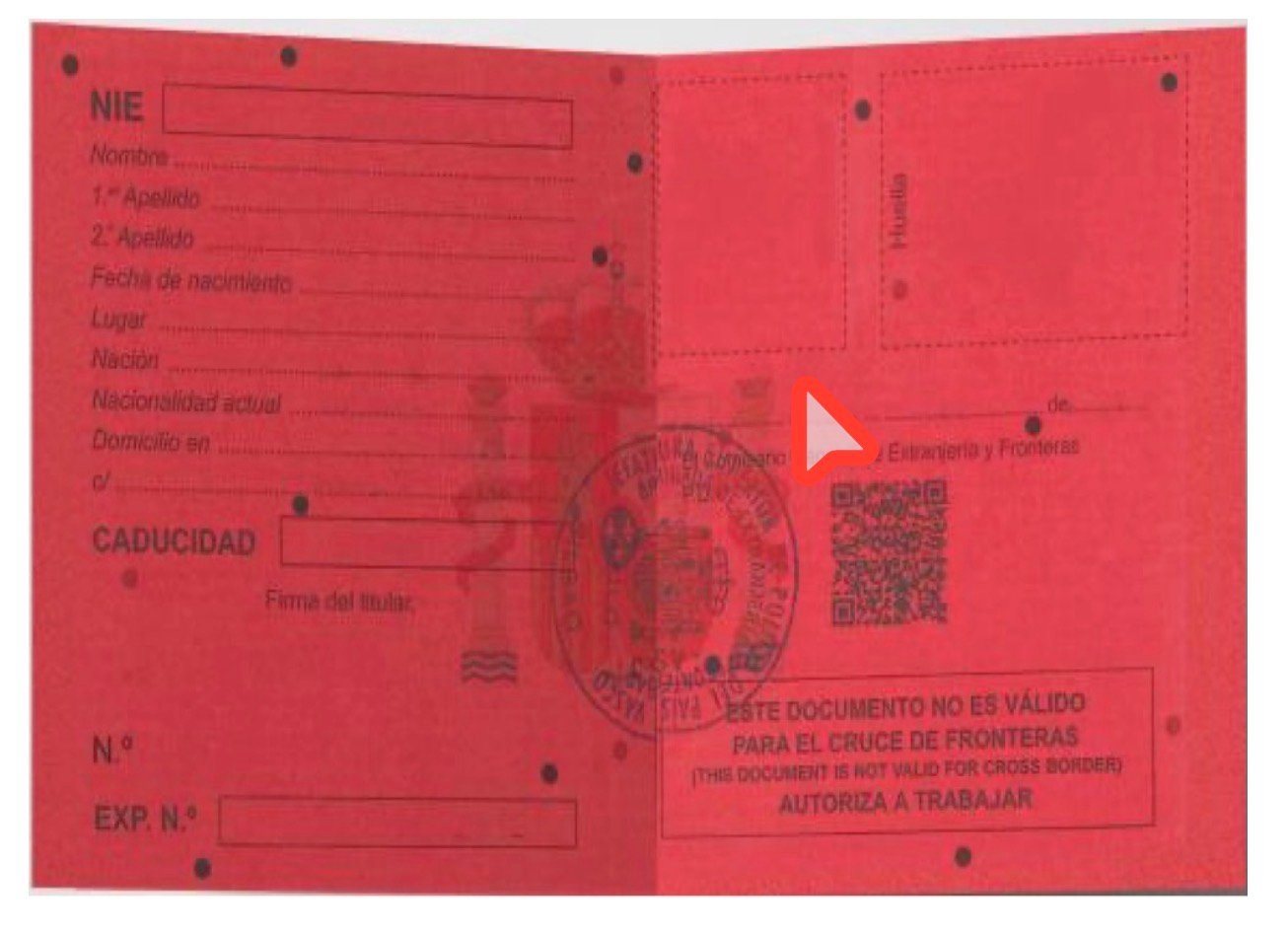
    Red, Green or White foreign-national identification card.

    Example of Red Card
    Example of Red Card | Source: Euskadi.eus (Basque Government)

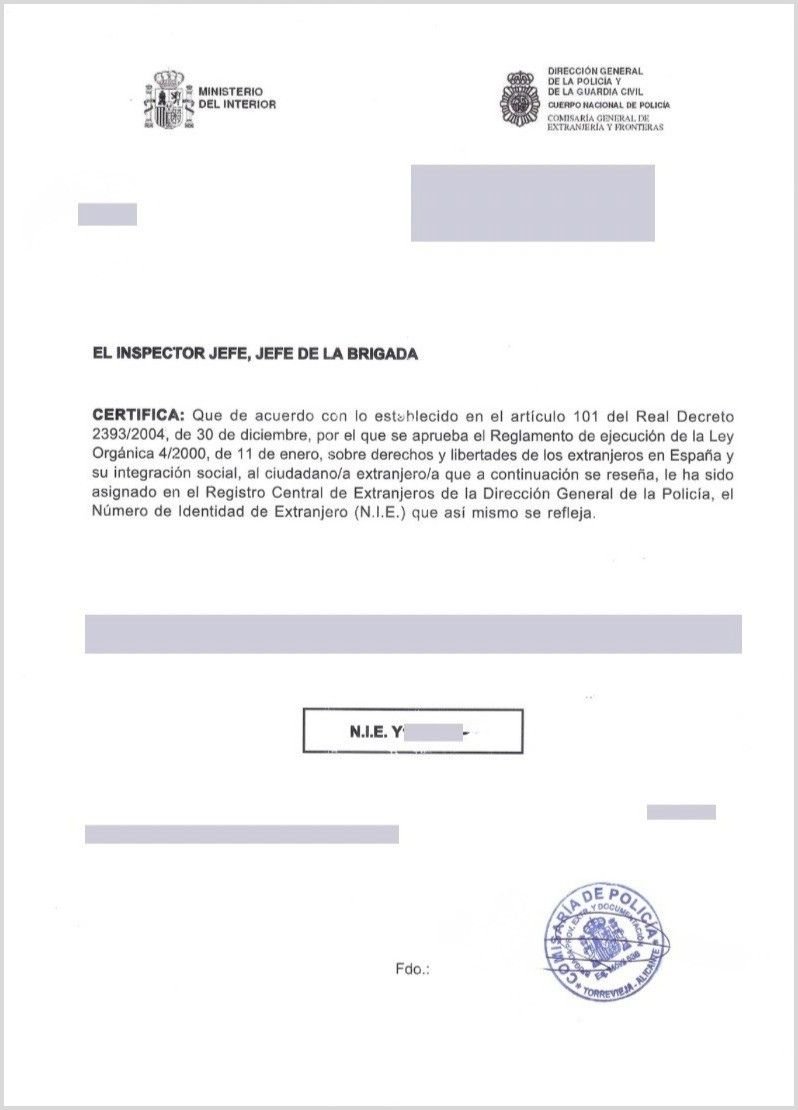
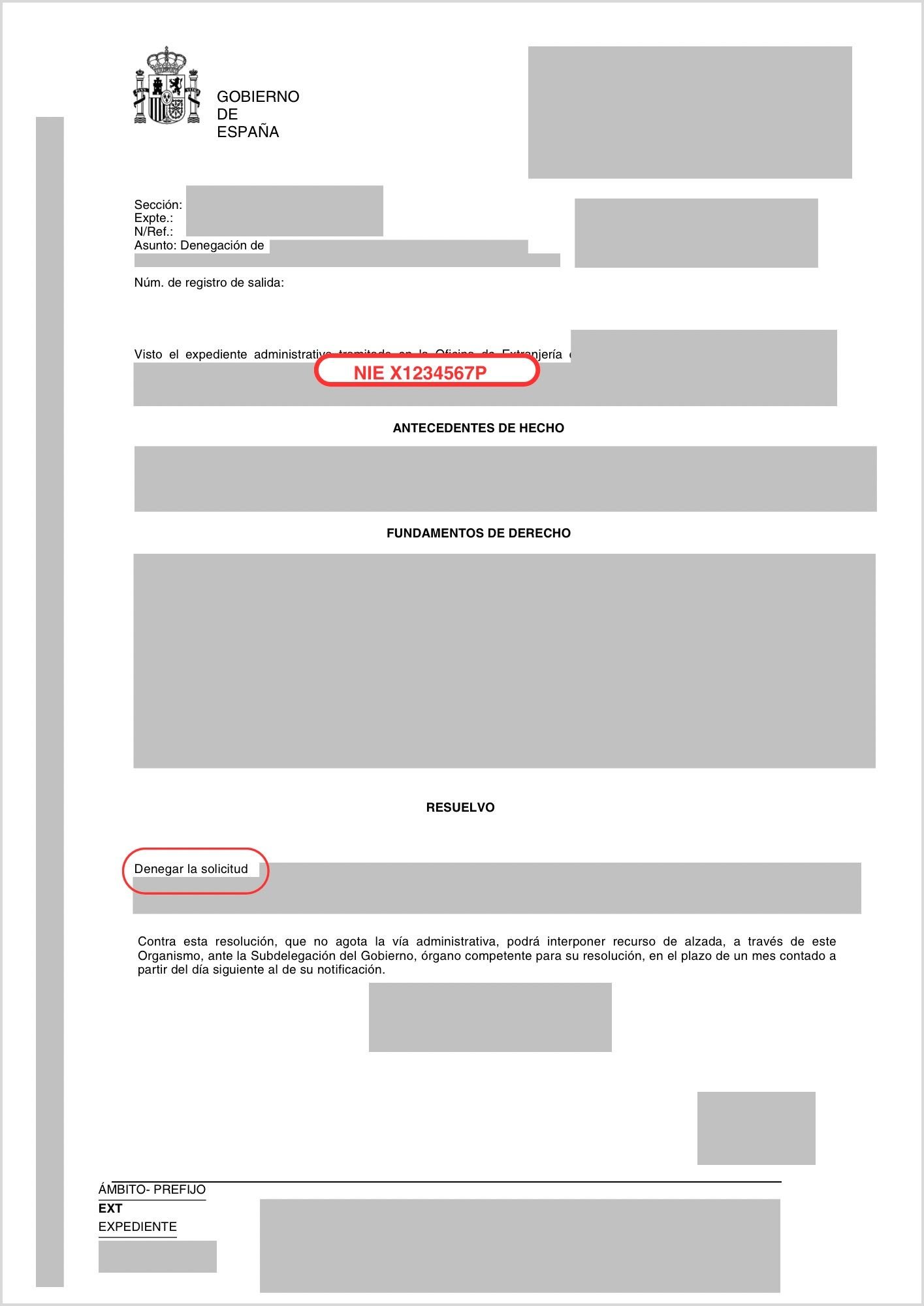
    Official document granting the NIE — and in the absence of that document or any of the previous ones, it may be possible to try another alternative containing the NIE, for example an Immigration Office decision, whether favourable or a refusal.

    Example of the official NIE grant document (personal data anonymised)
    Example of the official NIE grant document | Source: Real document, personal data anonymised by intercultural.info
    Example of a refusal decision with an NIE assigned (personal data anonymised)
    Example of a refusal decision with an NIE assigned | Source: Real document, personal data anonymised by intercultural.info
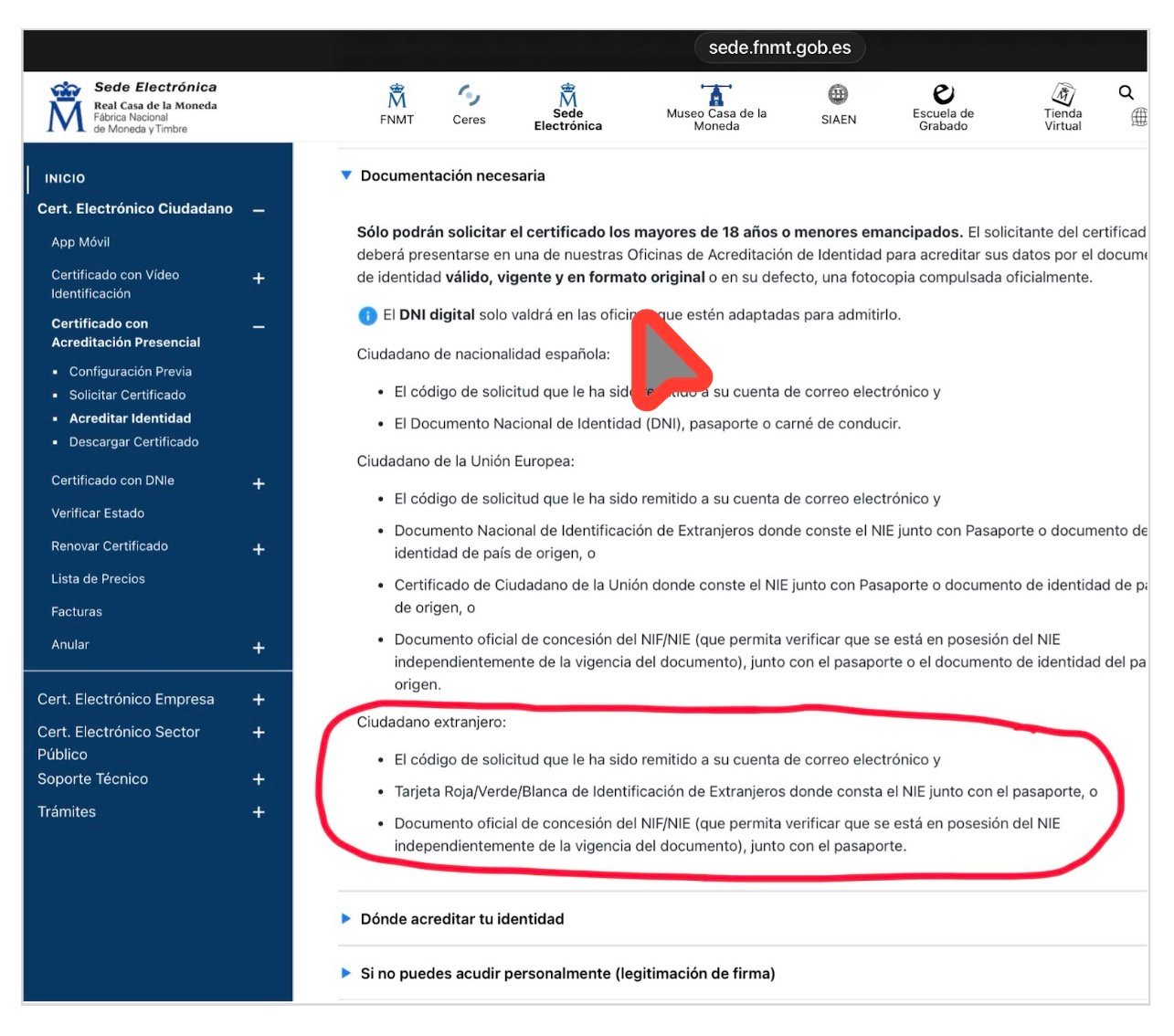
    Documentation required by type of applicant — FNMT page
    Documentation required by type of applicant | Source: sede.fnmt.gob.es

    Key point: the FNMT specifies on its electronic office that it accepts an «official document granting the NIF/NIE which makes it possible to verify that the person is in possession of the NIE, irrespective of the validity of the document», together with the passport.

    What happens if you do not have that NIE grant document? In that case, it may be possible to try another document containing the NIE — such as an Immigration Office decision, whether favourable or a refusal. In practice, the experience may vary depending on the Accreditation Office. Some may accept that document; others may be more strict. We recommend that you consult the office before travelling there.

    FNMT video identification is NOT available for persons with NIE. It may only be conducted with the electronic DNI (DNIe). If you have an NIE, identity accreditation must be in person.

    Step 4 — Download, install and create a backup copy

    After verifying your identity at the office, your certificate will be available for download. The waiting time may vary depending on the accreditation office you attend.

    Go to: sede.fnmt.gob.es › Certificados › Persona Física › Obtener Certificado Software › Descargar Certificado.

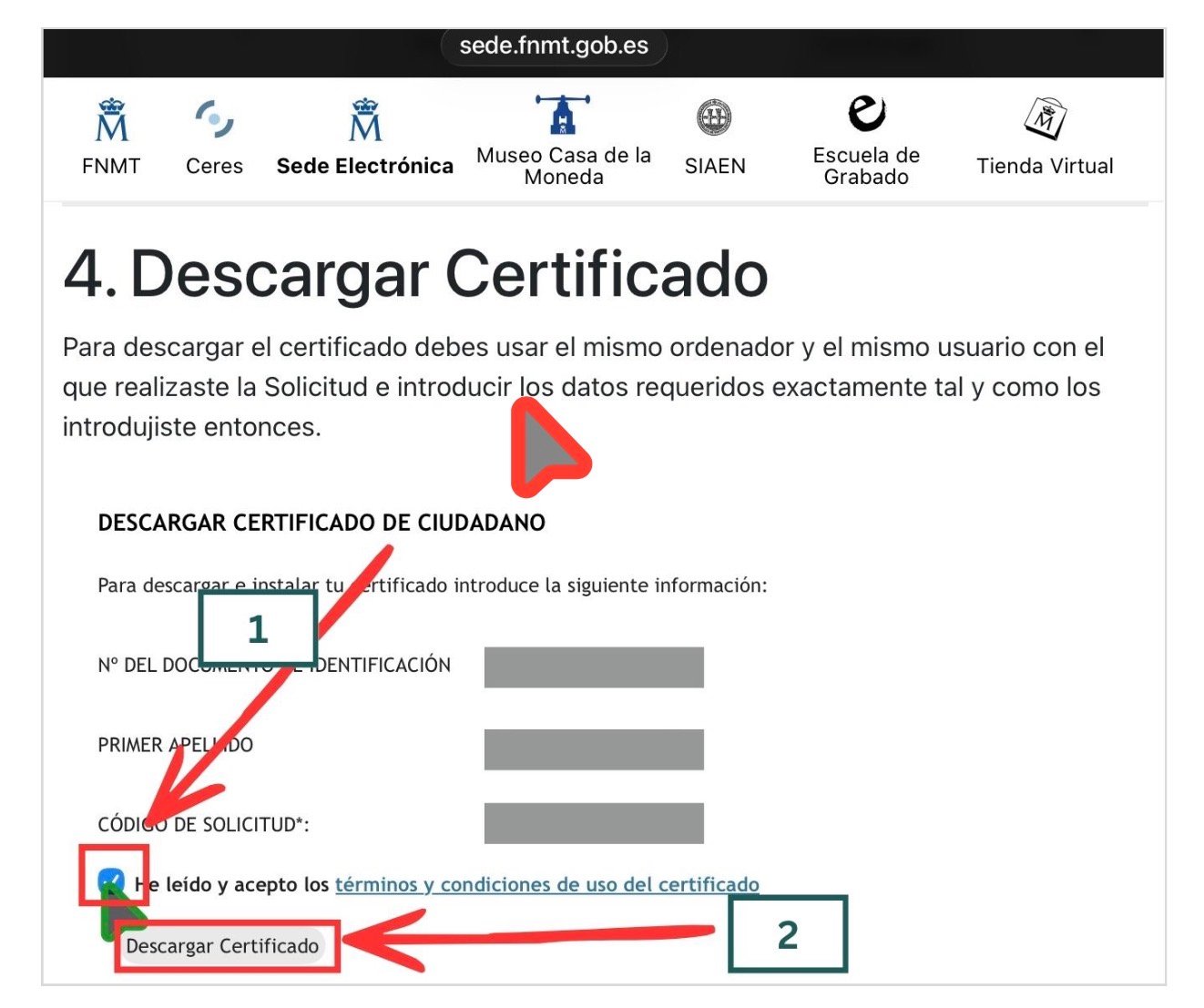
    Enter your NIE, your first surname and the application code. Read and accept the conditions of use, then click on «Descargar Certificado». Remember: you must do this from the same computer, the same browser and the same user account that you used for the application.

    Certificate download form on the FNMT electronic office
    Certificate download form | Source: sede.fnmt.gob.es

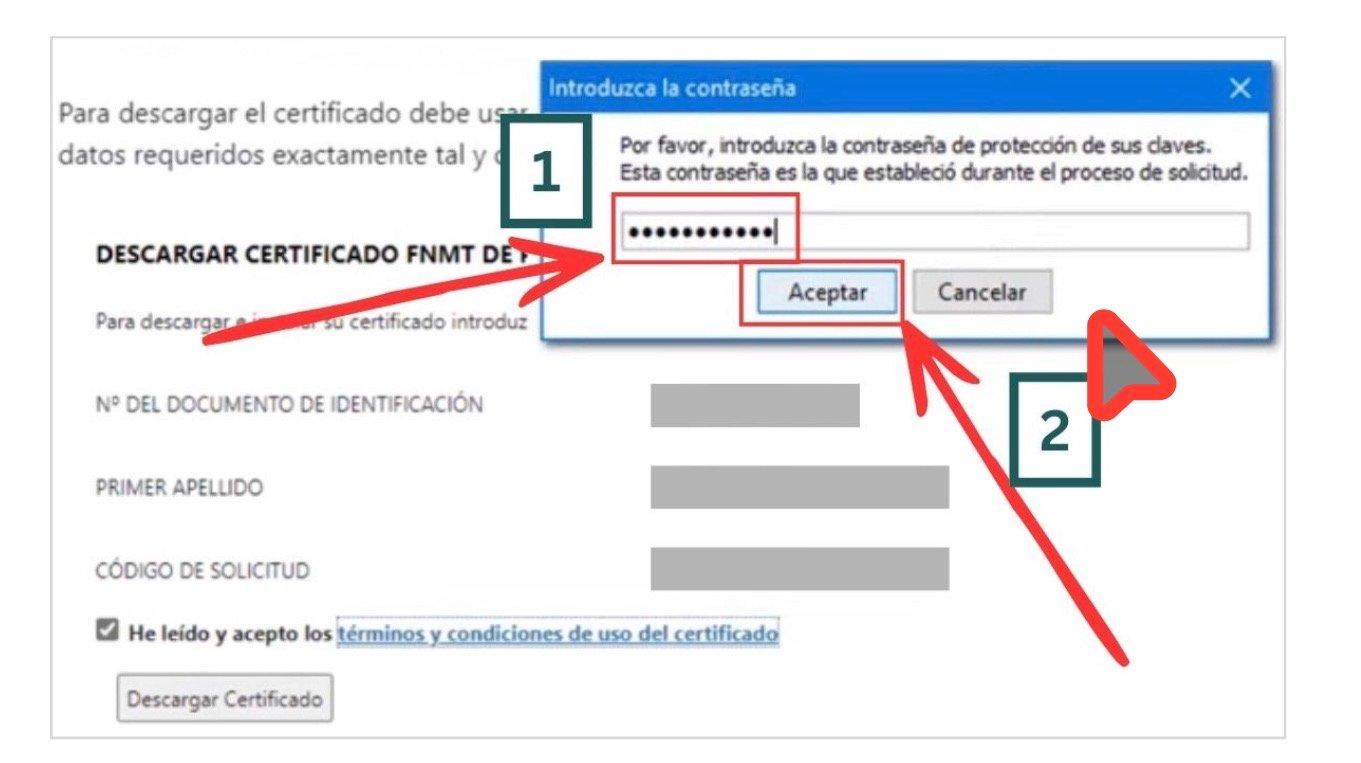
    When downloading, you will be asked for the password that you created in Step 2.

    Password dialogue during the certificate download
    Password dialogue during download | Source: sede.fnmt.gob.es (screenshot from the AEAT tutorial video)

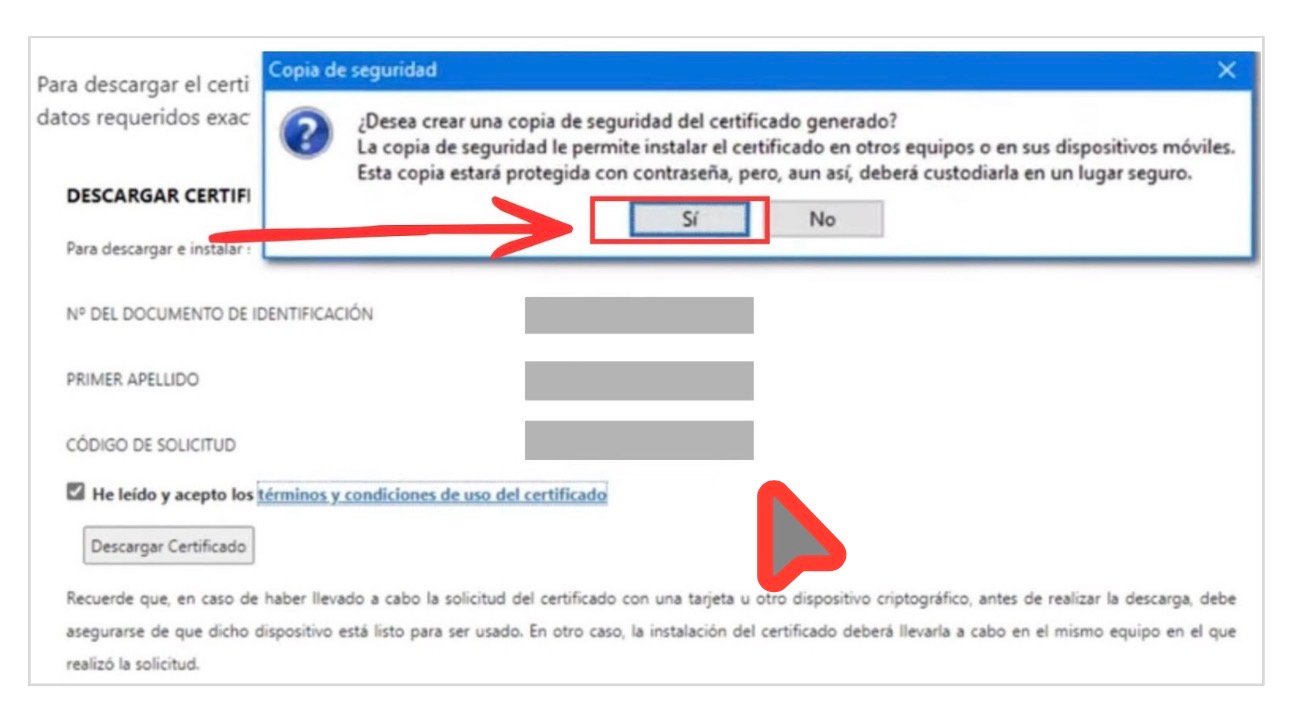
    During the download, the system will offer you the possibility of creating a backup copy of the certificate. Accept. This step is important: if you format the computer, change device, or the browser updates and loses the certificates, without a backup copy you would have to repeat the entire process from the beginning.

    Certificate backup dialogue
    Certificate backup dialogue | Source: sede.fnmt.gob.es (screenshot from the AEAT tutorial video)

    Click «Sí» to create the backup copy. Save the file in a secure place: a USB device, an external disk, or a password-protected cloud service.

    If that dialogue does not appear, you may also export the certificate manually:

    • In Chrome or Edge: go to Settings › Privacy and security › Security › Manage certificates. Select your certificate and export it with the private key.
    • In Firefox: go to Settings › Privacy and security › Certificates › View certificates. In the «Your Certificates» tab, select yours and click on «Back Up».

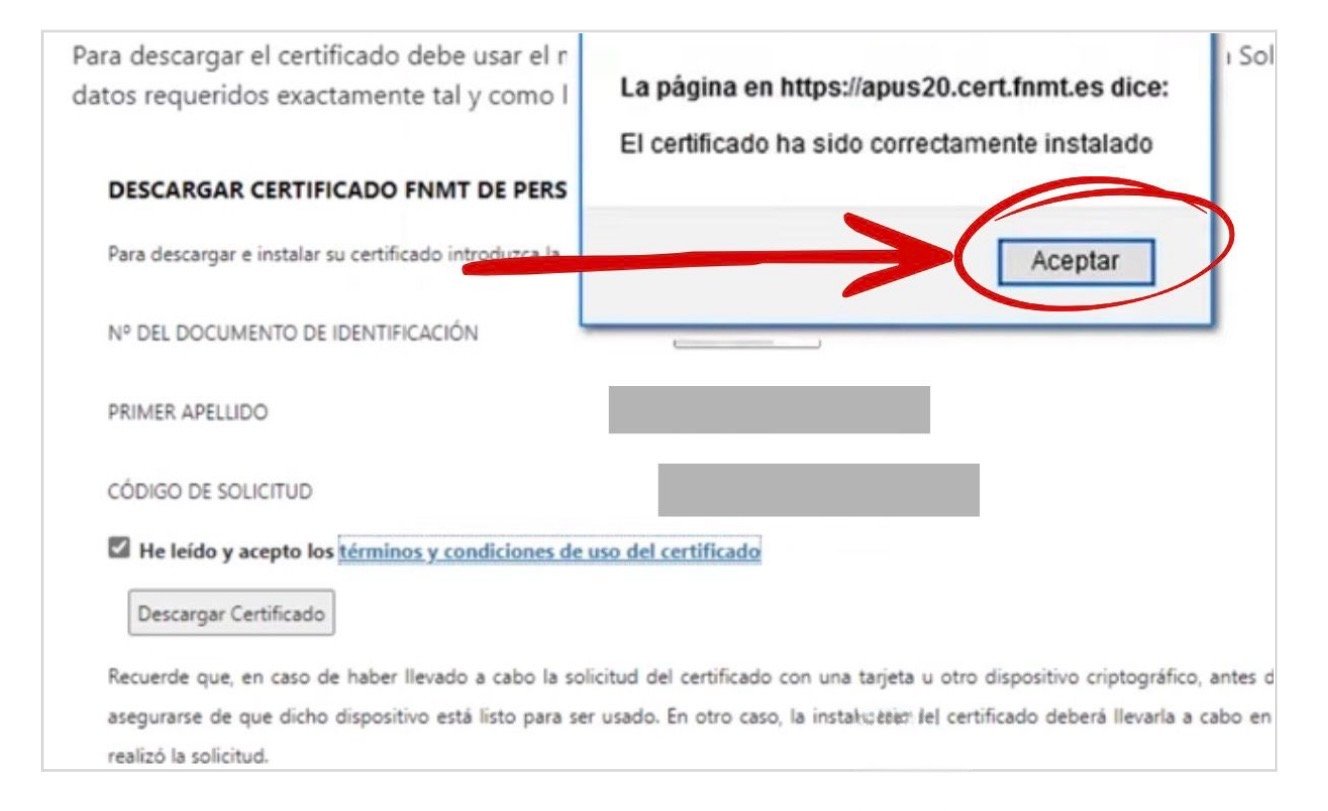
    Once the process has been completed, you will see a message confirming the correct installation of the certificate.

    Confirmation: the certificate has been correctly installed
    Confirmation: «The certificate has been correctly installed» | Source: sede.fnmt.gob.es (screenshot from the AEAT tutorial video)

    Step 5 — Check that it works

    To verify that your certificate has been correctly installed, access Mi Carpeta Ciudadana at sede.administracion.gob.es/carpeta/clave.htm. Select the access option with electronic certificate. If you enter correctly and see your data, the certificate is functioning.

    And the extraordinary regularisation 2026?

    If you are awaiting the extraordinary regularisation 2026, the digital certificate may be especially important. The drafts that have circulated indicate that one route for submitting applications may be online, through the Mercurio platform. If that route is confirmed, having a digital certificate or a valid electronic signature system could make a real practical difference.

    ⚠️ Pending confirmation in the BOE

    As of 25 March 2026, the Real Decreto that will regulate the extraordinary regularisation has still not been published in the BOE. The details concerning the submission channel for applications will be confirmed when the definitive text is published.

    When the Real Decreto is published, we shall generate a specific tutorial on how to submit the application through Mercurio. In the meantime, the most prudent course is to have the digital certificate ready.

    If you wish to know more about the extraordinary regularisation 2026, which documents to prepare and when the period will open, read our article: Extraordinary regularisation 2026 in Spain: what is known, who is eligible, and what you should do now.

    Frequent problems

    «It does not allow me to apply for the certificate on the website.» Check that you have installed the Configurador FNMT-RCM and that you are using a compatible and updated browser. Some antivirus programs or proxies may block the application: deactivate them temporarily if necessary.

    «It asks me for a password and I do not remember it.» The password is created during the application stage in Step 2 and cannot be recovered. If you have forgotten it, you will have to begin a new application from the start.

    «At the office they do not accept my document.» The experience may vary depending on the office. If they do not accept your alternative to the official NIE grant document, try another Accreditation Office (see alternatives in Step 3). You may also consult your municipality, since some collaborate with certification entities and may orient you.

    «I have downloaded the certificate but it does not function.» Make sure that you have used the same computer, the same browser and the same user account as in the application stage. If you changed something in the meantime, it is possible that you may need to repeat the process.

    If you have reached this point and completed all the steps: congratulations. You now have a tool that gives you direct access to the Spanish administration from your home, without queues and with much greater autonomy. Use it. And if you know somebody who may need it, share this tutorial.

  • Digital certificate for foreign nationals in Spain: the free tool that could change everything, whether or not your papers are in order

    Digital certificate for foreign nationals in Spain: the free tool that could change everything, whether or not your papers are in order

    This article is also available in: English | Español | العربية | Français

    Including why it may be important for the extraordinary regularisation 2026, if the online submission channel is confirmed in the BOE

    Updated on 25 March 2026 | intercultural.info

    There is a very useful tool that many foreign nationals in Spain can obtain free of charge, which enables them to manage their immigration procedures, among many other procedures, from home, without queues, without appointments that are impossible to obtain, and with much greater autonomy. It is called a digital certificate, and a large proportion of those who need it most do not know that it exists.

    In this article, we explain what it is, what problems it resolves, why so few professionals speak about it, and what it has to do with the extraordinary regularisation 2026.

    ▶ Step-by-step tutorial: How to obtain your digital certificate

    Complete guide with screenshots.

    → Go to the tutorial

    The problem you have without realising it

    Think of the last time you had to complete a procedure with the Spanish administration — and if you have never done so, ask any migrant person around you who has had that experience. Perhaps you requested an appointment and it took weeks to obtain one. Perhaps you paid somebody to do it for you. Perhaps the matter has remained unresolved for months because you do not know how to check the status of your file, nor how to provide a document that has been requested from you.

    This should not be the case. The Spanish administration has been digitalising its services for years. Today, a large part of procedures can already be completed online. The problem is that, in order to do so, one thing is necessary: to identify yourself digitally. And without that step, the person remains trapped in a system designed for those whose papers are already in order.

    The digital certificate may be that step. With it, a foreign national may access many services of the Spanish public administration without travelling and with much greater autonomy.

    Why almost nobody speaks about this

    If you search on YouTube for information about immigration procedures, you will find dozens of channels explaining arraigo procedures — arraigo social is a Spanish residence regularisation pathway based on social ties, with no direct English equivalent — renewals, or the extraordinary regularisation. But very few speak about the digital certificate for migrant persons. And those who do so rarely mention that it serves to submit immigration applications in one’s own name or on behalf of other persons.

    Without entering into speculation about the intentions of each professional, we may say that there are several reasons why this subject is explained so little. One of them is that many guides focus on the final procedure, but not on the tool that enables it to be completed online. Another is that electronic identification still appears complex to many persons, when with a clear explanation it is usually much more manageable than it seems. intercultural.info exists precisely to break that dynamic.

    What is the digital certificate for in the real life of a foreign national?

    With a digital certificate, a foreign national may, among other things:

      • Submit immigration applications online through Mercurio, including regularisation, arraigo social, family reunification, renewals, and others

      • Consult the status of their immigration file and download decisions and notifications

      • Provide documentation to an already opened file, without the need to attend in person

      • Request the empadronamiento certificate (certificate of municipal registration) in those municipalities that permit it online

      • Obtain the employment record report and other Social Security documents

      • Conduct tax procedures with the Tax Agency (Agencia Tributaria / Hacienda), including the income tax return and tax certificates

      • Apply for Spanish nationality

      • Request the homologation or recognition of qualifications obtained abroad

      • Access Mi Carpeta Ciudadana, the unified portal of the Spanish administration

      • Sign documents with full legal validity, without the need for a notary

    In summary, the digital certificate converts the person into an active subject before the administration, capable of managing their own affairs without dependence on intermediaries and without appointments that are in many cases very difficult to obtain.

    What is electronic identification and what are your options?

    Electronic identification is the way of demonstrating to the administration that it is you, online, in a secure manner. In Spain, several systems exist.

    Digital certificate (FNMT): the most complete one, and the one we recommend. It is free of charge, valid throughout the Spanish administration, and enables you not only to identify yourself, but also to sign documents with full legal validity. It is issued by the Fábrica Nacional de Moneda y Timbre (FNMT, the Spanish National Mint and Stamp Factory). In practice, it is the most useful system for many online immigration procedures, including the submission of applications in Mercurio when the procedure permits that route.

    Cl@ve Permanente with Cl@ve Firma: a valid alternative for identification and also for signing. It requires a registration procedure in person or through video identification. With Cl@ve Firma activated, it may be used to sign certain electronic procedures and may be a valid alternative depending on the procedure.

    Cl@ve PIN: a basic identification system. It permits consultation of files and identification before the administration, but does not permit the signing of applications. It is useful for consultations and serves to identify yourself in some services, but by itself it does not usually suffice when the procedure requires an electronic signature.

    Certificates from autonomous communities and other entities: in addition to the FNMT, other certification entities recognised by the Spanish State exist, including ACCV (Comunitat Valenciana), Izenpe (Basque Country), CATCert (Catalonia), or the Chambers of Commerce through Camerfirma, among others. All are valid for procedures with the administration. In some areas, obtaining one through the municipality itself or through these entities may be more accessible than doing so via the FNMT.

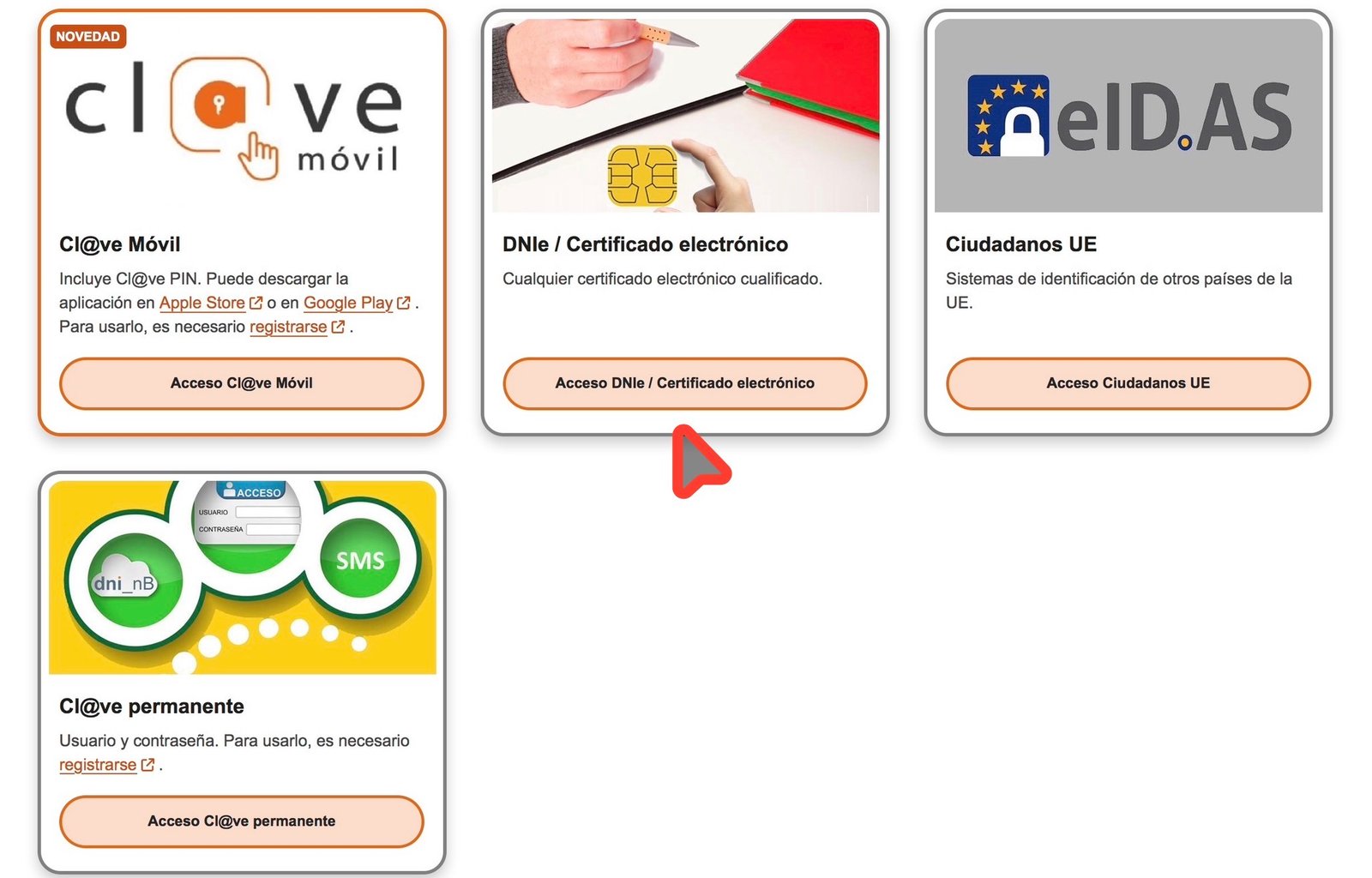
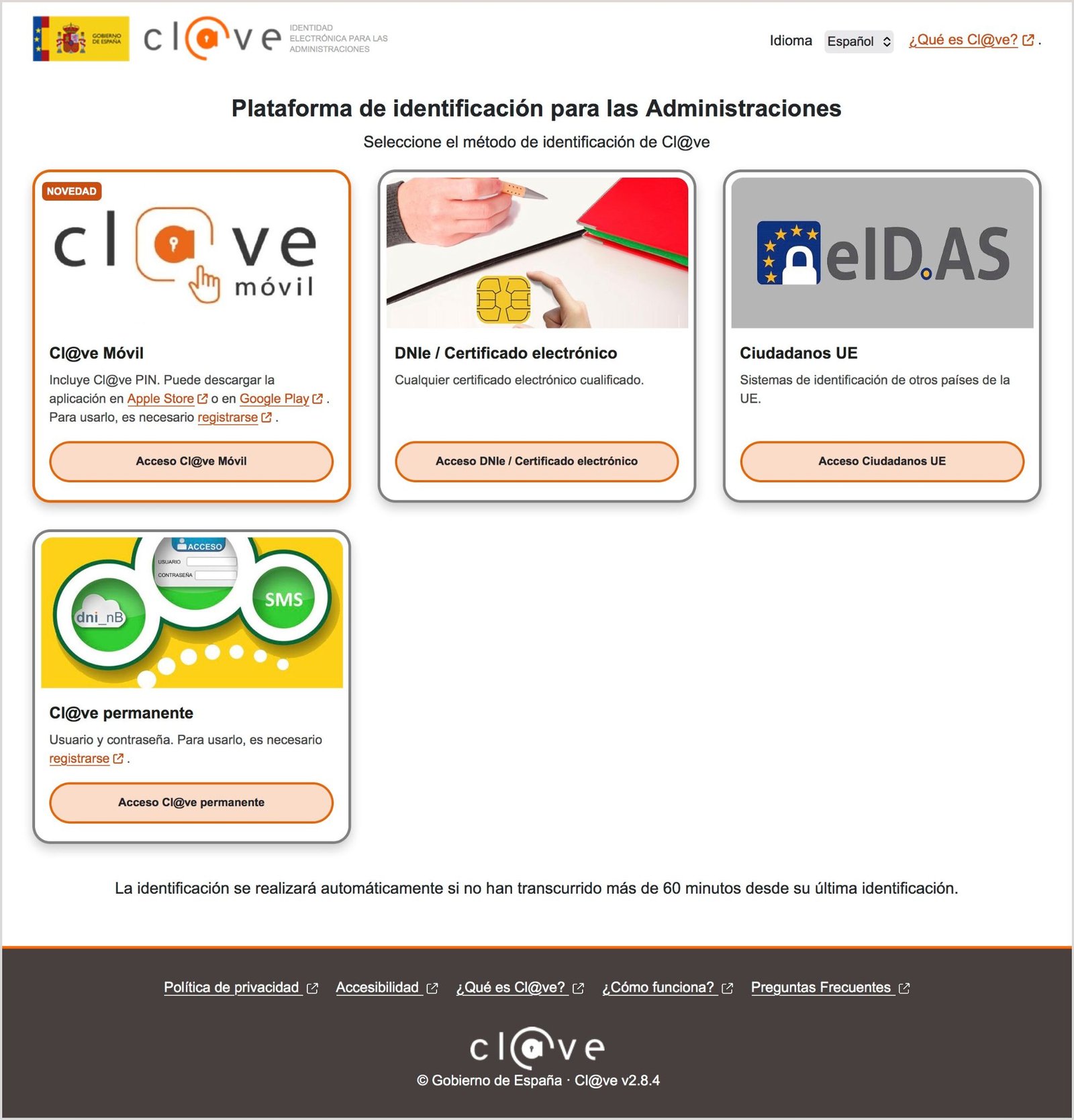
    Ways of identifying yourself before the Spanish administration: digital certificate, Cl@ve and electronic DNI
    Ways of identifying yourself before the Spanish administration: digital certificate, Cl@ve and electronic DNI | Source: carpetaciudadana.gob.es (access via the Cl@ve gateway)

    In this article, we focus on the FNMT digital certificate because it is the most universal, free of charge, and accessible throughout the national territory.

    NIE, residence authorisation and TIE: three different things — and why this article also matters to you even if your papers are not in order

    Before speaking about who may obtain the digital certificate, it is useful to clarify three concepts that generate much confusion.

    NIE (Número de Identidad de Extranjero/a, Foreigner Identification Number): it is an identification number, not a document and not a permit. It is assigned by the National Police when a foreign national initiates any formal procedure with the Spanish administration, or when it is expressly requested before that administration while demonstrating a legitimate interest, subject to certain conditions. A person may have an NIE even if they do not have a valid residence permit, and even if they have never had one.

    Example of the NIE grant document (personal data anonymised)
    Example of the NIE grant document | Source: Real document, personal data anonymised by intercultural.info

    Residence authorisation (or residence permit): this is the administrative authorisation that permits residence in Spain. It is different from the NIE and from the TIE.

    Example of a decision granting residence authorisation (personal data anonymised)
    Example of a decision granting residence authorisation | Source: Real document, personal data anonymised by intercultural.info

    TIE (Tarjeta de Identidad de Extranjero/a, Foreigner Identity Card): this is the card-format expression of the residence authorisation. It contains the NIE, the photograph, and the type of permit granted.

    Example of a Tarjeta de Identidad de Extranjero/a (TIE)
    Example of a Tarjeta de Identidad de Extranjero/a (TIE) | Source: policia.es

    Why does this distinction matter? Because the FNMT digital certificate may be obtained with an NIE, even if you do not have a TIE or a valid residence permit. The FNMT itself specifies on its electronic office that the «official document granting the NIF/NIE which makes it possible to verify that the person is in possession of the NIE, irrespective of the validity of the document«, is valid, together with the passport.

    That said, in practice the experience may vary depending on the Accreditation Office. Some may accept a document containing your NIE — such as an Immigration Office decision, whether favourable or a refusal. Others may be more strict. We recommend that you consult the office before travelling there. If the FNMT route does not function in your case, in some areas municipalities collaborate with recognised certification entities and may orient you towards other alternatives.

    ⚠ Important: what if you think you do not have an NIE?

    Many persons who submitted applications to the Immigration Office in the past — even if they were refused — were assigned an NIE. That number appears on the decision they were sent. If you keep any Immigration document, look for it: it is possible that you already have an NIE without realising it.

    If you have never been assigned an NIE, that does not mean this article is of no use to you: understanding how electronic identification functions may be useful if the regularisation ultimately permits submission by representation.

    And if at this moment you do not have an NIE, continue reading all the same. In a scenario of online submission, it may be important to know not only how the digital certificate functions, but also whether the final Real Decreto permits another person to act in your name by way of representation.

    Example of a refusal decision with an NIE assigned (personal data anonymised)
    Example of a refusal decision with an NIE assigned | Source: Real document, personal data anonymised by intercultural.info

    The extraordinary regularisation 2026 and the digital certificate

    If you are awaiting the extraordinary regularisation 2026, the digital certificate acquires particular relevance. As of today, 25 March 2026, the Real Decreto has still not been published in the BOE (Boletín Oficial del Estado, Official State Gazette), but the drafts that have circulated indicate that one principal route for submitting applications will be online, through the Mercurio platform. If the principal submission channel ultimately proves to be online, having a digital certificate or a valid electronic signature system may make an important practical difference — unless one has recourse to a professional, to a registered collaborating organisation, or — and this is important although almost nobody explains it — to a trusted person who may act as representative, if the definitive Real Decreto confirms this, as we explain further below.

    ⚠ Information pending confirmation in the BOE

    Everything relating to the submission channel is provisional. The exact details — whether direct submission in Mercurio will be possible and in what manner, which documents will be admitted, whether an expired passport will be valid, whether other routes will be enabled — will be confirmed when the definitive text of the Real Decreto is published in the BOE.

    As regards the in-person route, everything indicates that it may be less agile than the online route, but the concrete details — offices, timetables, capacity and procedure — remain pending official confirmation. Several unofficial sources indicate that the offices enabled would function in the afternoon, with limited availability and a very high volume of applications.

    The key point, in any case, is to prepare now. Whoever arrives with the digital certificate ready on the day the period opens will have a real advantage over whoever does not.

    Can another person submit the online application on your behalf?

    This is perhaps one of the most important pieces of information that nobody explains. And the answer is: probably yes, if that person has a digital certificate and acts as your representative.

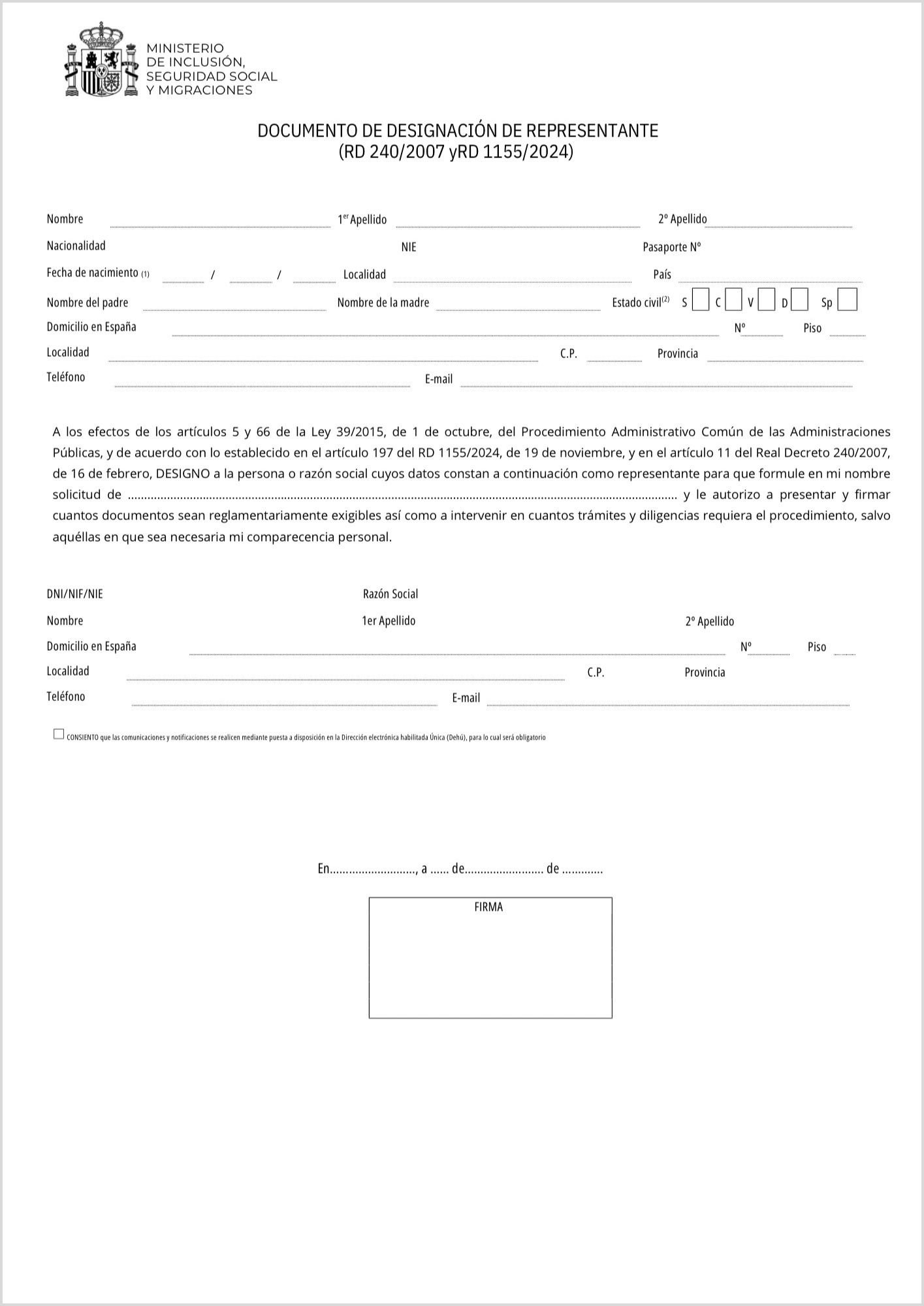
    Law 39/2015, in its Article 5, establishes that any person may act as representative of another before the Spanish public administration — it is not necessary to be a registered and authorised professional for these procedures. It is sufficient to complete and submit the document of «designación de representante» (appointment of representative), available in our Resources section, together with the remaining documents, and for the representative to possess the necessary electronic means, that is to say, a digital certificate.

    Download the designación de representante form at: intercultural.info/en/recursos/

    (Source: Ministry of Inclusion, Social Security and Migration — inclusion.gob.es. Verify that this is the current version before using it.)

    A concrete example:

    Between 2020 and 2022, thousands of UK nationals in Spain needed to regularise their situation after Brexit, in the middle of the pandemic. A significant proportion of applications were submitted online through Mercurio on behalf of those persons, without that representation being exercised by a registered professional — simply by means of the corresponding designación de representante document. This experience demonstrates that the mechanism exists, functions, and has been used on a large scale.

    Designación de representante form — Ministry of Inclusion, Social Security and Migration
    Designación de representante form | Source: Ministry of Inclusion, Social Security and Migration — inclusion.gob.es

    If you have a family member, a close friend, or any trusted person with a residence permit in Spain or Spanish nationality, and who has or may obtain a digital certificate, it may be worthwhile for that person to prepare in order to assist you when the time comes. Pending confirmation by the BOE for the extraordinary regularisation, this route could be key for many persons who do not have electronic identification of their own.

    What to do right now

      • If you do not know whether you have an NIE: search among your documents for any Immigration Office decision. Your NIE may be there.

      • If you do not have an NIE: you may request the direct assignment of an NIE before the National Police or an Immigration Office, by means of form EX-15 and payment of the corresponding fee. Bear in mind that this procedure requires compliance with certain conditions, and that in an irregular administrative situation it may be difficult to obtain it. The legal period for a decision is five working days, although, as in any administrative matter, the real timeframes may vary. If the application is refused, that is not the end of the road: the following options also apply to you.

      • If you have family members or trusted persons whose documentation is in order: encourage them to obtain their digital certificate. If the BOE confirms it, they may be able to submit applications in your name as representatives.

      • If you have neither an NIE nor a personal representative, other routes exist: support organisations for migrant persons registered as collaborating entities — NGOs and trade unions entered in the Register published in the BOE on 5 March 2026 — may orient you and assist you free of charge. If you decide to consult professional firms, ensure that they are registered with the relevant professional body and authorised for these procedures. The in-person route is also available without a digital certificate.

      • If you already have the digital certificate: use it to prepare documentation that you may need for the regularisation, such as a historical empadronamiento certificate proving your arrival and presence in Spain since before January 2026, or the certificate of cohabitation (certificado de convivencia) proving direct family ties — one of the situations in the second regularisation pathway according to the drafts currently circulating, as we explain in our article Extraordinary regularisation 2026 in Spain: what is known, who is eligible, and what you should do now.

    ▶ Step-by-step tutorial: How to obtain your digital certificate

    Detailed steps, screenshots and explanations.

    → Go to the tutorial