
25 April 2026 | intercultural.info
Two pathways, one outcome
The 2026 extraordinary regularisation offers two access pathways, regulated by Royal Decree 316/2026, dated 14 April:
Pathway 1 — Additional Provision Twenty (DA 20ª): for persons who submitted an international protection application in Spain before 1 January 2026, regardless of the current status of that application. Eligible persons include those whose:
- international protection application remains pending,
- international protection application was withdrawn,
- administrative or judicial review appeal against a rejection decision was withdrawn,
- application or appeal received a rejection decision, or
- administrative or judicial review appeal remains in progress.
The application is submitted using form EX-31 →.
Pathway 2 — Additional Provision Twenty-First (DA 21ª), arraigo (community-integration residence permit) extraordinario: for persons in an irregular situation who did not apply for asylum, or who applied after 1 January 2026. The application is submitted using form EX-32 →.
Both pathways lead to the same outcome: a one-year residence and work permit.
Do you qualify? Find out now
Answer a few questions and discover in minutes whether you can apply for the regularisation and through which pathway.
Go to the simulator →Requirements common to both pathways
👤 Legal majority
The person who submits the application must be of legal age at the time of submission. Minors may benefit from this regularisation, but through the application submitted by their parent or legal guardian. If you have minor children, or adult children with a disability, consult the section on special circumstances.
📅 Presence in Spain before 1 January 2026
You must have been present in Spain before that date and be able to demonstrate it with relevant evidence. If you arrived after 31 December 2025, this regularisation does not apply to your situation.
📍 Present in Spain at the time of submission
You must be physically present in Spain at the time of submitting your application.
🚫 No valid or pending stay or residence permit
You must not hold any valid stay or residence permit, nor have any application of this type under examination — this includes:
- initial grants, extensions, renewals or modifications of any type of permit
- stays for study purposes or non-profit residence
Stateless persons are also excluded, as they are governed by specific legislation.
🇺🇦 Not a beneficiary of Ukrainian temporary protection
Persons with this protection are covered by a separate procedure and must not apply for this regularisation.
🗓️ Five months of uninterrupted presence
You must have remained in Spain without interruption for the five months prior to the date on which you submit your application. This is not the five months prior to 1 January 2026: it is the five months prior to the date of submission.
This may be evidenced by any legally valid document containing personal data. Several documents may be combined:
- padrón (municipal register) or empadronamiento (municipal residence registration) history
- medical or healthcare records
- employment contracts or payslips
- utility bills (water, electricity, telephone)
- bank transfers or statements
- public transport cards or tickets bearing your personal details
⚖️ No criminal record
You must have no criminal record in Spain or in the countries where you resided during the five years prior to your entry into Spain.
Note that:
- Expungable offences in Spain are not taken into consideration.
- The existence of entries in the police report does not constitute automatic rejection: each case is assessed individually.
If you do not yet have the certificate: its absence does not prevent you from submitting your application. If you requested it more than one month ago and have not received it, you may submit Anexo I-1 (a statutory declaration in lieu of the certificate) or Anexo I-2 (an authorisation for the Spanish authorities to request it through diplomatic channels). Both documents are included in forms EX-31 → and EX-32 →.
🔒 Not representing a threat to public order, public security or public health
🌍 Not listed as inadmissible and not subject to a return commitment period
You must not be listed as inadmissible in countries with which Spain has signed a relevant agreement, nor be within a commitment period not to return to Spain.
💶 Processing fee
Once you are notified that your application has been accepted for examination, you will be required to pay a fee of €38.28 via Modelo 790, code 052, section 2.3.1 →.
Additional evidence required for Pathway 2 (if you did not apply for asylum)
If you are applying via Pathway 2 (arraigo extraordinario, DA 21ª), in addition to all the above requirements, you must demonstrate at least one of the following three grounds.
Ground 1 — Employment or intention to work
Having worked in Spain or demonstrating the intention to do so. The following situations are valid:
- Having been employed or self-employed in Spain before submitting the regularisation application.
- Intention to work as an employee: a job offer is submitted. The contract resulting from that offer must exceed 90 days in one year.
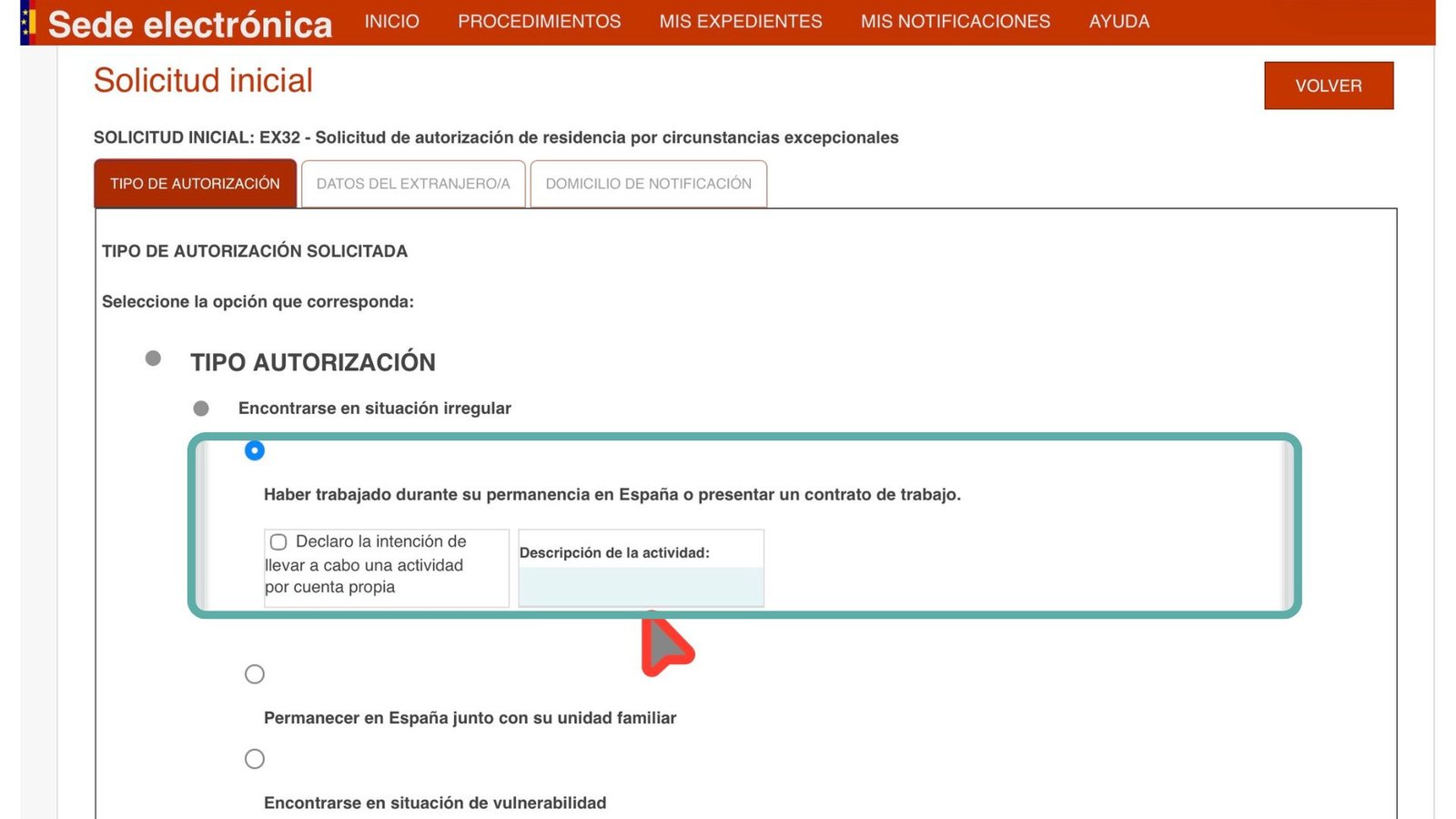
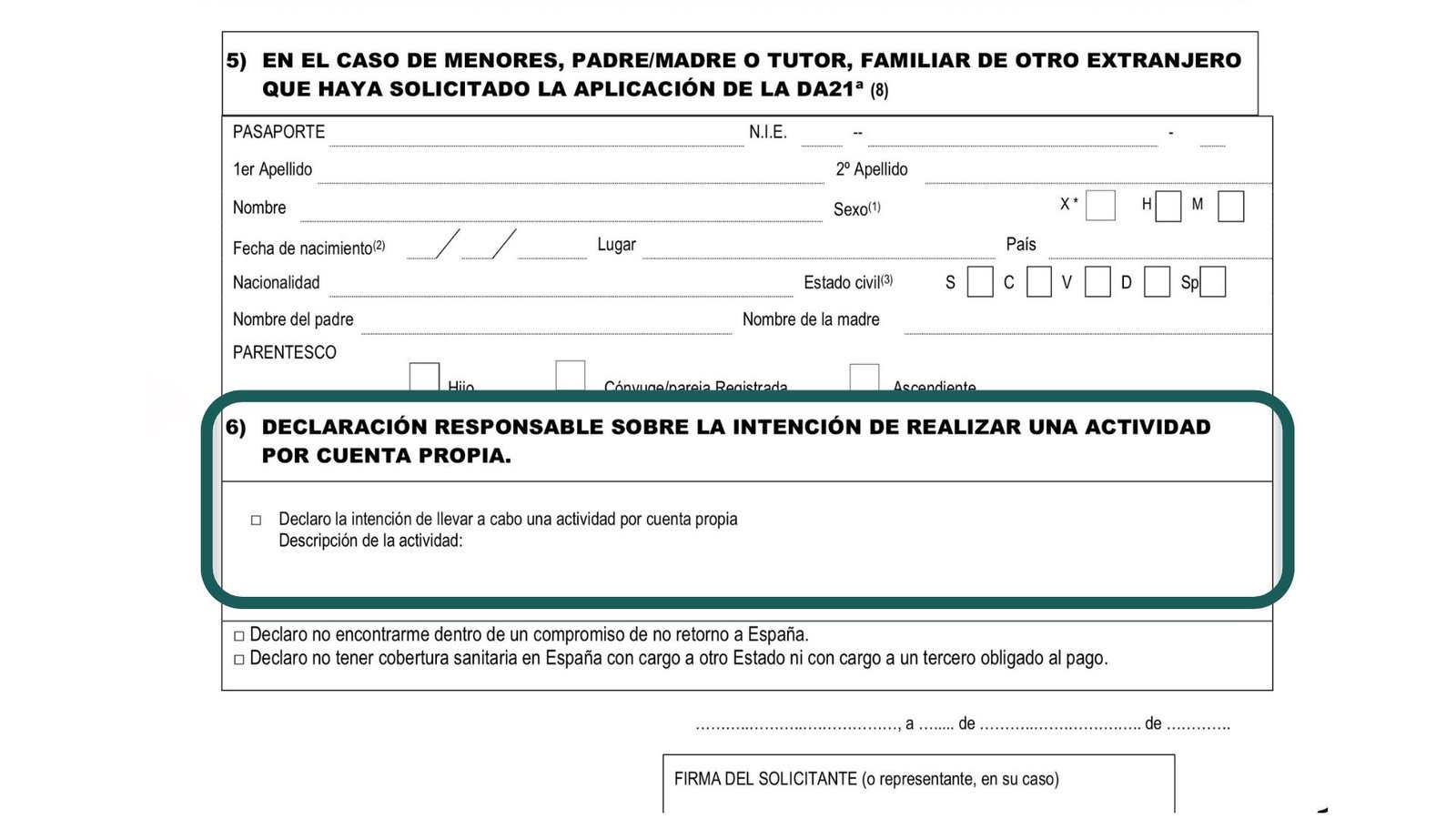
💡 From the moment you are notified of the initiation of the procedure, you are authorised to work throughout the national territory and in any sector of activity. - Intention to work as self-employed: a statutory declaration with a description of the intended activity is submitted. This section is completed in the Mercurio platform (electronic application) or in section 6 of form EX-32 → when the application is submitted in person.
Ground 2 — Cohabitation with family unit
Residing in Spain with your family unit, provided it comprises:
- minor children, or
- adult children with a disability requiring support, or who are objectively unable to provide for their own needs, or
- direct ascendants of the first degree (parent) with whom you reside.
Ground 3 — Vulnerability
Vulnerability is evidenced by the vulnerability certificate (Anexo II →) in the official form, issued by:
- the social services of the competent public administration, or
- an entity registered in the RECEX (Registry of Organisations Collaborating on Immigration Affairs).
For the certificate to be valid, it must satisfy two formal requirements:
- it must bear the stamp of the issuing entity, whether electronic or physical, and
- it must indicate the file number recorded in the RECEX.
Without these two elements, the certificate has no legal effect for the purposes of this application.
The regulation expressly recognises that an irregular administrative situation, together with its personal, economic or social consequences, may in itself constitute vulnerability.
Find an organisation that can assist you
Locate accredited organisations near you that provide free guidance and can submit the application on your behalf.
Search for organisations →Special circumstances
🔄 Pending arraigo or other exceptional authorisation, or appeal in progress
If you have a pending arraigo or other exceptional circumstances authorisation submitted between 20 May 2025 and 15 April 2026 inclusive, you are not required to submit any additional application. Your file will be resolved under simplified requirements: you will not need to demonstrate employment activity, family ties or a vulnerability situation. You must still satisfy the remaining common requirements — including the absence of a criminal record under the terms of the regulation and not representing a threat to public order or public security.
This simplified regime also applies to appeals in progress — whether administrative or judicial — against decisions on applications submitted during that same period.
👨👩👧 Simultaneous applications within the same household unit
If other persons in your household unit also wish to apply for the regularisation — including a spouse or registered civil partner, or direct ascendants of the first degree — all applications may be submitted simultaneously, both electronically and in person. Applications will be resolved collectively.
👶 Minor children and adult children with disabilities
If you are an applicant with minor children, or adult children with a disability, you may simultaneously request a residence permit for them. Both applications are resolved collectively. Permits issued to minors will be valid for five years.
📄 Documents from other countries: translation and legalisation
Documents issued in other countries must:
- be translated into Castilian by a sworn translator. Only persons who hold this official title, recognised by the Spanish authorities, produce translations that are valid for administrative purposes in Spain. A translation produced by any other person — even if bilingual or a professional translator — has no legal validity. Before engaging their services, verify that the translator is authorised or registered with the competent Spanish authorities.
- be legalised by the Spanish consulate in the country of issue, or apostilled in accordance with the 1961 Hague Convention.
This applies in particular to the criminal record certificate and any documentation evidencing family ties.
What happens once your application is submitted
✅ Provisional work authorisation from the outset
From the moment the Administration notifies you of the initiation of the administrative procedure, you are provisionally authorised to reside and work — both as an employee and as self-employed — throughout the national territory and in any sector of activity, while your application is under examination.
⏱️ Resolution period
The maximum resolution period is three months from the date your application is entered in the register of the competent authority. In practice, administrative timescales may vary — for example, if the Administration requests additional documentation, the procedure may be suspended and resumed once the documentation is provided, which may extend the actual resolution time. In any event, if you receive no response within the maximum period, the application may be considered rejected by administrative silence.
🪪 Foreigner’s Identity Card (TIE)
Once the grant is notified, you have one month to personally request the TIE (Foreigner’s Identity Card) at the Police Station in your area of residence, with payment of the corresponding fee under Modelo 790, code 012.
🕐 Non-extendable deadline: 30 June 2026
Sources:
- Royal Decree 316/2026, dated 14 April (BOE-A-2026-8284)
- Interpretive Guidelines of the Directorate-General for Migration Management (DGGM), 22 April 2026
- Information Sheet 28 Ter — DA 21ª (arraigo extraordinario), updated 17 April 2026
- Information Sheet 28 bis — DA 20ª (international protection applicants), updated 17 April 2026