Categoría: Regularización

Todo sobre la regularización extraordinaria 2026

  • Le travail indépendant dans la régularisation 2026 : comment rédiger votre déclaration sur l’honneur, avec 25 idées d’activité réalistes

    Le travail indépendant dans la régularisation 2026 : comment rédiger votre déclaration sur l’honneur, avec 25 idées d’activité réalistes

    Cet article est également disponible en : Español العربية English Français

    Mis à jour le 10 mai 2026 | intercultural.info

    En bref : la régularisation extraordinaire 2026 ouvre trois portes au sein de la voie professionnelle : un emploi antérieur, une offre d’emploi ou une déclaration sur l’honneur d’activité indépendante. Si vous ne relevez ni de la voie familiale ni de la voie de vulnérabilité, et que vous n’obtenez pas d’offre d’emploi, le travail indépendant constitue la seule porte qui dépend entièrement de vous. Dans cet article, nous vous précisons ce que la norme exige, ce qu’elle n’exige pas, et nous mettons à votre disposition un générateur de modèles gratuit afin que vous prépariez votre déclaration dans votre langue, puis que vous la copiiez en espagnol dans le formulaire EX-32 ou sur Mercurio.


    Pourquoi cette porte est-elle importante ?

    La Vingt-et-unième Disposition additionnelle du Règlement du droit des étranger.ère.s, modifiée par le Décret royal 316/2026 (BOE-A-2026-8284), exige que la personne demandeuse justifie, en plus des conditions générales, au moins l’une de ces trois situations :

    • Voie familiale : résider en Espagne avec des enfants mineur.e.s, des enfants majeur.e.s en situation de handicap nécessitant un soutien, ou des ascendant.e.s direct.e.s au premier degré.
    • Voie de vulnérabilité : disposer d’un certificat de vulnérabilité délivré par les services sociaux ou par une organisation inscrite au Registre des entités collaboratrices en matière d’immigration (RECEX).
    • Voie professionnelle : avoir travaillé en Espagne, présenter une offre d’emploi, ou présenter une déclaration sur l’honneur d’activité indépendante.

    (Source : fiche d’information 28 Ter du Ministère de l’Inclusion, de la Sécurité sociale et des Migrations, mise à jour du 17 avril 2026.)

    Dans la pratique, une part considérable des personnes en situation administrative irrégulière ne relève pas de la voie familiale — elles n’ont pas d’enfants mineur.e.s à charge en Espagne ni d’ascendant.e.s direct.e.s vivant avec elles — et ne parviennent pas à obtenir un certificat de vulnérabilité, parce que les services sociaux de leur municipalité ou les entités du RECEX sont saturés ou exigent un suivi préalable.

    Au sein de la voie professionnelle, obtenir une offre d’emploi formelle de quatre-vingt-dix jours ou plus, sans encore disposer d’autorisation de travail, demeure un obstacle majeur pour de nombreux profils, en particulier dans les secteurs où l’offre est informelle ou saisonnière.

    Le travail indépendant est la seule option à l’intérieur de la voie professionnelle qui ne dépend pas d’un tiers. Elle repose uniquement sur un texte bref que vous rédigez et signez, dans lequel vous déclarez votre intention de débuter une activité en tant que travailleur.euse indépendant.e. L’Administration, à ce stade, ne vous demande pas de démontrer la viabilité économique ni de disposer d’un capital préalable.

    Précaution importante : le fait que cette porte soit techniquement accessible ne la rend pas anodine. Si l’autorisation vous est accordée par cette voie, vous devrez vous inscrire au Régime spécial du travail indépendant (RETA) et exercer effectivement l’activité déclarée, au moins pendant la première année, afin de pouvoir renouveler votre titre de séjour. Nous l’expliquons en détail plus bas.


    Ce que la norme exige — et ce qu’elle n’exige pas

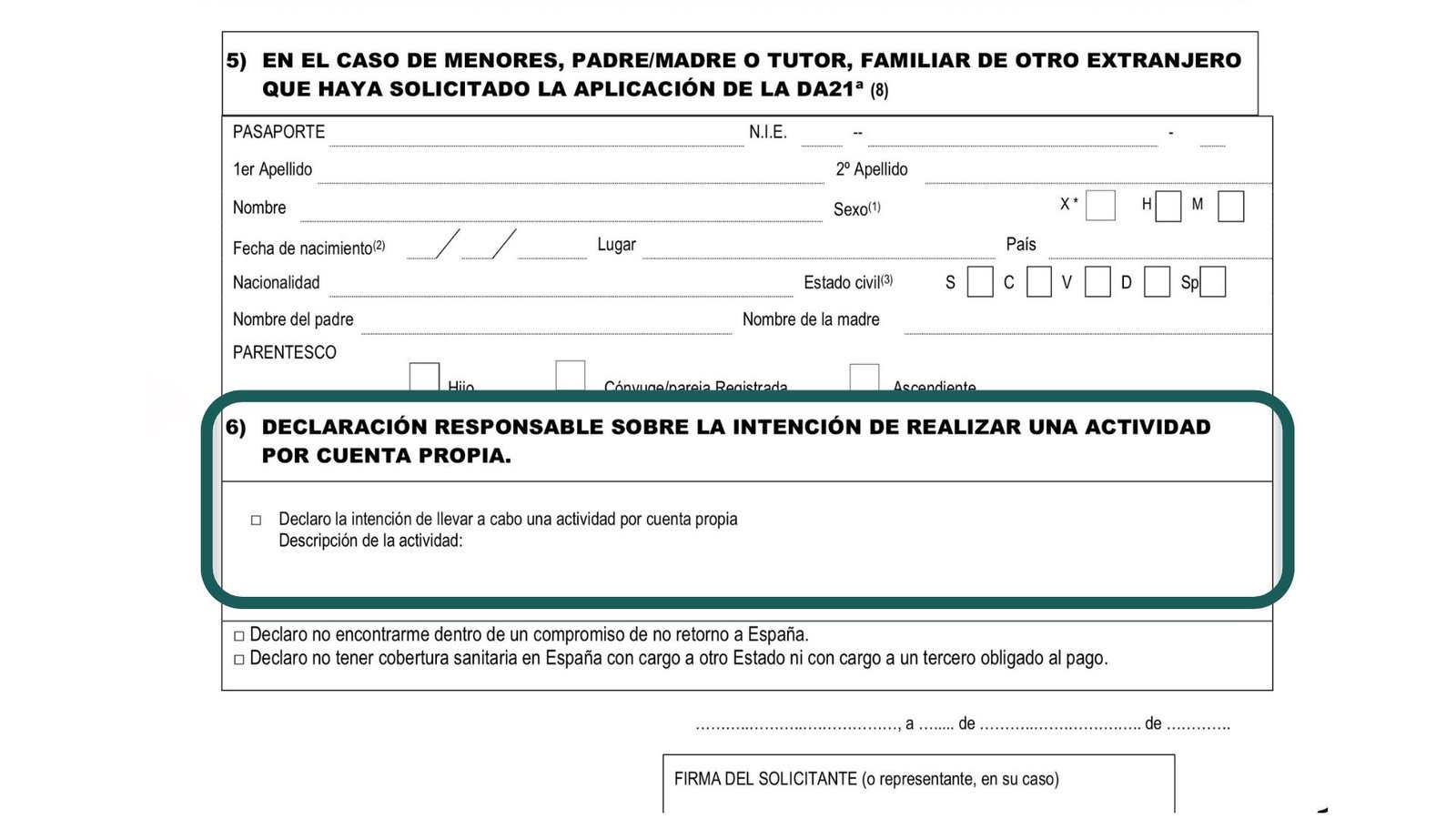
    Le formulaire officiel EX-32 intègre une section spécifique, la numéro 6, intitulée « Déclaration sur l’honneur relative à l’intention d’exercer une activité indépendante ». Dans cette section, vous devez :

    • Cocher la case « Je déclare l’intention d’exercer une activité indépendante ».
    • Décrire l’activité que vous comptez exercer (c’est le point que nous allons travailler dans cet article). Le texte doit être rédigé toujours en espagnol, même si vous y réfléchissez dans votre langue maternelle pendant la préparation.

    (Le formulaire comporte également deux cases supplémentaires qui doivent aussi être cochées : « Je déclare ne pas être tenu.e par un engagement de non-retour en Espagne » et « Je déclare ne pas bénéficier d’une couverture sanitaire en Espagne à la charge d’un autre État ou d’un tiers tenu au paiement ». Ce sont des déclarations formelles sans texte libre associé.)

    L’espace physique pour décrire l’activité est très réduit : sur le formulaire papier, à peine deux lignes y tiennent, et sur la plateforme électronique Mercurio, le champ est limité à environ 470 caractères. Pour cette raison, la description doit être claire, précise et réaliste, sans gaspiller de mots dans des explications générales.

    Ce que la norme N’exige PAS — du moins pas explicitement

    Aux fins de cette procédure de régularisation, la Vingt-et-unième Disposition additionnelle n’exige pas (source : fiche 28 Ter, déjà citée) :

    • Un projet d’activité détaillé ou un plan d’affaires.
    • La justification d’un capital préalable, de dépôts bancaires ou d’un financement.
    • Un contrat de location de local, une licence d’ouverture ni une autorisation administrative préalable.
    • Un diplôme reconnu pour les professions ne nécessitant pas l’inscription ordinale obligatoire.
    • Une expérience professionnelle formelle préalable.

    Cela représente une simplification radicale par rapport à la procédure ordinaire de résidence et de travail indépendant, et ouvre une possibilité réelle pour les personnes qui arrivent sans ressources ni réseaux entrepreneuriaux.

    Attention ! À ce jour, aucune source officielle ne confirme que l’Unité de traitement des dossiers des étranger.ère.s (UTEX) exigera des informations détaillées sur l’activité que la personne demandeuse compte exercer en tant que travailleur.euse indépendant.e. Il n’est pas exclu que, durant l’instruction, le bureau émette une demande de demande de pièces complémentaires sollicitant des éclaircissements, mais à la date du 10 mai 2026 il n’existe aucune preuve publique que cela se produise de manière systématique.


    Que se passe-t-il ensuite, si l’autorisation vous est accordée

    Voici la partie qu’il convient de comprendre avant de déposer la demande, et non après. Si l’Administration vous accorde l’autorisation par cette voie, vous assumez implicitement l’engagement de débuter effectivement l’activité déclarée au cours de la première année. L’autorisation a une validité initiale d’un an et, pour la renouveler, vous devrez démontrer que l’activité économique existe et a été développée (RD 316/2026 et l’article modifié du RD 1155/2024).

    Inscription au RETA

    Dès que la décision favorable vous est notifiée, vous devrez solliciter la titre de séjour (Tarjeta de Identidad de Extranjero — TIE) dans un délai d’un mois, et vous immatriculer auprès de l’Agence fiscale espagnole (formulaire 036 ou 037) et au Régime spécial du travail indépendant (RETA) de la Sécurité sociale.

    Tarif fixe 2026 : environ 90 euros par mois pendant les 12 premiers mois

    Les personnes qui s’inscrivent pour la première fois au RETA durant 2026 peuvent solliciter le tarif fixe de quatre-vingts euros mensuels durant la première année — soit environ 89 euros mensuels en incluant la cotisation correspondant au Mécanisme d’équité intergénérationnelle (MEI, 0,9 %). Il s’agit d’une cotisation réduite spécifiquement conçue pour les nouvelles inscriptions. Une fois les douze premiers mois écoulés, le tarif fixe peut être prorogé pour douze mois supplémentaires si vos revenus nets demeurent inférieurs au salaire minimum interprofessionnel espagnol (SMI). Une fois la période de tarif fixe épuisée, vous passerez au système général de cotisation par paliers, en fonction de vos revenus réels (source : Importass de la Sécurité sociale, guide du travail indépendant).

    Important, pour ne pas être pris.e au dépourvu : une fois le tarif fixe épuisé (à douze ou vingt-quatre mois, selon prorogation), la cotisation mensuelle est calculée sur les revenus nets réels et oscille approximativement entre 200 et 590 euros par mois, répartis sur quinze paliers en vigueur en 2026 (source : Simulateur de cotisation d’indépendant — Importass, Sécurité sociale espagnole). Il convient de projeter ce coût dans toute estimation de viabilité de l’activité.

    Obligations fiscales minimales

    En tant que travailleur.euse indépendant.e, vous aurez des obligations trimestrielles : déclaration de TVA (formulaire 303) et acomptes provisionnels d’impôt sur le revenu (IRPF, formulaire 130 ou 131), ainsi qu’une déclaration annuelle d’IRPF à la clôture de l’exercice. Pour la majorité des activités manuelles et de services, la gestion est parfaitement réalisable avec un service de conseil de base ou, voire, avec une formation minimale. (Source : Agence fiscale espagnole — formulaires en vigueur 2026.)

    Si l’activité ne fonctionne pas

    Si, après une période, l’activité déclarée ne s’avère pas viable, la norme elle-même prévoit des solutions alternatives. Vous pouvez solliciter une modification vers le travail salarié dès que vous obtenez un contrat de travail. Si tel est le cas, notre recommandation est qu’avant de prendre des décisions en ce sens, vous consultiez des entités et des professionnel.le.s du domaine de l’immigration. Et si, au moment du renouvellement, votre situation est celle d’une recherche active d’emploi, une prorogation extraordinaire est prévue qui permet de maintenir le titre de séjour pendant la recherche d’emploi, à condition d’être inscrit.e au service public de l’emploi ou de fournir un rapport d’effort d’intégration (RD 316/2026, articles modifiant le régime des prorogations).

    Avertissement : cette prorogation extraordinaire n’est pas garantie à 100 %. Son octroi est subordonné à une appréciation favorable de l’autorité compétente, qui examinera votre situation concrète et la documentation fournie.

    L’essentiel à retenir est que déclarer une activité implique de s’engager à la tenter sérieusement. Il ne s’agit pas d’une formalité vide de conséquences.


    Anatomie d’une déclaration efficace

    Une déclaration de travail indépendant bien construite, dans la limite d’environ 450 caractères, devrait contenir cinq éléments :

    1. Quelle activité concrète vous allez exercer (avec des verbes d’action et un secteur identifiable).
    2. À qui elle s’adresse (clients particuliers, copropriétés, petits commerces, grandes entreprises, institutions publiques, autres personnes migrantes…).
    3. Où elle s’exerce (au domicile du client, sur la voie publique, depuis votre propre domicile…).
    4. Pourquoi elle a un sens pour vous (formation ou expérience préalable, même informelle).
    5. Avec quels moyens minimaux vous démarreriez (outils de base, transport public ou bicyclette…).

    Exemple de déclaration bien construite

    Inicio actividad de limpieza doméstica y de comunidades de vecinos en el área de Málaga, prestando servicio a particulares y pequeñas comunidades. Trabajo a domicilio del cliente, sin local propio, con productos y útiles propios y desplazamientos en transporte público. Cuento con cuatro años de experiencia previa en limpieza en mi país de origen. Solicitaré el alta en el RETA con tarifa plana en los primeros doce meses.

    (Traduction approximative : « Je débute une activité de nettoyage domestique et de copropriétés dans la zone de Malaga, en fournissant le service à des particuliers et à de petites copropriétés. Je travaille au domicile du client, sans local propre, avec mes propres produits et ustensiles, en me déplaçant en transport public. J’ai quatre ans d’expérience préalable en nettoyage dans mon pays d’origine. Je solliciterai l’inscription au RETA avec tarif fixe pendant les douze premiers mois. » Le texte présenté dans le formulaire doit être en espagnol.)

    Moins de 450 caractères, dans la limite Mercurio.

    Comparez avec cette autre version, nettement plus faible :

    Tengo intención de trabajar por cuenta propia en lo que pueda. Ya tengo experiencia.

    (Traduction approximative : « J’ai l’intention de travailler à mon compte dans ce que je peux. J’ai déjà de l’expérience. »)

    Les deux sont techniquement des déclarations sur l’honneur. Toutefois, la première décrit une personne avec un projet ; la seconde ne décrit rien.

    📷 En attente d’insertion : capture d’écran de la section 6 du formulaire EX-32 (la même que dans l’article sur les conditions), montrant la case de la déclaration sur l’honneur.


    Vingt idées d’activité réalistes et à faible investissement initial

    Ce qui suit est une liste non exhaustive d’activités que vous pouvez démarrer avec très peu de ressources, sans local propre dans la majorité des cas, et sans diplôme reconnu. Elles sont regroupées par famille professionnelle afin de faciliter l’identification de celle qui correspond le mieux à votre parcours.

    Nettoyage et entretien

    1. Nettoyage domestique pour particuliers.
    2. Nettoyage de copropriétés, bureaux et petits locaux.
    3. Blanchisserie et repassage à domicile du client.
    4. Jardinage de base et entretien d’espaces verts communs.

    Travaux manuels et petites rénovations

    1. Peinture intérieure dans des logements particuliers et des copropriétés.
    2. Plomberie de base (changement de robinets, réparation de petites fuites, installation de sanitaires).
    3. Petite maçonnerie (pose de carrelage, petites réparations, retouches).
    4. Montage de meubles et petit bricolage à domicile.
    5. Aide aux déménagements et transferts dans la ville.

    Livraison, courses et logistique sans permis de conduire

    1. Livraison locale à vélo ou en trottinette électrique (colis, repas, documents).
    2. Distribution de prospectus pour petits commerces.
    3. Récupération et livraison de commandes pour petits commerces de quartier.

    Soins aux personnes

    1. Accompagnement et aide aux personnes âgées à domicile.
    2. Garde d’enfants ponctuelle ou régulière.

    Cuisine, couture et métiers « manuels »

    1. Cuisine à domicile ou petite restauration, spécialisée dans la cuisine de votre culture d’origine.
    2. Couture, retouches de vêtements et petite confection sur mesure.
    3. Coiffure et soins personnels à domicile (coupe de cheveux, épilation, manucure).

    Services accessibles aux profils ayant une formation générale

    1. Cours particuliers de matières variées et de langues (votre langue maternelle, en particulier l’arabe ou les langues africaines, dont la demande croît en Espagne).
    2. Traduction et interprétation en milieu social pour particuliers, petits cabinets et services sociaux.
    3. Assistance numérique de base pour personnes âgées ou voisin.e.s du quartier (configuration de téléphone, courriel, Cl@ve, certificat numérique, démarches en ligne).

    Pour les profils qualifiés : cinq idées supplémentaires

    Toutes les personnes en situation administrative irrégulière ne proviennent pas de professions peu qualifiées. Une partie de notre public arrive avec une formation technique, universitaire ou une expérience professionnelle qualifiée dans son pays d’origine — dans les nouvelles technologies, la communication, l’ingénierie, le sport ou l’hôtellerie et le tourisme, parmi de nombreux autres secteurs. Le travail indépendant fonctionne également pour ces profils, à condition que l’activité choisie puisse être exercée en tant que travail indépendant et qu’elle ne nécessite pas une inscription ordinale ou une habilitation réglementée impossibles à obtenir actuellement.

    1. Design web, graphique ou numérique en freelance. Construction de pages web, identité visuelle pour petits commerces, modèles pour réseaux sociaux, gestion des réseaux sociaux pour entreprises de quartier. Sans local, depuis chez vous, avec un équipement informatique de base.
    1. Réparation de téléphones, ordinateurs et petits appareils électroniques. À domicile ou en petit atelier. Avertissement : la manipulation et l’élimination finale des batteries et des déchets électroniques peuvent exiger une inscription en tant que gestionnaire de déchets d’équipements électriques et électroniques (DEEE / RAEE) dans certains cas. Pour des réparations ponctuelles et le remplacement d’écrans ou de composants, l’inscription comme travailleur.euse indépendant.e peut suffire. (Avertissement : consultez une personne qualifiée en la matière.)
    1. Photographie et vidéo d’événements, portraits et produits. Mariages, communions, événements communautaires, photographie commerciale pour petits commerces, montage vidéo pour réseaux sociaux. Avec un équipement modeste, on peut démarrer.
    1. Entraînement personnel, moniteur.rice d’activités physiques ou instructeur.rice de yoga et pilates. Avertissement important : pour dispenser une activité physique-sportive dans des salles de sport et des environnements réglementés, la majorité des régions autonomes exigent une qualification spécifique (Technicien.ne sportif.ve, TAFAD / CAFD ou équivalent reconnu). Dans les cours particuliers en plein air ou à domicile, la réglementation est moins stricte, mais il est recommandé de vérifier la réglementation de votre communauté autonome avant de déclarer l’activité.
    1. Services à l’hôtellerie-restauration et au tourisme non réglementés. Cuisinier.ère ou pâtissier.ère à domicile spécialisé.e dans la cuisine du pays d’origine, services de petite restauration, animation culturelle pour événements, traduction pour groupes touristiques, photographie touristique. Avertissement : la gestion d’hébergements touristiques (appartements, locations saisonnières), comme d’autres activités du secteur touristique, exige une licence régionale et n’entre donc pas dans le cadre d’une simple déclaration sur l’honneur. Avant de prendre une décision, consultez les autorités compétentes.

    Avertissement général sur les professions réglementées. Certains domaines exigent une inscription ordinale obligatoire ou un diplôme officiel reconnu pour être exercés en Espagne : ingénierie supérieure avec projets visés, architecture, professions de santé (médecine, soins infirmiers, kinésithérapie, psychologie clinique) ou profession d’avocat, parmi d’autres. Si votre parcours relève de l’une de ces professions et que vous ne disposez pas encore d’un diplôme reconnu, le travail indépendant ne résout pas le problème de l’habilitation professionnelle, bien qu’il puisse servir pour des activités connexes non réglementées pendant que vous instruisez la reconnaissance. Pour la reconnaissance des diplômes universitaires étrangers, consultez le portail officiel Valida-TE du Ministère des Sciences, de l’Innovation et des Universités et l’information sur la reconnaissance des diplômes officiels. Pour la reconnaissance des diplômes non universitaires (enseignement secondaire, baccalauréat, formation professionnelle), consultez l’information officielle du Ministère de l’Éducation, de la Formation professionnelle et des Sports.

    Les idées précédentes sont des exemples. L’essentiel est que l’activité que vous choisissez soit cohérente avec votre parcours, gérable avec des moyens minimaux et honnêtement réalisable durant la première année. Le générateur interactif vous aide à rédiger la déclaration pour l’une de ces activités, ou pour une activité distincte que vous proposez vous-même.


    Trois erreurs fréquentes (et comment les éviter)

    Première erreur : description générique. « Je travaillerai à mon compte », sans plus, affaiblit le dossier. La déclaration sur l’honneur offre une certaine latitude, mais elle ne convertit pas une intention vague en stratégie viable.

    Deuxième erreur : activité incohérente avec votre réalité. Déclarer que vous allez ouvrir un cabinet de conseil informatique alors que tout votre parcours est dans le bâtiment manque de crédibilité. La déclaration doit s’accorder avec qui vous êtes.

    Troisième erreur : oublier que l’inscription au RETA vient ensuite et exige le respect des engagements. Si vous déclarez une activité sans la moindre intention de la débuter, au moment du renouvellement, vous n’aurez pas de justification d’activité économique. Et si l’Administration détecte que la déclaration initiale était fausse, une procédure de révocation pourrait être engagée. Il ne s’agit pas d’une démarche sans conséquences.


    Comment utiliser le générateur interactif

    Le générateur de déclarations de travail indépendant d’intercultural.info vous permet de préparer votre texte en quatre étapes : vous choisissez l’activité dans la liste (ou vous en décrivez une qui vous est propre), vous ajoutez le lieu et les détails concrets, vous indiquez votre expérience et votre situation de départ, et en cliquant sur le bouton Générer la déclaration, vous obtenez un modèle en espagnol prêt à copier dans le champ du formulaire EX-32 ou de Mercurio, dans la limite de caractères.

    L’idée est que la déclaration reflète votre situation réelle, et non un texte standard. C’est pourquoi le générateur vous demande des données précises : ville, formation préalable, moyens disponibles. Le résultat final est un paragraphe personnalisé, révisé automatiquement pour corriger les fautes d’orthographe, de grammaire ou de rédaction, que vous pouvez modifier avant de copier. Souvenez-vous : le texte présenté sur Mercurio ou dans l’EX-32 doit toujours être en espagnol.

    Générateur de déclarations de travail indépendant


    Que faire maintenant

    1. Lisez d’abord l’article principal sur la régularisation 2026 : Régularisation extraordinaire 2026 en Espagne : ce que l’on sait, qui peut en bénéficier et ce que vous devez faire dès maintenant.
    2. Vérifiez que vous remplissez les conditions générales : présence continue en Espagne, casier judiciaire demandé, identité justifiée. Pour cela, utilisez notre simulateur de conditions.
    3. Si vous relevez plutôt de la voie familiale ou de la vulnérabilité, privilégiez ces voies. Le travail indépendant est la solution lorsque les deux autres portes vous sont fermées.
    4. Si le travail indépendant est votre voie, utilisez le générateur et révisez le texte obtenu avec calme. Modifiez-le si nécessaire.
    5. Envisagez d’obtenir votre certificat numérique afin d’effectuer toute démarche en ligne avec l’Administration espagnole : Comment obtenir votre certificat numérique en Espagne : guide étape par étape.
    6. N’oubliez pas le délai : les demandes doivent être déposées avant le 30 juin 2026. Non prorogeable.

    Sources officielles et références


    Mention légale : Cet article est fourni à titre informatif et ne constitue pas un conseil juridique. Les conditions définitives seront confirmées par la pratique administrative résultant des premières décisions. Pour les situations individuelles, consultez des professionnel.le.s du domaine de l’immigration ou une organisation inscrite au Registre des entités collaboratrices en matière d’immigration (RECEX).

  • العمل الحرّ في التسوية الاستثنائيّة (arraigo extraordinario) 2026: كيفيّة تحرير «التصريح بالشرف» و25 فكرة مشاريع بسيطة وواقعيّة

    العمل الحرّ في التسوية الاستثنائيّة (arraigo extraordinario) 2026: كيفيّة تحرير «التصريح بالشرف» و25 فكرة مشاريع بسيطة وواقعيّة

    هذه المقالة متوفّرة أيضاً بـ: Español العربية English Français

    آخر تحديث: 10 مايو 2026 | intercultural.info

    في بِضعة أسطر: تفتح تسوية «الجذور» الاستثنائيّة (arraigo extraordinario) 2026 ثلاثة أبواب في المسار المِهَني: العمل السابق، أو عرض عمل، أو «تصريح بالشرف» بنشاط مهنيّ مستقلّ. إذا لم ينطبق عليك المسار العائلي ولا مسار الهَشاشة الاجتماعيّة، ولم تحصل/تحصلي على عرض عمل، فإنّ العمل الحرّ هو الباب الوحيد الذي يعتمد بالكامل عليك. هنا نشرح ما تشترطه القاعدة وما لا تشترطه، ونوفِّر لك أداة مجّانية لتُحضِّر تصريحك بلغتك، ثمّ تنسخه بالإسبانيّة في النموذج EX-32 أو في منصّة Mercurio.


    ما أهميّة هذا الباب؟

    يَشترط الحُكم الإضافي الحادي والعشرون من نظام الأجانب، المُعدَّل بموجب المرسوم الملكي 316/2026 (BOE-A-2026-8284)، أن يُثبِت طالب التسوية، بالإضافة إلى الشروط العامّة، واحدةً على الأقلّ من هذه الكُتل الثلاث:

    • المسار العائلي: العيش في إسبانيا مع أبناء أو بنات قاصرين/قاصرات، أو أبناء بالغين/بالغات في وضعيّة إعاقة تستوجب الدعم، أو أصول مباشرين/مباشرات من الدرجة الأولى.
    • مسار الهَشاشة الاجتماعيّة: الحصول على شهادة هَشاشة من الخدمات الاجتماعيّة أو من مُنظّمة مُدرَجة في سجلّ المُنظّمات المتعاونة في شؤون الأجانب (RECEX).
    • المسار المِهَني: العمل السابق في إسبانيا، أو تقديم عرض عمل، أو تقديم تصريح بالشرف بنشاط مهنيّ مستقلّ.

    (المصدر: النشرة الإعلاميّة 28 Ter لوزارة الإدماج والضمان الاجتماعي والهجرة، تحديث 17 أبريل 2026.)

    في الواقع العملي، نسبة كبيرة من الأشخاص في وضعيّة بدون إقامة قانونيّة لا ينطبق عليها المسار العائلي (لا أبناء قاصرين/قاصرات تحت الكفالة في إسبانيا، ولا أصول مباشرين/مباشرات يعيشون معها)، ولا تستطيع الحصول على شهادة هَشاشة لأنّ الخدمات الاجتماعيّة في بلديّتها أو المُنظّمات المُدرَجة في الـRECEX مُثقَلة بالطلبات أو تشترط متابعة سابقة.

    وفي قلب المسار المِهَني، فإنّ الحصول على عرض عمل رسمي مدّته تسعون يوماً أو أكثر، دون تصريح عمل ساري المفعول حتّى الآن، يبقى عقبة كبيرة لكثير من الملفّات، خصوصاً في القطاعات التي يكثر فيها العمل غير الرسمي أو الموسمي.

    العمل الحرّ هو الخيار الوحيد داخل المسار المِهَني الذي لا يعتمد على طرف ثالث. يقوم فقط على نصّ مُختصر تُحرِّره/تُحرِّرينه وتوقِّعه/توقِّعينه، تُعلن/تُعلنين فيه نيّتك في الانطلاق بنشاط كعامل/عاملة لحسابه/لحسابها الخاصّ. والإدارة، في هذه المرحلة، لا تشترط منك إثبات الجدوى الاقتصاديّة ولا توفير رأس مال مُسبَق.

    تنبيه مهمّ: كَون هذا الباب مُتاحاً تقنيّاً لا يعني أنّه شيء عابر. إذا مُنح لك التصريح عبر هذا المسار، سيتعيَّن عليك التسجيل في النظام الخاصّ بالعمل الحرّ (RETA) وممارسة النشاط المُصرَّح به فعليّاً، على الأقلّ خلال السنة الأولى، حتّى تتمكّن من تجديد إقامتك. نشرح الأمر بالتفصيل أسفل المقال.


    ما تشترطه القاعدة فعلاً — وما لا تشترطه

    يتضمَّن النموذج الرسمي EX-32 فقرةً مُخصَّصة، رقمها 6، بعنوان «تصريح بالشرف بشأن نيّة ممارسة نشاط لحسابك الخاصّ». في هذه الفقرة عليك:

    • التأشير على المربّع «أُصرِّح بنيّتي في ممارسة نشاط لحسابي الخاصّ».
    • وصف النشاط الذي تنوي ممارسته (هذه هي النقطة التي سنشتغل عليها في هذا المقال). يجب تحرير النصّ دائماً بالإسبانيّة، حتّى وإن كنت تُفكِّر بلغتك الأمّ أثناء إعداده.

    (يتضمَّن النموذج كذلك مربّعَين إضافيَّين يجب التأشير عليهما: «أُصرِّح بأنّي لست خاضعاً/خاضعة لتعهُّد بعدم العودة إلى إسبانيا» و«أُصرِّح بعدم تمتُّعي بتغطية صحّيّة في إسبانيا على عاتق دولة أخرى أو طرف ثالث ملزم بالأداء». هما تصريحان رسميّان دون نصّ حرّ مُرتبط بهما.)

    المساحة المادّيّة لوصف النشاط ضيّقة جدّاً: في النسخة الورقيّة من النموذج لا تتعدّى سطرَين تقريباً، وفي منصّة Mercurio الإلكترونيّة فإنّ الحقل محدود بنحو 470 حرفاً. لذلك يجب أن يكون الوصف واضحاً، مُحدَّداً وواقعيّاً، دون إهدار كلمات في تفسيرات عامّة.

    ما لا تشترطه القاعدة — أو على الأقلّ ليس صراحةً

    في إطار عمليّة التسوية هذه، لا يَشترط الحُكم الإضافي الحادي والعشرون (المصدر: النشرة الإعلاميّة 28 Ter، نفس المرجع السابق):

    • مشروع تفصيلي للنشاط أو خطّة عمل (business plan).
    • إثبات رأس مال مُسبَق، أو وَدائع بنكيّة، أو تمويل.
    • عقد إيجار محلّ، أو رخصة فتح، أو تراخيص إداريّة سابقة.
    • شهادة مُعادَلة في المهن التي لا تستوجب التسجيل الإلزامي في نقابة.
    • خبرة مهنيّة رسميّة سابقة.

    يُمثِّل هذا تبسيطاً جذريّاً قياساً بالمسطرة العاديّة للحصول على إقامة وعمل للحساب الخاصّ، ويفتح إمكانيّةً حقيقيّةً للأشخاص الذين يصلون دون موارد ولا شبكات تجاريّة.

    انتباه! حتّى الآن، لا تُؤكِّد أيّ مصدر رسمي أنّ وحدة معالجة ملفّات الأجانب (UTEX) ستشترط معلومات تفصيليّة عن النشاط الذي ينوي طالب التسوية ممارسته للحساب الخاصّ. لا يُستبعد أن يصدر، خلال المعالجة، طلب تصحيح يُطالب بتوضيحات، لكن في تاريخ 10 مايو 2026 لا يوجد أيّ دليل علني يُفيد بأنّ ذلك يجري بشكل مُمنهَج.


    ماذا يحدث لاحقاً إذا مُنح لك التصريح

    هذا هو القسم الذي ينبغي فهمه قبل تقديم الطلب، لا بعده. إذا منحتك الإدارة التصريح عبر هذا المسار، فأنت تتحمّل ضمنيّاً التزام الانطلاق فعليّاً بالنشاط المُصرَّح به خلال السنة الأولى. التصريح صالح في البداية لمدّة سنة، ولتجديده عليك إثبات أنّ النشاط الاقتصادي قائم وقد جرى تطويره (المرسوم الملكي 316/2026 والمادّة المُعدَّلة من المرسوم الملكي 1155/2024).

    التسجيل في النظام الخاصّ بالعمل الحرّ (RETA)

    بمجرّد أن يُبلَّغ القرار، عليك طلب بطاقة هويّة الأجنبي/الأجنبيّة (TIE) خلال شهر واحد، والتسجيل في وكالة الضرائب (AEAT) (النموذج 036 أو 037) وفي النظام الخاصّ بالعمل الحرّ (RETA) للضمان الاجتماعي.

    التعريفة الموحَّدة 2026: نحو 90 يورو شهريّاً في الأشهر الاثني عشر الأولى

    يمكن للأشخاص الذين يُسجَّلون لأوّل مرّة في الـRETA خلال 2026 طلب التعريفة الموحَّدة بمبلغ ثمانين يورو شهريّاً خلال السنة الأولى — أي نحو 89 يورو شهريّاً مع إضافة الاشتراك المُتعلِّق بآلية الإنصاف بين الأجيال (MEI، 0,9 ٪). إنّها رسوم مُخفَّضة مُصمَّمة خصّيصاً للتسجيلات الجديدة. بعد انقضاء الأشهر الاثني عشر الأولى، يمكن تمديد التعريفة الموحَّدة لاثني عشر شهراً إضافيّةً إذا بقيت المداخيل الصافية دون الحدّ الأدنى للأجور (SMI). وعند انقضاء فترة التعريفة الموحَّدة، تنتقل/تنتقلين إلى النظام العامّ للاشتراك حسب شرائح المداخيل الفعليّة (المصدر: Importass للضمان الاجتماعي، دليل العمل الحرّ).

    مهمّ كي لا تُفاجَأ: بعد انقضاء التعريفة الموحَّدة (12 أو 24 شهراً حسب التمديد)، يُحسَب الاشتراك الشهري على أساس المداخيل الصافية الفعليّة ويتراوح تقريباً بين 200 و590 يورو شهريّاً، موزَّعةً على خمس عشرة شريحةً سارية في 2026 (المصدر: محاكي اشتراك العامل المستقلّ — Importass، الضمان الاجتماعي الإسباني). يُستحسن إدراج هذه التكلفة في أيّ تقدير لجدوى النشاط.

    الالتزامات الضريبيّة الدنيا

    كعامل/عاملة لحسابه/لحسابها الخاصّ، ستكون لديك التزامات فصليّة: تصريح ضريبة القيمة المضافة (IVA) عبر النموذج 303، ومدفوعات مُجزَّأة من الضريبة على دخل الأشخاص الطبيعيّين (IRPF، النموذج 130 أو 131)، وتصريح سنوي لـIRPF عند إغلاق السنة الماليّة. وبالنسبة لمعظم الأنشطة اليدويّة وأنشطة الخدمات، فإنّ التدبير سهل على مكتب استشارة قانونيّة بسيط، أو حتّى مع تكوين أدنى. (المصدر: وكالة الضرائب — النماذج السارية 2026.)

    إذا لم ينجح النشاط

    إذا تبيَّن بعد فترة أنّ النشاط المُصرَّح به غير قابل للحياة، فإنّ القاعدة ذاتها توفِّر بدائل. يمكنك طلب تعديل نحو العمل لحساب الغير بمجرّد حصولك على عقد عمل. في هذه الحالة، نُوصيك قبل اتّخاذ قرارات في هذا الاتّجاه باستشارة مُنظّمات ومتخصّصين/متخصّصات في مجال الأجانب. وإذا حلّ موعد التجديد ووضعك حينها هو البحث الفعّال عن عمل، فهناك تمديد استثنائي يوفِّر الاحتفاظ بالإقامة أثناء البحث عن عمل، شرط التسجيل في الخدمة العموميّة للتشغيل أو تقديم تقرير جهد الاندماج (المرسوم الملكي 316/2026، الفصول المُعدَّلة لنظام التمديدات).

    تنبيه: هذا التمديد الاستثنائي ليس مضموناً بنسبة 100 ٪. منحه يخضع لتقدير إيجابي من السلطة المختصّة، التي تَدرس وضعك المُحدَّد والوثائق المُقدَّمة.

    المهمّ أن نفهم أنّ التصريح بنشاط يَستلزم التزاماً جدّيّاً بمحاولته. ليست مجرّد إجراء فارغ.


    تشريح تصريح فعّال

    التصريح بالعمل الحرّ المُحكَم البناء، ضمن حدود نحو 450 حرفاً، ينبغي أن يحتوي على خمسة عناصر:

    1. ما هو النشاط المُحدَّد الذي ستُمارسه (بأفعال حركيّة وقطاع قابل للتحديد).
    2. لمَن هو موجَّه (أفراد، مجمَّعات سكنيّة، تجارة صغيرة، شركات كبرى، مؤسّسات عموميّة، مهاجرين/مهاجرات آخرين/أخريات…).
    3. أين يُمارَس (في منزل الزبون، في الفضاء العامّ، انطلاقاً من منزلك…).
    4. لماذا له معنى بالنسبة لك (تكوين أو خبرة سابقة، حتّى لو كانت غير رسميّة).
    5. بأيّ وسائل دنيا ستنطلق (أدوات أساسيّة خاصّة، نقل عموميّ أو درّاجة هوائيّة…).

    مثال على تصريح مُحكَم البناء

    Inicio actividad de limpieza doméstica y de comunidades de vecinos en el área de Málaga, prestando servicio a particulares y pequeñas comunidades. Trabajo a domicilio del cliente, sin local propio, con productos y útiles propios y desplazamientos en transporte público. Cuento con cuatro años de experiencia previa en limpieza en mi país de origen. Solicitaré el alta en el RETA con tarifa plana en los primeros doce meses.

    (الترجمة التقريبيّة: «أنطلق بنشاط في التنظيف المنزلي وتنظيف المجمَّعات السكنيّة في منطقة ملقا، أُقدِّم الخدمة للأفراد والمجمَّعات الصغيرة. أعمل في منزل الزبون، دون محلّ خاصّ، بمنتجات وأدوات خاصّة بي والتنقُّل بوسائل النقل العامّ. لديّ أربع سنوات من الخبرة السابقة في مجال التنظيف ببلدي الأصلي. سأطلب التسجيل في الـRETA مع التعريفة الموحَّدة في الأشهر الاثني عشر الأولى». النصّ الذي يُقدَّم في النموذج هو الإسبانيّ.)

    أقلّ من 450 حرفاً، ضمن حدود Mercurio.

    قارن مع هذه النسخة الأخرى، الأضعف بكثير:

    Tengo intención de trabajar por cuenta propia en lo que pueda. Ya tengo experiencia.

    (الترجمة التقريبيّة: «لديّ نيّة العمل لحسابي الخاصّ في ما أستطيعه. لديّ خبرة من قبل».)

    كلاهما تقنيّاً تصريح بالشرف. لكنّ الأوّل يصف شخصاً لديه/لديها خطّة؛ والثاني لا يصف شيئاً.

    📷 في انتظار إدراج لقطة شاشة للفقرة 6 من النموذج EX-32 (نفس الصورة المُستخدَمة في مقال الشروط)، تُظهر مربّع التصريح بالشرف.


    عشرون فكرة مشروع واقعيّة وبتمويل أوّلي منخفض

    هذه قائمة غير حصريّة لأنشطة يمكن الانطلاق فيها بموارد قليلة جدّاً، دون محلّ خاصّ في معظم الحالات، ودون شهادة مُعادَلة. وهي مُجمَّعة حسب العائلة المهنيّة لتسهيل التعرُّف على الفكرة الأنسب لمسارك.

    التنظيف والصيانة

    1. التنظيف المنزلي للأفراد.
    2. تنظيف المجمَّعات السكنيّة، والمكاتب والمحلّات الصغيرة.
    3. الغسل والكي في منزل الزبون.
    4. البَستَنة الأساسيّة وصيانة المساحات الخضراء المُشترَكة.

    الأشغال اليدويّة والإصلاحات الصغيرة

    1. صباغة الفضاءات الداخليّة في المساكن الفرديّة والمجمَّعات السكنيّة.
    2. السباكة الأساسيّة (تغيير الصنابير، إصلاح التسرُّبات الصغيرة، تركيب الأدوات الصحّيّة).
    3. أعمال البناء الصغرى (تركيب البلاط، إصلاحات صغيرة، لمسات أخيرة).
    4. تركيب الأثاث والأشغال اليدويّة الصغيرة في المنازل.
    5. المساعدة في النقل والترحيل داخل المدينة.

    التوزيع والخدمات اللوجستيّة بدون رخصة سياقة

    1. التوزيع المحلّي بالدرّاجة الهوائيّة أو الكهربائيّة (طرود، طعام، وثائق).
    2. توزيع المنشورات الإعلانيّة للتجارة الصغيرة.
    3. استلام وتسليم الطلبات للتجارة الصغيرة في الأحياء.

    رعاية الأشخاص

    1. مرافقة كبار السنّ ومساعدتهم/مساعدتهن في منازلهم/منازلهن.
    2. خدمة جليس/جليسة الأطفال ورعاية القاصرين/القاصرات بشكل عَرَضي أو منتظم.

    الطبخ والخياطة و«الحِرَف اليدويّة»

    1. الطبخ في المنزل أو خدمة تموين صغيرة (catering)، متخصِّصة في مطبخ ثقافة بلدك الأصلي.
    2. الخياطة وإصلاحات الملابس والتفصيل البسيط على المقاس.
    3. الحلاقة والعناية الشخصيّة في منزل الزبون (قصّ الشعر، إزالة الشعر، العناية بالأظافر).

    خدمات في متناول مَن لديهم/لديهنّ تكوين عامّ

    1. دروس خصوصيّة في موادّ متعدّدة وفي اللغات (لغتك الأمّ، خصوصاً العربيّة أو اللغات الإفريقيّة التي يتزايد الطلب عليها في إسبانيا).
    2. الترجمة الشفويّة والتحريريّة للأفراد، والمكاتب الصغيرة، والخدمات الاجتماعيّة.
    3. الدعم الرقمي الأساسي لكبار السنّ أو لجيران الحي (إعداد الهاتف، البريد الإلكتروني، Cl@ve، الشهادة الإلكترونيّة، الإجراءات الرقميّة).

    للملفّات المُؤهَّلة: خمس أفكار إضافيّة

    ليس جميع الأشخاص في وضعيّة بدون إقامة قانونيّة قادمين/قادمات من مهن منخفضة التأهيل. جزء من جمهورنا يصل بتكوين تقني، أو جامعي، أو خبرة مهنيّة مُؤهَّلة في بلده/بلدها الأصلي — في التكنولوجيات الحديثة، أو الإعلام، أو الهندسة، أو الرياضة، أو السياحة والمطعمة، من بين قطاعات أخرى عديدة. العمل الحرّ يَصلح أيضاً لهذه الملفّات، شرط أن يكون النشاط المُختار قابلاً للممارسة كعمل مُستقلّ ولا يَستوجب تسجيلاً نقابيّاً أو ترخيصاً مُنظَّماً يصعب الحصول عليه في هذا الوقت.

    1. التصميم على الويب، أو الجرافيك، أو الرقمي بشكل مستقلّ. بناء صفحات الويب، الهويّة البصريّة لتجارة صغيرة، قوالب لمواقع التواصل الاجتماعي، تدبير شبكات التواصل لمشاريع الحيّ. دون محلّ، انطلاقاً من المنزل، بمعدّات إعلاميّة أساسيّة.
    1. إصلاح الهواتف، والحواسيب، والأجهزة الإلكترونيّة الصغيرة. في منزل الزبون أو في ورشة صغيرة. تنبيه: تدبير البطّاريات والنفايات الإلكترونيّة والتخلُّص النهائي منها قد يَستوجب التسجيل كمُسيِّر نفايات الأجهزة الكهربائيّة والإلكترونيّة (RAEE) في بعض الحالات. أمّا الإصلاحات النقطيّة وتعويض الشاشات أو المُكوِّنات، فإنّ التسجيل كعامل/عاملة لحسابه/لحسابها الخاصّ قد يكون كافياً. (تنبيه: استشر/استشيري شخصاً مُؤهَّلاً في المجال.)
    1. التصوير الفوتوغرافي وتصوير الفيديو للمناسبات، والصور الشخصيّة، والمنتجات. الأعراس، الاحتفالات الدينيّة، الفعّاليّات المجتمعيّة، التصوير التجاري للتجارة الصغيرة، تحرير الفيديو لمواقع التواصل. يمكن الانطلاق بمعدّات متواضعة.
    1. التدريب الشخصي، أو التأطير في الأنشطة البدنيّة، أو تدريس اليوغا والبيلاتس. تنبيه مهمّ: لتقديم نشاط بدني-رياضي في القاعات الرياضيّة والبيئات المُنظَّمة، تَشترط معظم الجهات الحاصلة على الحكم الذاتي شهادة مُحدَّدة (تقني/تقنيّة رياضيّة، TAFAD / CAFD أو ما يُعادلها مُعادَلةً رسميّة). في الدروس الخصوصيّة في الفضاء العامّ أو في منزل الزبون، التنظيم أقلّ صرامة، لكن يُستحسن التحقُّق من القاعدة الجِهَويّة في جهتك قبل التصريح بالنشاط.
    1. خدمات للمطعمة والسياحة غير المُنظَّمة. طبّاخ/طبّاخة أو مُحضِّر/مُحضِّرة حلويّات في منزل الزبون متخصِّص/متخصِّصة في مطبخ بلد الأصل، خدمات تموين صغيرة، تنشيط ثقافي للفعّاليّات، الترجمة لمجموعات سياحيّة، التصوير السياحي. تنبيه: تدبير الإقامات السياحيّة (الشقق، المساكن السياحيّة)، وكذا أنشطة أخرى في المجال السياحي، يَستوجب ترخيصاً جِهَويّاً ولذلك لا يَدخل في إطار تصريح بالشرف بسيط. قبل اتّخاذ قرار، استشر/استشيري السلطات المختصّة.

    انتباه عامّ للمهن المُنظَّمة. بعض المجالات تَشترط التسجيل النقابي الإلزامي أو شهادة رسميّة مُعادَلة لممارستها في إسبانيا: الهندسة العليا بمشاريع مُصادَق عليها، والهندسة المعماريّة، والمهن الصحّيّة (الطبّ، التمريض، العلاج الطبيعي، علم النفس السريري) أو المحاماة، من بين أخرى. إذا كان مسارك في إحدى هذه المهن وليست لديك شهادة مُعادَلة بعد، فإنّ العمل الحرّ لا يَحلّ مشكلة الترخيص المهني، لكنّه قد يصلح لأنشطة مُلحَقة غير مُنظَّمة أثناء معالجة المُعادَلة. لـمُعادَلة الشهادات الجامعيّة الأجنبيّة، راجع/راجعي البوّابة الرسميّة Valida-TE لوزارة العلوم والابتكار والجامعات والمعلومات حول المُعادَلة بالشهادات الرسميّة. لـمُعادَلة الشهادات غير الجامعيّة (الإعداديّة، البكالوريا، التكوين المهني)، راجع/راجعي المعلومات الرسميّة لـوزارة التربية والتكوين المهني والرياضة.

    الأفكار السابقة هي مجرّد أمثلة. المهمّ أن يكون النشاط الذي تختاره/تختارينه مُنسجماً مع مسارك، قابلاً للتنفيذ بموارد دنيا، ومُمكِن التحقيق بصدق خلال السنة الأولى. الأداة تُساعدك في تحرير التصريح لأيّ من هذه الأنشطة، أو لنشاط آخر تقترحه/تقترحينه أنت.


    ثلاثة أخطاء شائعة (وكيفيّة تجنُّبها)

    الخطأ الأوّل: الوصف العامّ. «سأعمل لحسابي الخاصّ»، دون أيّ تفصيل، يُضعف الملفّ. التصريح بالشرف يترك هامشاً، لكنّه لا يُحوِّل النيّة الغامضة إلى استراتيجيّة قابلة للحياة.

    الخطأ الثاني: نشاط لا يَنسجم مع واقعك. التصريح بفتح مكتب استشارات في الإعلاميّات بينما يُغطّي مسارك بالكامل البناء فقدان للمصداقيّة. التصريح يجب أن يَنسجم مع هويّتك المهنيّة.

    الخطأ الثالث: نسيان أنّ التسجيل في الـRETA يأتي لاحقاً ويَستوجب التطبيق. إذا صرَّحت بنشاط دون أدنى نيّة في الانطلاق فيه، فعند موعد التجديد لن تجد ما يُبرِّر النشاط الاقتصادي. وإذا اكتشفت الإدارة أنّ التصريح الأوّلي كان كاذباً، يمكن فتح مسطرة إلغاء. هذا ليس إجراءً بدون عواقب.


    كيف تستخدم/تستخدمين الأداة

    يوفِّر لك أداة إعداد تصريحات العمل الحرّ التابع لـintercultural.info تحضير نصّك في أربع خطوات: تختار/تختارين النشاط من القائمة (أو تصف/تصفين نشاطاً خاصّاً بك)، تُضيف/تُضيفين الموقع والتفاصيل المُحدَّدة، تُشير/تُشيرين إلى خبرتك ووضعك الانطلاقي، وعند الضغط على زرّ توليد التصريح تحصل/تحصلين على قالب بالإسبانيّة جاهز للنسخ في حقل النموذج EX-32 أو في Mercurio، ضمن حدود الأحرف.

    الفكرة هي أن يَعكس التصريح وضعك الفعلي، لا نصّاً معياريّاً. لذلك تَطلب منك الأداة بيانات مُحدَّدة: المدينة، التكوين السابق، الوسائل المتوفّرة. الإخراج النهائي فقرة شخصيّة، مُراجَعة آليّاً لتصحيح الأخطاء الإملائيّة، النحويّة أو التحريريّة، يمكنك تحريرها قبل النسخ. تذكَّر/تذكَّري: النصّ الذي يُقدَّم في Mercurio أو في EX-32 يجب أن يكون دائماً بالإسبانيّة.

    أداة إعداد تصريحات العمل الحرّ


    ماذا تفعل/تفعلين الآن

    1. اقرأ/اقرأي أوّلاً المقال الرئيسي حول تسوية 2026: التسوية الاستثنائيّة للمهاجرين في إسبانيا 2026: ما نعرفه، من يحقّ له طلبها، وماذا عليك أن تفعل الآن.
    2. تحقَّق/تحقَّقي من استيفائك للشروط العامّة: الإقامة المتواصلة في إسبانيا، طلب شهادة حُسن السيرة، إثبات الهويّة. لذلك، استخدم/استخدمي مُحاكي الشروط الخاصّ بنا.
    3. إذا كنت تَنطبق عليك شروط المسار العائلي أو مسار الهَشاشة بشكل أفضل، أعطِ/أعطي الأولويّة لتلك المسارات. العمل الحرّ هو الحلّ عندما تكون البابان الآخران مُغلقَين أمامك.
    4. إذا كان العمل الحرّ هو مسارك، استخدم/استخدمي الأداة وراجع/راجعي النصّ النهائي بهدوء. حرِّره/حرِّريه إن لزم الأمر.
    5. فكِّر/فكِّري في الحصول على شهادتك الإلكترونيّة لإجراء أيّ معاملة رقميّة مع الإدارة الإسبانيّة: كيف تحصل على شهادتك الإلكترونيّة في إسبانيا: دليل عملي خطوةً بخطوة.
    6. تذكَّر/تذكَّري الأجل: يجب تقديم الطلبات قبل 30 يونيو 2026. غير قابل للتمديد.

    المصادر الرسميّة والمراجع


    إشعار قانوني: هذا المقال ذو طابع إعلامي ولا يُشكِّل استشارة قانونيّة. ستُؤكَّد الشروط النهائيّة بالممارسة الإداريّة المُترتِّبة على القرارات الأولى. للحالات الفرديّة، استشر/استشيري متخصّصين/متخصّصات في مجال الأجانب أو مُنظّمة مُدرَجة في سجلّ المُنظّمات المتعاونة في شؤون الأجانب (RECEX).

  • Self-employment within the 2026 regularisation: how to draft your responsible declaration, with 25 realistic business ideas

    Self-employment within the 2026 regularisation: how to draft your responsible declaration, with 25 realistic business ideas

    This article is also available in: Español العربية English Français

    Updated 10 May 2026 | intercultural.info

    In brief: the 2026 extraordinary regularisation opens three doors within the employment route — prior employment, a job offer or a responsible declaration of self-employed activity. If you do not satisfy the family or the vulnerability route, and you do not obtain a job offer, self-employment constitutes the only door that depends entirely on you. In this article we specify what the regulation requires, what it does not require, and we provide a free template generator so that you may prepare your declaration in your own language and then copy it in Spanish into the EX-32 form or into Mercurio.


    Why does this door matter?

    The Twenty-first Additional Provision of the Immigration Regulations, modified by Royal Decree 316/2026 (BOE-A-2026-8284), requires applicants to demonstrate, in addition to the general requirements, at least one of these three blocks:

    • Family route: residing in Spain with minor children, adult children with a disability requiring support, or direct ascendants of the first degree.
    • Vulnerability route: holding a vulnerability certificate issued by social services or by an entity registered in the Registry of Immigration Collaborating Entities (RECEX).
    • Employment route: prior employment in Spain, presenting a job offer, or presenting a responsible declaration of self-employed activity.

    (Source: factsheet 28 Ter of the Ministry of Inclusion, Social Security and Migration, updated 17 April 2026.)

    In practice, a considerable proportion of persons in irregular administrative situation do not fit into the family route — they do not have minor children in Spain in their care or direct ascendants residing with them — and cannot obtain a vulnerability certificate, because their municipal social services or the entities of the RECEX are saturated or require prior follow-up.

    Within the employment route, securing a formal job offer of ninety days or more, while still without a work permit, remains a substantial obstacle for many applicants, particularly in sectors where the offer is informal or seasonal.

    Self-employment is the only option within the employment route that does not depend on a third party. It is sustained solely by a brief text that you draft and sign, in which you declare your intention to commence an activity as a self-employed person. The Administration, at this stage, does not require you to demonstrate economic viability or prior capital.

    Important precaution: the technical accessibility of this door does not render it trivial. Should the authorisation be granted to you through this route, you will be required to register with the Special Regime for Self-Employment (RETA) and effectively conduct the declared activity, at least during the first year, in order to renew your residence permit. We explain this in detail further below.


    What the regulation requires — and what it does not

    The official EX-32 form incorporates a specific section, number 6, entitled «Responsible declaration regarding the intention to conduct a self-employed activity». In that section you must:

    • Tick the box «I declare my intention to conduct a self-employed activity».
    • Describe the activity that you intend to perform (this is the point we shall examine in this article). The text must be drafted always in Spanish, even though you may consider it in your mother tongue while preparing it.

    (The form additionally includes two further boxes that must also be ticked: «I declare that I am not bound by a non-return commitment to Spain» and «I declare that I do not have health coverage in Spain at the expense of another State or of a third party obliged to pay». These are formal declarations with no associated free text.)

    The physical space for describing the activity is severely restricted: in the paper form barely a couple of lines fit, and on the Mercurio electronic platform the field is limited to approximately 470 characters. For this reason the description must be clear, specific and realistic, without expending words on generic explanations.

    What the regulation does NOT require — at least not explicitly

    For the purposes of this regularisation process, the Twenty-first Additional Provision does not require (source: factsheet 28 Ter, as cited):

    • A detailed activity project or business plan.
    • Evidence of prior capital, bank deposits or financing.
    • A premises rental contract, an opening licence, or any prior administrative permits.
    • A recognised qualification for professions that do not require compulsory professional registration.
    • Prior formal professional experience.

    This represents a radical simplification compared with the ordinary procedure for residence and self-employment authorisation, and it opens a real possibility for persons who arrive without resources or business networks.

    Caution! As of now, no official source confirms that the Foreigners’ Files Processing Unit (UTEX) will demand detailed information regarding the activity that the applicant intends to develop on a self-employed basis. It is not excluded that, during processing, the office may issue a request for rectification seeking clarifications, although as of 10 May 2026 there is no public evidence that this is occurring on a systematic basis.


    What happens next, if the authorisation is granted to you

    This is the section that should be understood before submitting the application, not afterwards. If the Administration grants you the authorisation through this route, you implicitly assume the commitment to effectively commence the declared activity during the first year. The authorisation has an initial validity of one year and, for its renewal, you will need to demonstrate that the economic activity exists and has been developed (RD 316/2026 and the modified article of RD 1155/2024).

    Registration with the RETA

    Once the favourable decision is notified to you, you will need to apply for the Foreign National Identity Card (Tarjeta de Identidad de Extranjero — TIE) within one month, and register with the Tax Agency (form 036 or 037) and with the Special Regime for Self-Employment (RETA) of the Social Security.

    2026 flat rate: approximately €90 per month for the first 12 months

    Persons who register for the first time with the RETA during 2026 may apply for the flat rate of eighty euros per month during the first year — approximately €89 per month including the contribution corresponding to the Intergenerational Equity Mechanism (MEI, 0.9 %). It is a reduced rate specifically designed for new registrations. After the first twelve months, the flat rate may be extended for a further twelve months if your net earnings remain below the Spanish minimum wage (SMI). Once the flat-rate period is exhausted, you will move on to the general contribution system based on brackets according to actual earnings (source: Importass of the Social Security, self-employment guide).

    Important, so that you are not caught by surprise: once the flat-rate period concludes (at twelve or twenty-four months, depending on the extension), the monthly contribution is calculated on actual net earnings and ranges approximately between €200 and €590 per month, distributed across fifteen brackets in force in 2026 (source: Self-employed contribution simulator — Importass, Spanish Social Security). It is advisable to project this cost into any estimate of viability for the activity.

    Minimum tax obligations

    As a self-employed person you will have quarterly obligations: VAT declaration (form 303) and instalment payments of personal income tax (IRPF, form 130 or 131), together with an annual IRPF declaration at year-end. For most manual and service activities, management is perfectly manageable with a basic advisory service or, indeed, with minimal training. (Source: Tax Agency — forms in force in 2026.)

    If the activity does not work out

    If, after a period, the declared activity proves not to be viable, the regulation itself provides alternatives. You may apply for a modification towards employed work as soon as you obtain a labour contract. Should that be the case, our recommendation is that, before taking decisions in that direction, you consult organisations and professionals working in the field of immigration. And if, when the moment of renewal arrives, your situation is one of active job-seeking, an extraordinary extension is provided which permits residence to be maintained while you seek employment, provided that you are registered with the public employment service or that you submit an integration effort report (RD 316/2026, articles modifying the extension regime).

    Notice: this extraordinary extension is not 100 % guaranteed. Its grant is subject to a favourable assessment by the competent authority, who will examine your specific situation and the documentation submitted.

    The point to grasp is that declaring an activity entails the commitment to attempt it seriously. It is not an empty procedural step.


    Anatomy of an effective declaration

    A well-constructed self-employment declaration, within the limit of approximately 450 characters, should contain five elements:

    1. Which specific activity you will conduct (with action verbs and an identifiable sector).
    2. To whom it is addressed (private clients, residents’ associations, small businesses, large companies, public institutions, fellow migrants…).
    3. Where it is conducted (at the client’s home, in public spaces, from your own home…).
    4. Why it makes sense for you (training or experience, even if informal).
    5. With which minimum resources you would commence (basic tools, public transport or a bicycle…).

    Example of a well-constructed declaration

    Inicio actividad de limpieza doméstica y de comunidades de vecinos en el área de Málaga, prestando servicio a particulares y pequeñas comunidades. Trabajo a domicilio del cliente, sin local propio, con productos y útiles propios y desplazamientos en transporte público. Cuento con cuatro años de experiencia previa en limpieza en mi país de origen. Solicitaré el alta en el RETA con tarifa plana en los primeros doce meses.

    (Approximate translation: «I commence an activity in domestic cleaning and cleaning of residents’ associations in the Málaga area, providing my service to private clients and small communities. I work at the client’s home, without my own premises, with my own products and tools, travelling by public transport. I have four years of previous experience in cleaning in my country of origin. I shall apply to register with the RETA at the flat rate during the first twelve months.» The text submitted in the form must be the Spanish version.)

    Fewer than 450 characters, within the Mercurio limit.

    Compare it with this other version, which is markedly weaker:

    Tengo intención de trabajar por cuenta propia en lo que pueda. Ya tengo experiencia.

    (Approximate translation: «I intend to work on a self-employed basis in whatever I can. I already have experience.»)

    Both are technically responsible declarations. However, the first describes a person with a plan; the second describes nothing at all.

    📷 Pending insertion of the screenshot of section 6 of the EX-32 form (the same image used in the requirements article), showing the responsible declaration tickbox.


    Twenty realistic business ideas with low initial investment

    The following list is non-exhaustive: activities that may be commenced with very few resources, without your own premises in most cases, and without recognised qualification. They are grouped by professional family in order to facilitate identification of the option that best fits your background.

    Cleaning and maintenance

    1. Domestic cleaning for private clients.
    2. Cleaning of residents’ associations, offices and small premises.
    3. Laundry and ironing at the client’s home.
    4. Basic gardening and maintenance of communal green spaces.

    Manual work and minor refurbishment

    1. Interior painting in private dwellings and residents’ associations.
    2. Basic plumbing (replacement of taps, repair of minor leaks, installation of sanitary fittings).
    3. Minor masonry (tile-laying, small repairs, retouches).
    4. Furniture assembly and small DIY work in homes.
    5. Assistance with removals and local relocations within the city.

    Delivery, courier and logistics without a driving licence

    1. Local delivery by bicycle or electric scooter (parcels, food, documents).
    2. Distribution of leaflets for small businesses.
    3. Pick-up and delivery of orders for neighbourhood retailers.

    Care for persons

    1. Accompaniment and support for older persons at their home.
    2. Childminding and care of minors on an occasional or regular basis.

    Cooking, sewing and «manual» trades

    1. Cooking at the client’s home or small catering, specialising in the cuisine of your country of origin.
    2. Sewing, clothing alterations and small bespoke tailoring.
    3. Hairdressing and personal grooming at the client’s home (haircuts, depilation, manicure).

    Accessible services for applicants with general training

    1. Private tuition in various subjects and languages (your mother tongue, particularly Arabic or African languages, for which demand in Spain is increasing).
    2. Community translation and interpreting for private clients, small offices and social services.
    3. Basic digital support for older persons or neighbours (mobile phone configuration, email, Cl@ve, digital certificate, online procedures).

    For qualified applicants: five further ideas

    Not all persons in irregular administrative situation come from low-qualification professions. A proportion of our audience arrive with technical or university training, or with qualified professional experience in their country of origin — in new technologies, communication, engineering, sport or hospitality and tourism, among many others. Self-employment also serves these applicants, provided that the chosen activity may be performed as self-employed work and does not require professional registration or regulated authorisation that cannot be obtained at this stage.

    1. Freelance web, graphic or digital design. Construction of web pages, visual identity for small businesses, templates for social media, social media management for neighbourhood enterprises. Without premises, from home, with basic computer equipment.
    1. Repair of mobile phones, computers and small electronic devices. At the client’s home or in a small workshop. Notice: the handling and final disposal of batteries and electronic waste may require registration as a manager of waste electrical and electronic equipment (WEEE / RAEE) in certain cases. For occasional repairs and replacement of screens or components, registration as a self-employed worker may be sufficient. (Notice: consult a person qualified in the field.)
    1. Photography and video for events, portraits and products. Weddings, communions, community events, commercial photography for small businesses, video editing for social media. A modest set of equipment is sufficient to commence.
    1. Personal training, fitness instruction or yoga and pilates teaching. Important notice: in order to deliver physical-sporting activity in gyms and regulated environments, most autonomous communities require specific qualification (Sports Technician, TAFAD / CAFD or an equivalent recognised qualification). For private classes in the open air or at the client’s home, regulation is less strict, although the regional rules of your autonomous community should be verified before declaring the activity.
    1. Services for non-regulated hospitality and tourism. Cooks or pastry-makers at the client’s home specialising in the cuisine of the country of origin, small catering services, cultural entertainment for events, translation for tourist groups, tourist photography. Notice: the management of tourist accommodation (apartments, holiday lets), as with other activities in the tourism sector, requires a regional licence and therefore does not fit within a simple responsible declaration. Before taking a decision, consult the competent authorities.

    General notice on regulated professions. Certain fields require compulsory professional registration or an officially recognised qualification in order to be practised in Spain: senior engineering with stamped projects, architecture, healthcare professions (medicine, nursing, physiotherapy, clinical psychology) or law, among others. If your background is in one of these and you do not yet hold a recognised qualification, self-employment does not resolve the question of professional authorisation, although it may serve for related, non-regulated activities while you process the recognition. For the recognition of foreign university qualifications, consult the official portal Valida-TE of the Ministry of Science, Innovation and Universities and the information regarding recognition with official qualifications. For the recognition of non-university qualifications (secondary education, baccalaureate, vocational training), consult the official information of the Ministry of Education, Vocational Training and Sport.

    The ideas above are examples. What matters is that the activity you choose should be consistent with your background, manageable with minimum resources and honestly achievable during the first year. The interactive generator assists you in drafting the declaration for any of these activities, or for a different one that you propose yourself.


    Three frequent errors (and how to avoid them)

    First error: generic description. «I shall work on a self-employed basis», with nothing further, weakens the file. The responsible declaration provides a margin, although it does not transform a vague intention into a sustainable strategy.

    Second error: an activity inconsistent with your reality. Declaring that you will open an IT consultancy when your entire background is in construction has limited credibility. The declaration must align with who you are.

    Third error: forgetting that registration with the RETA comes afterwards and demands compliance. If you declare an activity without the slightest intention of commencing it, at the moment of renewal you will not have evidence of economic activity. And if the Administration were to detect that the initial declaration was false, revocation proceedings could be initiated. This is not a procedural step without consequences.


    How to use the interactive generator

    The intercultural.info self-employment declaration generator enables you to prepare your text in four steps: you choose the activity from the list (or describe one of your own), you add the location and specific details, you indicate your experience and starting situation, and on pressing the Generate declaration button you obtain a template in Spanish ready to copy into the EX-32 field or into Mercurio, within the character limit.

    The intention is that the declaration should reflect your actual situation, not a standard text. For this reason the generator requests specific data: city, prior training, available resources. The final output is a personalised paragraph, automatically reviewed for spelling, grammatical and editorial errors, which you may edit before copying. Remember: the text submitted on Mercurio or in the EX-32 must always be in Spanish.

    Self-employment declaration generator


    What to do now

    1. First read the main article on the 2026 regularisation: Extraordinary regularisation 2026 in Spain: what is known, who is eligible, and what you should do now.
    2. Verify that you satisfy the general requirements: continuous presence in Spain, criminal record certificate requested, identity evidenced. For this purpose, use our requirements simulator.
    3. If you fit better through the family or vulnerability route, prioritise those routes. Self-employment is the solution when the other two doors are closed to you.
    4. If self-employment is your route, use the generator and review the resulting text calmly. Edit it if necessary.
    5. Consider obtaining your digital certificate in order to perform any electronic procedure with the Spanish Administration: How to obtain your digital certificate in Spain: a step-by-step guide.
    6. Remember the deadline: applications must be submitted before 30 June 2026. Non-extendable.

    Official sources and references


    Legal notice: This article is provided for informational purposes only and does not constitute legal advice. The definitive requirements will be confirmed by administrative practice arising from the first decisions. For individual circumstances, consult professionals working in the field of immigration or an entity registered in the Registry of Immigration Collaborating Entities (RECEX).

  • Cuenta propia en la regularización 2026: cómo redactar tu declaración responsable y 25 ideas de negocio realistas

    Cuenta propia en la regularización 2026: cómo redactar tu declaración responsable y 25 ideas de negocio realistas

    Este artículo también está disponible en: Español العربية English Français

    Actualizado el 10 de mayo de 2026 | intercultural.info

    En breve: la regularización extraordinaria 2026 abre tres puertas en la vía laboral: trabajo previo, oferta de empleo o declaración responsable de cuenta propia. Si no encajas en familia ni en vulnerabilidad y no consigues una oferta de trabajo, la cuenta propia es la única puerta que depende íntegramente de ti. Aquí te explicamos qué exige la norma, qué no exige, y te ofrecemos un generador gratuito de plantillas para que prepares tu declaración en tu idioma y la copies en español al EX-32 o a Mercurio.


    ¿Por qué importa esta puerta?

    La Disposición Adicional 21ª del Reglamento de Extranjería, modificada por el Real Decreto 316/2026 (BOE-A-2026-8284), exige que la persona solicitante acredite, además de los requisitos generales, al menos uno de estos tres bloques:

    • Vía familiar: convivir en España con hijos o hijas menores de edad, hijos mayores con discapacidad que requiera apoyo, o ascendientes de primer grado.
    • Vía de vulnerabilidad: disponer de un certificado de vulnerabilidad emitido por servicios sociales o por una entidad inscrita en el Registro de Colaboradores de Extranjería (RECEX).
    • Vía laboral: haber trabajado en España, presentar una oferta de empleo, o presentar una declaración responsable de actividad por cuenta propia.

    (Fuente: hoja informativa 28 Ter del Ministerio de Inclusión, Seguridad Social y Migraciones, actualización de 17 de abril de 2026.)

    En la práctica, una parte considerable de las personas en situación irregular no encaja en la vía familiar (no tienen hijos a cargo en España ni ascendientes de primer grado convivientes) y no consigue acceder a un certificado de vulnerabilidad porque los servicios sociales de su municipio o las entidades del RECEX están saturadas o exigen requisitos de seguimiento previo.

    Y dentro de la vía laboral, conseguir una oferta de empleo formal de noventa días o más, sin tener todavía permiso de trabajo, sigue siendo un obstáculo importante para muchos perfiles, sobre todo en sectores donde la oferta es informal o estacional.

    La cuenta propia es la única opción dentro de la vía laboral que no depende de un tercero. Se sostiene únicamente con un texto breve que tú redactas y firmas, en el que declaras tu intención de iniciar una actividad como persona autónoma. La administración, en este momento, no te exige demostrar viabilidad económica ni capital previo.

    Precaución importante: que esta puerta sea técnicamente accesible no significa que sea trivial. Si te conceden la autorización por esta vía, tendrás que darte de alta en el Régimen Especial del Trabajo Autónomo (RETA) y desarrollar realmente la actividad declarada, al menos durante el primer año, para poder renovar tu residencia. Lo explicamos en detalle más abajo.


    Lo que sí exige la norma — y lo que no exige

    El formulario oficial EX-32 incorpora un apartado específico, el número 6, titulado «Declaración responsable sobre la intención de realizar una actividad por cuenta propia». En ese apartado debes:

    • Marcar la casilla «Declaro la intención de llevar a cabo una actividad por cuenta propia».
    • Describir la actividad que pretendes realizar (es el punto que vamos a trabajar en este artículo). El texto debe redactarse siempre en español, aunque pienses en tu idioma materno mientras lo preparas.

    (El formulario incluye además dos casillas adicionales que también deben marcarse: «Declaro no encontrarme dentro de un compromiso de no retorno a España» y «Declaro no tener cobertura sanitaria en España con cargo a otro Estado ni con cargo a un tercero obligado al pago». Son declaraciones formales sin texto libre asociado.)

    El espacio físico para describir la actividad es muy reducido: en el formulario en papel cabe poco más de un par de líneas, y en la plataforma telemática Mercurio el campo está limitado a unos 470 caracteres aproximadamente. Por eso la descripción debe ser clara, concreta y realista, sin perder palabras en explicaciones genéricas.

    Lo que la norma NO exige — al menos no de forma explícita

    Para este proceso de regularización, la DA21ª NO exige (fuente: hoja informativa 28 Ter, ya citada):

    • Un proyecto detallado de actividad o plan de negocio.
    • Acreditación de capital previo, depósitos bancarios o financiación.
    • Contrato de alquiler de local, licencia de apertura ni licencias administrativas previas.
    • Titulación homologada para profesiones que no requieran colegiación obligatoria.
    • Experiencia profesional formal previa.

    Esto representa una simplificación radical respecto al procedimiento ordinario de residencia y trabajo por cuenta propia, y abre la posibilidad real a personas que llegan sin recursos ni redes empresariales.

    ¡Ojo! Aviso importante: por ahora, ninguna fuente oficial confirma que la Unidad de Tramitación de Expedientes de Extranjería (UTEX) vaya a exigir información detallada sobre la actividad que el solicitante pretende desarrollar por cuenta propia. No se descarta que, durante la tramitación, la oficina pueda emitir un requerimiento de subsanación pidiendo aclaraciones, pero a fecha de 10 de mayo de 2026 no hay constancia pública de que esto esté ocurriendo de forma sistemática.


    Qué pasa después si te conceden la autorización

    Esta es la parte que conviene entender antes de presentar la solicitud, no después. Si la administración te concede la autorización por esta vía, asumes implícitamente el compromiso de iniciar realmente la actividad declarada durante el primer año. La autorización tiene una vigencia inicial de un año y, para renovarla, tendrás que demostrar que la actividad económica existe y ha sido desarrollada (RD 316/2026 y artículo modificado del RD 1155/2024).

    Alta en el RETA

    Una vez te notifiquen la concesión, tendrás que solicitar la Tarjeta de Identidad de Extranjero (TIE) en el plazo de un mes, y darte de alta en la Agencia Tributaria (modelo 036 o 037) y en el Régimen Especial del Trabajo Autónomo (RETA) de la Seguridad Social.

    Tarifa plana 2026: ~90 euros al mes los primeros 12 meses

    Las personas que se den de alta inicialmente en el RETA durante 2026 pueden solicitar la tarifa plana de ochenta euros mensuales durante el primer año — unos 89 euros mensuales incluyendo la cotización correspondiente al Mecanismo de Equidad Intergeneracional (0,9 %). Es una cuota reducida específicamente diseñada para nuevas altas. Pasados los primeros doce meses, la tarifa plana puede prorrogarse otros doce meses adicionales si tus rendimientos netos quedan por debajo del Salario Mínimo Interprofesional. Una vez agotado el periodo de tarifa plana, pasarás al sistema general de cotización por tramos en función de tus ingresos reales (fuente: Importass de la Seguridad Social, guía del trabajo autónomo).

    Importante para que no te pille por sorpresa: agotada la tarifa plana (a los doce o veinticuatro meses, según prórroga), la cuota mensual se calcula sobre tus rendimientos netos reales y oscila aproximadamente entre 200 € y 590 € al mes, distribuidos en quince tramos vigentes en 2026 (fuente: Simulador de cuota de autónomo — Importass, Seguridad Social). Conviene proyectar este coste en cualquier estimación de viabilidad de la actividad.

    Obligaciones fiscales mínimas

    Como persona autónoma tendrás obligaciones trimestrales: declaración de IVA (modelo 303) y pagos fraccionados de IRPF (modelo 130 o 131), y una declaración anual de IRPF al cierre del ejercicio. Para la mayoría de las actividades manuales y de servicios, la gestión es perfectamente asumible con una asesoría básica o, incluso, con una formación mínima. (Fuente: Agencia Tributaria — modelos vigentes 2026.)

    Si la actividad no funciona

    Si después de un tiempo la actividad declarada no resulta viable, la propia normativa prevé alternativas. Puedes solicitar una modificación hacia trabajo por cuenta ajena en cuanto consigas un contrato laboral. Si se da esa circunstancia, nuestra recomendación es que antes de tomar decisiones en ese sentido consultes con entidades y profesionales del ámbito de Extranjería. Y si llegado el momento de la renovación tu situación es de búsqueda activa de empleo, hay una prórroga extraordinaria prevista que permite mantener la residencia mientras buscas trabajo, siempre que estés inscrito en el servicio público de empleo o aportes un informe de esfuerzo de integración (RD 316/2026, articulado de modificación del régimen de prórrogas).

    Aviso: esta prórroga extraordinaria no está garantizada al 100 %. Su concesión queda sujeta a la valoración favorable de la autoridad competente, que examinará tu situación concreta y la documentación aportada.

    Lo importante es entender que declarar una actividad implica asumir el compromiso de intentarla seriamente. No es un trámite vacío.


    Anatomía de una declaración eficaz

    Una declaración de cuenta propia bien construida, dentro del límite de unos 450 caracteres, debería contener cinco elementos:

    1. Qué actividad concreta vas a desarrollar (con verbos de acción y un sector identificable).
    2. A quién va dirigida (clientes particulares, comunidades de vecinos, pequeños comercios, grandes empresas, entidades públicas, otras personas migrantes…).
    3. Dónde se desarrolla (a domicilio del cliente, en vía pública, desde tu propio domicilio…).
    4. Por qué tiene sentido para ti (formación o experiencia previa, aunque sea informal).
    5. Con qué medios mínimos arrancarías (herramientas básicas propias, transporte público o bicicleta…).

    Ejemplo de declaración bien construida

    Inicio actividad de limpieza doméstica y de comunidades de vecinos en el área de Málaga, prestando servicio a particulares y pequeñas comunidades. Trabajo a domicilio del cliente, sin local propio, con productos y útiles propios y desplazamientos en transporte público. Cuento con cuatro años de experiencia previa en limpieza en mi país de origen. Solicitaré el alta en el RETA con tarifa plana en los primeros doce meses.

    (menos de 450 caracteres, dentro del límite Mercurio.)

    Compara con esta otra versión, mucho más débil:

    Tengo intención de trabajar por cuenta propia en lo que pueda. Ya tengo experiencia.

    Ambas son técnicamente declaraciones responsables. Pero la primera describe una persona con un plan; la segunda no describe nada.

    📷 Pendiente de insertar la captura de pantalla del apartado 6 del EX-32 (la misma del artículo de requisitos), mostrando la casilla de la declaración responsable.


    Veinte ideas de negocio realistas y de baja inversión inicial

    Esta es una lista no exhaustiva de actividades que se pueden iniciar con muy pocos recursos, sin local propio en la mayoría de los casos, y sin titulación homologada. Están agrupadas por familia profesional para facilitar que identifiques la que mejor encaja con tu trayectoria.

    Limpieza y mantenimiento

    1. Limpieza doméstica a particulares.
    2. Limpieza de comunidades de vecinos, oficinas y locales pequeños.
    3. Lavandería y planchado a domicilio del cliente.
    4. Jardinería básica y mantenimiento de zonas verdes comunitarias.

    Trabajos manuales y reformas pequeñas

    1. Pintura de interiores en viviendas particulares y comunidades.
    2. Fontanería básica (cambio de grifos, reparación de fugas menores, instalación de sanitarios).
    3. Albañilería menor (alicatado, pequeñas reparaciones, retoques).
    4. Montaje de muebles y pequeño bricolaje a domicilio.
    5. Ayuda con mudanzas y traslados dentro de la ciudad.

    Reparto, mensajería y logística sin carnet de conducir

    1. Reparto local en bicicleta o patinete eléctrico (paquetería, comida, documentos).
    2. Distribución de publicidad y reparto de buzoneo para pequeños comercios.
    3. Recogida y entrega de pedidos para pequeños comercios de barrio.

    Cuidados a personas

    1. Acompañamiento y ayuda a personas mayores en su domicilio.
    2. Servicio de canguro y cuidado de menores ocasional o regular.

    Cocina, costura y oficios «de manos»

    1. Cocina a domicilio o catering pequeño, especializado en cocina de tu cultura de origen.
    2. Costura, arreglos de ropa y pequeña confección a medida.
    3. Peluquería y cuidado personal a domicilio (corte de pelo, depilación, manicura).

    Servicios accesibles para perfiles con formación general

    1. Clases particulares de diferentes materias y de idiomas (tu lengua materna, especialmente árabe o lenguas africanas con creciente demanda en España).
    2. Traducción e interpretación comunitaria para particulares, pequeños despachos y servicios sociales.
    3. Soporte digital básico a personas mayores o vecinos del barrio (configuración de móvil, correo electrónico, Cl@ve, certificado digital, gestiones online).

    Para perfiles cualificados: cinco ideas más

    No todas las personas en situación irregular vienen de profesiones de baja cualificación. Una parte de la audiencia llega con formación técnica, universitaria o experiencia profesional cualificada en su país de origen — en nuevas tecnologías, comunicación, ingeniería, deporte o turismo y hostelería, entre muchos otros. La cuenta propia funciona también para estos perfiles, siempre que la actividad escogida sea ejercitable como trabajo autónomo y que no requiera una colegiación o habilitación regulada que no se pueda obtener en este momento.

    1. Diseño web, gráfico o digital freelance. Construcción de páginas web, identidad visual para pequeños comercios, plantillas para redes sociales, gestión de redes sociales para negocios de barrio. Sin local, desde casa, con un equipo informático básico.
    1. Reparación de móviles, ordenadores y pequeños dispositivos electrónicos. A domicilio o en taller pequeño. Aviso: la manipulación y disposición final de baterías y residuos electrónicos puede requerir registro como gestor de residuos de aparatos eléctricos y electrónicos (RAEE) en algunos casos. Para reparaciones puntuales y sustitución de pantallas o componentes, el alta como autónomo puede ser suficiente. (Aviso: consultar con una persona cualificada en la materia.)
    1. Fotografía y vídeo de eventos, retratos y productos. Bodas, comuniones, eventos comunitarios, fotografía comercial para pequeños comercios, edición de vídeo para redes sociales. Con un equipo modesto se puede arrancar.
    1. Entrenamiento personal, monitor de actividades físicas o instructor de yoga y pilates. Aviso importante: para impartir actividad físico-deportiva en gimnasios y entornos regulados, la mayoría de las comunidades autónomas exigen titulación específica (Técnico Deportivo, TAFAD / CAFD o equivalente homologado). En clases particulares al aire libre o a domicilio la regulación es menos estricta, pero conviene verificar la normativa autonómica de tu comunidad antes de declarar la actividad.
    1. Servicios para hostelería y turismo no regulados. Cocinero o repostero a domicilio especializado en cocina del país de origen, servicios de catering pequeño, animación cultural para eventos, traducción para grupos turísticos, fotografía turística. Aviso: la gestión de alojamientos turísticos (apartamentos, viviendas vacacionales), igual que otras actividades del ámbito turístico, requiere licencia autonómica y por tanto no encaja en una declaración responsable simple. Antes de tomar una decisión, consulta con las autoridades competentes.

    Atención general a las profesiones reguladas. Algunos campos exigen colegiación obligatoria o titulación oficial homologada para ejercer en España: ingeniería superior con proyectos visados, arquitectura, profesiones sanitarias (medicina, enfermería, fisioterapia, psicología clínica) o abogacía, entre otras. Si tu trayectoria es una de estas y todavía no tienes la titulación homologada, la cuenta propia no resuelve el problema de la habilitación profesional, aunque sí pueda servir para actividades conexas no reguladas mientras tramitas la homologación. Para la homologación de títulos universitarios extranjeros, consulta el portal oficial Valida-TE del Ministerio de Ciencia, Innovación y Universidades y la información sobre homologación a títulos oficiales. Para la homologación de títulos no universitarios (educación secundaria, bachillerato, formación profesional), consulta la información oficial del Ministerio de Educación, Formación Profesional y Deportes.

    Las ideas anteriores son ejemplos. Lo importante es que la actividad que escojas sea coherente con tu trayectoria, asumible con medios mínimos y honestamente realizable durante el primer año. El generador interactivo te ayuda a redactar la declaración para cualquiera de estas actividades, o para una distinta que tú propongas.


    Tres errores frecuentes (y cómo evitarlos)

    Primer error: descripción genérica. «Trabajaré por cuenta propia», sin más, debilita el expediente. La declaración responsable da margen, pero no convierte una intención vaga en una estrategia sostenible.

    Segundo error: actividad incoherente con tu realidad. Declarar que vas a abrir una consultoría informática cuando toda tu trayectoria es la construcción tiene poca credibilidad. La declaración debe encajar con quien eres.

    Tercer error: olvidar que el alta en el RETA viene después y exige cumplir. Si declaras una actividad sin la menor intención de iniciarla, en el momento de la renovación no tendrás justificación de actividad económica. Y si la administración detectase que la declaración inicial fue falsa, podría iniciarse un procedimiento de revocación. Esto no es un trámite sin consecuencias.


    Cómo usar el generador interactivo

    El generador de declaraciones de cuenta propia de intercultural.info te permite preparar tu texto en cuatro pasos: eliges la actividad de la lista (o describes una propia), añades el lugar y los detalles concretos, indicas tu experiencia y tu situación de partida, y al pulsar el botón Generar declaración obtienes una plantilla en español lista para copiar en el campo del EX-32 o en Mercurio, dentro del límite de caracteres.

    La idea es que la declaración refleje tu situación real, no un texto estándar. Por eso el generador te pide datos concretos: ciudad, formación previa, medios disponibles. La salida final es un párrafo personalizado, revisado automáticamente para corregir errores ortográficos, gramaticales o de redacción, que tú puedes editar antes de copiar. Recuerda: el texto que se presenta en Mercurio o en el EX-32 debe estar siempre en español.

    Generador de declaraciones de cuenta propia


    Qué hacer ahora

    1. Lee primero el artículo principal sobre la regularización 2026: Regularización extraordinaria 2026 en España: qué se sabe, quién puede solicitarla y qué debes hacer ya.
    2. Verifica que cumples los requisitos generales: estancia continuada en España, antecedentes penales solicitados, identidad acreditada. Para ello, utiliza nuestro simulador de requisitos.
    3. Si encajas mejor por familia o por vulnerabilidad, prioriza esas vías. La cuenta propia es la solución cuando las otras dos puertas están cerradas para ti.
    4. Si la cuenta propia es tu vía, usa el generador y revisa el texto resultante con calma. Edítalo si hace falta.
    5. Considera obtener tu certificado digital para realizar cualquier trámite telemático con la administración española: Cómo obtener tu certificado digital en España: guía paso a paso.
    6. Recuerda el plazo: las solicitudes deben presentarse antes del 30 de junio de 2026. Es improrrogable.

    Fuentes oficiales y referencias


    Aviso legal: Este artículo tiene carácter informativo y no constituye asesoramiento jurídico. Los requisitos definitivos se confirmarán con la práctica administrativa derivada de las primeras resoluciones. Para situaciones individuales, consulta con profesionales del ámbito de extranjería o con una entidad inscrita en el Registro de Colaboradores de Extranjería (RECEX).

  • Regularización extraordinaria 2026: ¿cumples los requisitos?

    Regularización extraordinaria 2026: ¿cumples los requisitos?

    Este artículo también está disponible en: Español العربية English Français

    25 de abril de 2026 | intercultural.info

    ✅ Publicado en el BOE: El Real Decreto 316/2026, de 14 de abril (BOE-A-2026-8284), entra en vigor el 16 de abril de 2026. La información de este artículo refleja el texto oficial publicado, completado con los Criterios Interpretativos de la DGGM (22 de abril de 2026), la Hoja Informativa 28 Ter (DA 21ª) y la Hoja Informativa 28 bis (DA 20ª) — ambas actualizadas el 17 de abril de 2026.

    Dos vías, un mismo resultado

    La regularización extraordinaria de 2026 tiene dos vías de acceso, reguladas en el Real Decreto 316/2026, de 14 de abril:

    Vía 1 — Disposición Adicional Vigésima (DA 20ª): para personas que presentaron una solicitud de protección internacional en España antes del 1 de enero de 2026, independientemente de la situación actual de esa solicitud. Pueden acogerse quienes:

    • tengan su solicitud de protección internacional pendiente de resolución,
    • hayan desistido de la solicitud de protección internacional,
    • hayan desistido del recurso administrativo o contencioso-administrativo interpuesto frente a una resolución desestimatoria,
    • hayan recibido una resolución desestimatoria de su solicitud o del recurso, o
    • tengan un recurso administrativo o contencioso-administrativo en trámite.

    La solicitud se presenta mediante el formulario EX-31 →.

    Vía 2 — Disposición Adicional Vigesimoprimera (DA 21ª), arraigo extraordinario: para personas en situación irregular que no han pedido asilo, o que lo pidieron después del 1 de enero de 2026. La solicitud se presenta mediante el formulario EX-32 →.

    Las dos vías llevan al mismo resultado: un permiso de residencia y trabajo de un año.

    💡 ¿No sabes cuál es tu caso? Usa nuestro simulador de elegibilidad → y en pocos minutos tendrás una orientación personalizada.
    🧭

    ¿Cumples los requisitos? Compruébalo ahora

    Responde a unas pocas preguntas y descubre en minutos si puedes solicitar la regularización y por qué vía.

    Ir al simulador →

    Requisitos comunes para ambas vías

    ⚠️ Estos requisitos son acumulativos: debes cumplirlos todos a la vez, independientemente de la vía por la que accedas. Si no cumples alguno de ellos, esta regularización no es para ti — al menos por ahora.

    👤 Mayoría de edad

    La persona que presenta la solicitud debe ser mayor de edad en el momento de presentarla. Las personas menores de edad sí pueden ser beneficiarias de esta regularización, pero a través de la solicitud presentada por su progenitor, progenitora o persona tutora. Si tienes hijas o hijos menores, o hijas o hijos mayores con discapacidad, consulta el apartado de situaciones especiales.

    📅 Presencia en España antes del 1 de enero de 2026

    Debes haber estado en España antes de esa fecha, y demostrarlo con las pruebas pertinentes. Si llegaste después del 31 de diciembre de 2025, esta regularización no es para ti.

    📍 Estar en España al presentar la solicitud

    Debes encontrarte en España en el momento de presentar la solicitud.

    🚫 Sin autorización de estancia o residencia en vigor ni en trámite

    No puedes tener ninguna autorización de estancia o residencia en vigor, ni ninguna solicitud de este tipo en tramitación — esto incluye:

    • concesión inicial, prórroga, renovación o modificación de cualquier tipo de permiso
    • estancias por estudios o residencias no lucrativas

    Las personas en situación de apatridia también quedan excluidas, ya que cuentan con su propia normativa específica.

    🔎 Si tienes un arraigo u otra autorización por circunstancias excepcionales en tramitación, consulta el apartado de situaciones especiales — puede que no tengas que hacer nada adicional.

    🇺🇦 No ser titular de la protección temporal de Ucrania

    Las personas con esta protección tienen un procedimiento separado y no deben solicitar esta regularización.

    🗓️ Cinco meses de estancia ininterrumpida

    Debes haber permanecido en España de forma ininterrumpida durante los cinco meses anteriores al día en que presentes la solicitud. No son los cinco meses anteriores al 1 de enero de 2026: son los cinco meses anteriores a la fecha de presentación.

    ⚠️ Si sales de España antes de presentar la solicitud, esa continuidad se rompe.

    Puede acreditarse mediante cualquier prueba válida en derecho que incluya datos personales. Puedes combinar varios documentos:

    • padrón municipal o empadronamiento histórico
    • historial médico o de atención sanitaria
    • contratos de trabajo o nóminas
    • facturas de servicios (agua, luz, teléfono)
    • transferencias bancarias o extractos
    • tarjetas o billetes de transporte con tus datos personales
    💡 El empadronamiento es un documento muy importante pero no es obligatorio si tienes otros documentos válidos.

    ⚖️ Carecer de antecedentes penales

    Debes carecer de antecedentes penales en España y en los países donde hayas residido durante los cinco años anteriores a tu entrada en España.

    Ten en cuenta que:

    • Los antecedentes susceptibles de cancelación en España no se tienen en cuenta.
    • La existencia de anotaciones en el informe policial no supone una denegación automática: se valora caso por caso.

    Si todavía no tienes el certificado: no tenerlo no bloquea tu solicitud. Si lo solicitaste hace más de un mes y no lo has recibido, puedes presentar el Anexo I-1 (declaración responsable en sustitución del certificado) o el Anexo I-2 (autorización para que las autoridades españolas lo soliciten por vía diplomática). Ambos documentos están incluidos en los formularios EX-31 → y EX-32 →.

    ⚠️ Si el país de origen no responde en tres meses, la Administración te requerirá el certificado y tendrás 15 días para aportarlo. Por eso, conviene que lo solicites por tu cuenta al mismo tiempo, por si acaso.

    🔒 No representar una amenaza para el orden público, la seguridad pública o la salud pública

    🌍 No figurar como rechazable ni estar en plazo de compromiso de no retorno

    No puedes figurar como rechazable en países con los que España haya firmado un convenio en tal sentido, ni encontrarte dentro de un plazo de compromiso de no retorno a España.

    💶 Tasa de tramitación

    Una vez notificada la admisión a trámite de tu solicitud, deberás abonar una tasa de 38,28 euros mediante el Modelo 790, código 052, epígrafe 2.3.1 →.

    Qué debes acreditar además (solo si no pediste asilo)

    Si accedes por la vía 2 (arraigo extraordinario, DA 21ª), además de todos los requisitos anteriores, debes justificar al menos uno de estos tres supuestos.

    ✅ Solo hace falta cumplir UNO de los tres.

    Supuesto 1 — Actividad laboral o intención de trabajar

    Haber trabajado en España o acreditar la intención de hacerlo. Son situaciones válidas:

    • Haber trabajado por cuenta ajena o por cuenta propia en España antes de presentar la solicitud de regularización.
    • Intención de trabajar por cuenta ajena: se presenta una oferta de trabajo. El contrato que se derive de esa oferta debe superar los 90 días en un año.

      💡 Desde que se te comunica el inicio del procedimiento, quedas habilitada o habilitado para trabajar en todo el territorio nacional y en cualquier sector de actividad.
    • Intención de trabajar por cuenta propia: se presenta una declaración responsable con descripción de la actividad. Este apartado se cumplimenta en la plataforma Mercurio (solicitud telemática) o en la sección 6 del formulario físico EX-32 → cuando la presentación de la solicitud se hace presencialmente.
    Captura de la solicitud EX-32 en la sede electrónica (Mercurio): sección de actividad por cuenta propia
    Formulario EX-32 en la sede electrónica (Mercurio) — apartado de declaración de actividad por cuenta propia
    Captura del formulario EX-32 en papel: apartado 6, declaración responsable sobre la intención de realizar una actividad por cuenta propia
    Formulario EX-32 en papel — apartado 6: Declaración responsable sobre la intención de realizar una actividad por cuenta propia
    ⚠️ Si trabajaste en el pasado por cuenta ajena durante periodos de corta duración, o si tienes dudas sobre si tu situación laboral cumple los requisitos, consulta con una entidad colaboradora o una persona profesional habilitada antes de presentar la solicitud.

    Supuesto 2 — Convivencia con la unidad familiar

    Permanecer en España junto con tu unidad familiar, siempre que esté compuesta por:

    • hijas o hijos menores de edad, o
    • hijas o hijos mayores de edad con discapacidad que requieran apoyo, o que no sean objetivamente capaces de proveer a sus propias necesidades, o
    • ascendientes de primer grado (padre o madre) con quienes convivas.
    ℹ️ La convivencia con pareja, hermanas o hermanos u otras personas familiares no cubre este supuesto por sí sola — aunque sí pueden presentar su solicitud al mismo tiempo si forman parte de tu unidad de convivencia y cumplen los requisitos correspondientes. Consulta el apartado de situaciones especiales.

    Supuesto 3 — Situación de vulnerabilidad

    ⚠️ Importante: este certificado solo es necesario si presentas tu solicitud por esta vía (supuesto 3). Si accedes a la regularización por el supuesto laboral (supuesto 1) o por el familiar (supuesto 2), no necesitas aportar ningún certificado de vulnerabilidad.

    La situación de vulnerabilidad se acredita mediante el certificado de vulnerabilidad (Anexo II →) en modelo oficial, emitido por:

    • los servicios sociales de la administración pública competente, o
    • una entidad inscrita en el Registro Electrónico de Colaboradores de Extranjería (RECEX).

    Para que el certificado sea válido, debe cumplir dos requisitos formales:

    • incluir el sello de la entidad emisora, ya sea electrónico o en soporte físico, y
    • indicar el número de expediente que conste en el RECEX.

    Sin estos dos elementos, el certificado no surte efectos a los fines de esta solicitud.

    La norma reconoce expresamente que la propia situación irregular, junto con sus consecuencias personales, económicas o sociales, puede constituir vulnerabilidad.

    💡 Usa nuestro buscador de entidades colaboradoras → para encontrar una entidad cercana que pueda emitir el certificado. Los informes de vulnerabilidad, como cualquier otro servicio de orientación o asistencia prestado por estas entidades en el marco de la regularización extraordinaria, deben ser gratuitos.
    ⚠️ Si el plazo del 30 de junio se acerca y todavía no tienes el certificado: puedes presentar la solicitud con toda la documentación disponible e incluir un escrito explicando que el certificado está solicitado y pendiente. La Administración podrá requerirte que lo aportes en fase de subsanación.
    🤝

    Encuentra una entidad que pueda ayudarte

    Localiza organizaciones acreditadas cerca de ti que ofrecen orientación gratuita y pueden presentar la solicitud en tu nombre.

    Buscar entidades →

    Situaciones especiales

    🔄 Arraigo u otra autorización excepcional en tramitación o con recurso pendiente

    Si tienes un arraigo u otra autorización por circunstancias excepcionales en tramitación, presentado entre el 20 de mayo de 2025 y el 15 de abril de 2026, inclusive, no tienes que presentar ninguna solicitud adicional. Tu expediente se resolverá con requisitos simplificados: no necesitarás justificar actividad laboral, vínculos familiares ni situación de vulnerabilidad. Sí deberás cumplir los demás requisitos comunes — incluyendo carecer de antecedentes penales en los términos de la norma y no representar una amenaza para el orden público o la seguridad pública.

    Este régimen simplificado se aplica también a los recursos en trámite — tanto en vía administrativa como contencioso-administrativa — interpuestos frente a resoluciones de expedientes presentados en ese mismo período.

    ⚠️ Esta simplificación no aplica si tu solicitud es por razones humanitarias (artículo 128.1 del Reglamento de Extranjería). En ese caso, consulta con una entidad colaboradora →.
    🚫 No desistas ni renuncies a ese trámite para acogerte a la regularización — hacerlo daría lugar a la denegación.

    👨‍👩‍👧 Solicitudes simultáneas en la misma unidad de convivencia

    Si en tu unidad de convivencia hay más personas que también quieren solicitar la regularización — incluyendo cónyuge o pareja de hecho registrada, o ascendientes de primer grado — podéis presentar las solicitudes al mismo tiempo, tanto por vía telemática como presencial. Las solicitudes se resolverán conjuntamente.

    ℹ️ Cada persona debe cumplir los requisitos establecidos por su cuenta.

    👶 Hijas e hijos menores de edad, e hijas e hijos mayores con discapacidad

    Si eres solicitante y tienes hijas o hijos menores de edad, o hijas o hijos mayores con discapacidad, puedes solicitar al mismo tiempo una autorización de residencia para ellas y ellos. Ambas solicitudes se resuelven conjuntamente. Las autorizaciones de las personas menores tendrán una vigencia de cinco años.

    📄 Documentos de otros países: traducción y legalización

    Los documentos expedidos en otros países deben:

    • estar traducidos al castellano por una persona traductora jurada. Solo quienes poseen este título oficial, reconocido por las autoridades españolas, producen traducciones válidas a efectos administrativos en España. Una traducción realizada por cualquier otra persona — aunque sea bilingüe o profesional de la traducción — no tiene validez. Antes de contratar el servicio, verifica que la persona traductora está habilitada o registrada ante las autoridades españolas competentes.
    • estar legalizados por el consulado español en el país emisor, o apostillados según el Convenio de La Haya de 1961.

    Esto aplica especialmente al certificado de antecedentes penales y a cualquier documentación acreditativa del vínculo familiar.

    Qué ocurre una vez presentada la solicitud

    ✅ Autorización provisional de trabajo desde el inicio

    Desde el momento en que se te comunica el inicio del procedimiento administrativo, la Administración te autoriza de forma provisional a residir y trabajar — tanto por cuenta ajena como por cuenta propia — en todo el territorio nacional y en cualquier sector de actividad, mientras se resuelve tu solicitud.

    💡 El justificante de presentación de la solicitud no es la comunicación de inicio del procedimiento. Este último es una notificación que la Unidad de Tramitación de Expedientes de Extranjería (UTEX) te remitirá cuando tu solicitud sea admitida a trámite.

    ⏱️ Plazo de resolución

    El plazo máximo de resolución es de tres meses desde la entrada de tu solicitud en el registro del órgano competente. En la práctica, los plazos administrativos pueden variar — por ejemplo, si la Administración realiza un requerimiento de documentación adicional, el procedimiento puede suspenderse y reanudarse una vez aportada, lo que puede prolongar el tiempo real de resolución. En todo caso, si no recibes respuesta en el plazo máximo, la solicitud puede entenderse desestimada por silencio administrativo.

    🪪 Tarjeta de Identidad de Extranjero/a (TIE)

    Una vez notificada la concesión, tienes un mes para solicitar personalmente la TIE en la Comisaría de Policía de tu lugar de residencia, con el pago de la tasa correspondiente Modelo 790, código 012.

    🕐 Plazo improrrogable: 30 de junio de 2026

    ⚠️ Plazo improrrogable: La solicitud debe presentarse antes del 30 de junio de 2026. Este plazo no se prorroga.

    Fuentes:

  • التسوية الاستثنائيّة للمهاجرين 2026: هل تتوفَّر فيك الشُّروط؟

    التسوية الاستثنائيّة للمهاجرين 2026: هل تتوفَّر فيك الشُّروط؟

    هذا المقال متاح أيضاً بـ: Español العربية English Français

    25 أبريل 2026 | intercultural.info

    ✅ نُشر في الجريدة الرسميّة: صدر المرسوم الملكيّ 316/2026، المؤرَّخ في 14 أبريل (BOE-A-2026-8284)، ودخل حيّز التنفيذ في 16 أبريل 2026. تعكس المعلومات الواردة في هذا المقال النصّ الرسمي المنشور، مُستكمَلاً بـالمعايير التفسيريّة للمديريّة العامّة لإدارة الهجرة (DGGM) الصادرة في 22 أبريل 2026، وبـالنشرة الإعلاميّة 28 Ter (DA 21ª) والنشرة الإعلاميّة 28 bis (DA 20ª) — كلتاهما محدَّثتان في 17 أبريل 2026.

    مساران، نتيجة واحدة

    تتضمّن التسوية الاستثنائيّة لعام 2026 مسارَين للوصول، مُنظَّمَين بموجب المرسوم الملكيّ 316/2026، المؤرَّخ في 14 أبريل:

    المسار 1 — الحكم الإضافي العشرون (DA 20ª): للأشخاص الذين تقدّموا بطلب حماية دوليّة في إسبانيا قبل الأوّل من يناير 2026، بصرف النظر عن الوضع الراهن لذلك الطلب. يحقّ الاستفادة منه لمن:

    • لا يزال طلب الحماية الدوليّة الخاصّ بهم قيد البتّ،
    • تنازلوا عن طلب الحماية الدوليّة،
    • تنازلوا عن الطعن الإداري أو القضائيّ الإداريّ المرفوع في مواجهة قرار رفض،
    • صدر بحقّهم قرار رفض للطلب أو الطعن، أو
    • لديهم طعن إداري أو قضائيّ إداريّ قيد الدراسة.

    يُقدَّم الطلب عبر استمارة EX-31 →.

    المسار 2 — الحكم الإضافي الحادي والعشرون (DA 21ª)، arraigo (الإقامة بسبب الاندماج الاجتماعي) الاستثنائيّ: للأشخاص البالغين بدون إقامة قانونيّة الذين لم يتقدّموا بطلب لجوء، أو الذين تقدّموا به بعد الأوّل من يناير 2026. يُقدَّم الطلب عبر استمارة EX-32 →.

    يُفضي المساران إلى نفس النتيجة: تصريح إقامة وعمل لمدّة سنة واحدة.

    💡 لا تعرف أيّ مسار ينطبق على وضعك؟ استخدم أداة التحقّق من الأهليّة → وستحصل خلال دقائق على توجيه مُخصَّص.
    🧭

    هل تستوفي الشروط؟ تحقّق الآن

    أجب عن بعض الأسئلة واكتشف خلال دقائق إن كان بإمكانك تقديم طلب التسوية وعبر أيّ مسار.

    الانتقال إلى الأداة →

    الشروط المشتركة للمسارين

    ⚠️ هذه الشروط تراكميّة: يجب استيفاؤها جميعاً في آنٍ واحد، بصرف النظر عن المسار الذي تختاره. إن لم تستوفِ أيّاً منها، فهذه التسوية لا تنطبق على حالتك — على الأقل في الوقت الراهن.

    👤 بلوغ سنّ الرشد

    يجب أن يكون مُقدِّم الطلب بالغاً سنّ الرشد عند تقديمه. يحقّ للقاصرين الاستفادة من هذه التسوية، لكن عبر الطلب الذي يُقدِّمه أحد والدَيهم أو وليّهم القانونيّ. إن كان لديك أبناء أو بنات قاصرون، أو أبناء أو بنات بالغون يعانون من إعاقة، فراجع قسم الحالات الخاصّة.

    📅 التواجد في إسبانيا قبل الأوّل من يناير 2026

    يجب أن تكون قد تواجدت في إسبانيا قبل ذلك التاريخ، وإثبات ذلك بالوثائق المناسبة. إن وصلت بعد 31 ديسمبر 2025، فهذه التسوية لا تنطبق على حالتك.

    📍 التواجد في إسبانيا عند تقديم الطلب

    يجب أن تكون في إسبانيا عند تقديم الطلب.

    🚫 عدم وجود تصريح إقامة أو بقاء سارٍ أو قيد الدراسة

    لا يجوز أن يكون لديك أيّ تصريح إقامة أو بقاء ساريَ المفعول، ولا أيّ طلب من هذا النوع قيد الدراسة — ويشمل ذلك:

    • المنح الأوّلي أو التمديد أو التجديد أو تعديل أيّ نوع من التصاريح
    • الإقامة لأغراض الدراسة أو الإقامة غير الربحيّة

    يُستثنى أيضاً من هذه التسوية الأشخاص عديمو الجنسيّة، إذ تسري عليهم لوائح خاصّة بهم.

    🔎 إن كان لديك arraigo أو تصريح آخر بسبب ظروف استثنائيّة قيد الدراسة، فراجع قسم الحالات الخاصّة — فقد لا يلزمك تقديم أيّ طلب إضافيّ.

    🇺🇦 عدم الاستفادة من الحماية المؤقَّتة الممنوحة لأوكرانيا

    الأشخاص الحاملون لهذه الحماية لديهم إجراء منفصل ولا يجب عليهم التقدّم لهذه التسوية.

    🗓️ خمسة أشهر من الإقامة المتواصلة

    يجب أن تكون قد أمضيت في إسبانيا خمسة أشهر متواصلة سابقة لتاريخ تقديم طلبك. ليست هي الأشهر الخمسة السابقة للأوّل من يناير 2026: بل هي الأشهر الخمسة السابقة لتاريخ التقديم.

    ⚠️ إن غادرت إسبانيا قبل تقديم الطلب، تنقطع تلك الاستمراريّة.

    يمكن إثبات ذلك بأيّ وثيقة صالحة قانوناً تتضمّن بيانات شخصيّة. يمكنك الجمع بين عدّة وثائق:

    • padrón (سجل البلديّة) أو empadronamiento (شهادة السكنى) التاريخيّة
    • السجلّ الطبّي أو سجلّات الرعاية الصحيّة
    • عقود العمل أو كشوف الراتب
    • فواتير الخدمات (الماء، الكهرباء، الهاتف)
    • الحوالات البنكيّة أو كشوف الحساب
    • بطاقات أو تذاكر وسائل النقل التي تحمل بياناتك الشخصيّة
    💡 يُعدّ empadronamiento وثيقةً مهمّة جداً، لكنّها غير إلزاميّة إن كنت تملك وثائق أخرى صالحة.

    ⚖️ خُلوّ السجلّ الجنائيّ أو حُسن السِّيرة

    يجب ألّا تكون لديك سوابق عدلية في إسبانيا ولا في البلدان التي أقمت فيها خلال السنوات الخمس السابقة لدخولك إسبانيا.

    ضع في الاعتبار ما يلي:

    • السوابق القابلة للإلغاء في إسبانيا لا تُؤخذ بعين الاعتبار.
    • وجود سوابق في السجلّ الأمنيّ لا يُؤدّي إلى رفض تلقائيّ: تُدرَس كلّ حالة على حدة.

    إن لم تحصل على شهادة السوابق العدلية أو حُسن السِّيرة بعد: عدم امتلاكها لا يُوقف طلبك. إن كنت قد طلبتها منذ أكثر من شهر ولم تستلمها، يمكنك تقديم Anexo I-1 (إقرار المسؤوليّة بديلاً عن الشهادة) أو Anexo I-2 (تفويض للسلطات الإسبانيّة بطلبها عبر القنوات الدبلوماسيّة). كلا الوثيقتين مُدرَجتان في استمارتَي EX-31 → وEX-32 →.

    ⚠️ إن لم يَرُدّ بلد المنشأ خلال ثلاثة أشهر، ستطلب منك الإدارة الإسبانية تقديم الشهادة وسيكون لديك 15 يوماً لتقديمها. لذلك يُنصح بطلبها بنفسك في الوقت ذاته، احتياطاً.

    🔒 عدم تمثيل تهديدٍ للنظام العامّ أو الأمن العامّ أو الصحّة العامّة

    🌍 أن لا تكون مُسَجّلا في سِجّل الأفراد القابلين للردّ أو الخاضعين لالتزام عدم العودة

    لا يجوز أن تكون مُدرَجاً كشخص قابل للردّ في بلدان أبرمت إسبانيا معها اتفاقيّة في هذا الشأن، ولا أن تكون في مرحلة التزام عدم العودة إلى إسبانيا.

    💶 رسم طلب التسوية

    بمجرّد إشعارك بقبول طلبك للدراسة، يتعيّن عليك دفع رسم قدره 38,28 يورو عبر Modelo 790، código 052، epígrafe 2.3.1 →.

    ما عليك إثباته أيضاً (فقط إذا لم تتقدّم بطلب لجوء)

    إن كنت تتقدّم عبر المسار 2 (arraigo الاستثنائيّ، DA 21ª)، فعليك، بالإضافة إلى جميع الشروط السابقة، إثبات واحدٍ على الأقلّ من الحالات الثلاث التالية.

    ✅ يكفي استيفاء حالة واحدة فقط من الثلاث.

    الحالة 1 — النشاط المهنيّ أو نيّة العمل

    أن تكون قد عملت في إسبانيا أو أن تُثبت نيّتك في ذلك. الوضعيّات الصالحة هي:

    • العمل الرسميّ بأجر أو لحسابك الخاصّ كمُستقِّل في إسبانيا قبل تقديم طلب التسوية.
    • نيّة العمل بأجر: يُقدَّم عرض عمل. يجب أن يتجاوز العقد المترتّب على ذلك العرض 90 يوماً في السنة.

      💡 منذ إشعارك ببدء الإجراء، يُصرَّح لك مبدئيّاً بالعمل في جميع أنحاء الأراضي الإسبانيّة وفي أيّ قطاع من قطاعات النشاط.
    • نيّة العمل لحسابك الخاصّ: يُقدَّم إقرار مسؤوليّة يتضمّن وصف النشاط. يُملأ هذا القسم عبر منصّة Mercurio (الطلب الإلكترونيّ) أو في القسم 6 من استمارة EX-32 → الورقيّة عند التقديم الحضوريّ.
    لقطة من استمارة EX-32 على الموقع الإلكترونيّ (Mercurio): قسم العمل المستقِّل لحساب الشخص نفسه
    استمارة EX-32 على الموقع الإلكترونيّ (Mercurio) — قسم إقرار العمل المستقِّل لحساب الشخص نفسه
    لقطة من استمارة EX-32 الورقيّة: القسم 6، إقرار المسؤوليّة بشأن نيّة ممارسة عمل مستقِّل لحساب الشخص نفسه
    استمارة EX-32 الورقيّة — القسم 6: إقرار المسؤوليّة بشأن نيّة ممارسة عمل مستقِّل لحساب الشخص نفسه
    ⚠️ إن كنت قد عملت بأجر في الماضي لفترات قصيرة، أو كنت تشكّ في ما إذا كان وضعك المهنيّ يستوفي الشروط، فاستشر مُنظَّمة متعاونة أو متخصِّصاً مُعتمَداً قبل تقديم الطلب.

    الحالة 2 — المعيشة المشتركة مع الوحدة الأسريّة

    الإقامة في إسبانيا مع وحدتك الأسريّة، شريطة أن تتكوّن من:

    • أبناء أو بنات قاصرين، أو
    • أبناء أو بنات بالغين يعانون من إعاقة تستوجب دعماً، أو غير قادرين بشكل موضوعيّ على تأمين احتياجاتهم، أو
    • أصول من الدرجة الأولى (الأب أو الأمّ) تعيش معهم.
    ℹ️ المعيشة المشتركة مع الشريك أو الإخوة أو غيرهم من أفراد الأسرة لا تُغطّي هذه الحالة بمفردها — وإن كان بإمكانهم تقديم طلباتهم في الوقت ذاته إن كانوا جزءاً من وحدة المعيشة وكانوا يستوفون الشروط المطلوبة. راجع قسم الحالات الخاصّة.

    الحالة 3 — وضعيّة الهشاشة الاجتماعيّة

    ⚠️ مهمّ: هذه الشهادة ضروريّة فقط إذا تقدّمت بطلبك عبر هذه الحالة (الحالة 3). إن كنت تدخل إلى التسوية عبر الحالة المهنيّة (الحالة 1) أو الحالة الأسريّة (الحالة 2)، فلا حاجة إلى تقديم أيّ شهادة هشاشة.

    تُثبَت وضعيّة الهشاشة الاجتماعيّة عبر شهادة الهشاشة (Anexo II →) في نموذجها الرسميّ، الصادرة عن:

    • المصالح الاجتماعيّة التابعة للإدارة العامّة المختصّة، أو
    • مُنظَّمة مُسجَّلة في سجلّ المُنظَّمات المتعاونة في شؤون الأجانب (RECEX).

    حتى تكون الشهادة صالحة، يجب أن تستوفي شرطَين شكليَّين:

    • أن تتضمّن ختم المُنظَّمة المُصدِرة، سواء أكان إلكترونيّاً أم مادّيّاً، و
    • أن تُشير إلى رقم الملفّ المُسجَّل في RECEX.

    دون هذَين العنصرَين، لا تُنتج الشهادة أيّ أثر لأغراض هذا الطلب.

    تُقرّ اللوائح صراحةً بأنّ الوضعيّة غير النظاميّة بحدّ ذاتها، إلى جانب تداعياتها الشخصيّة والاقتصاديّة والاجتماعيّة، يمكن أن تُشكِّل وضعيّة هشاشة.

    💡 استخدم أداة البحث عن المُنظَّمات المتعاونة → للعثور على مُنظَّمة قريبة يمكنها إصدار الشهادة. تقارير الهشاشة، كأيّ خدمة توجيه أو مساعدة تُقدّمها هذه المُنظَّمات في إطار التسوية الاستثنائيّة، يجب أن تكون مجّانيّة.
    ⚠️ إن اقترب أجل 30 يونيو ولم تحصل على الشهادة بعد: يمكنك تقديم الطلب مع كامل الوثائق المتاحة وإرفاق مذكّرة توضيحيّة بأنّ الشهادة مطلوبة وقيد الانتظار. يجوز للإدارة أن تطلب منك تقديمها في مرحلة التصحيح.
    🤝

    اعثر على مُنظَّمة تساعدك

    ابحث عن مُنظَّمات مُعتمَدة قريبة منك تُقدّم توجيهاً مجّانيّاً ويمكنها تقديم الطلب نيابةً عنك.

    البحث عن مُنظَّمات →

    الحالات الخاصّة

    🔄 arraigo أو تصريح استثنائيّ آخر قيد الدراسة أو بانتظار طعن

    إن كان لديك arraigo أو تصريح آخر بسبب ظروف استثنائيّة قيد الدراسة، مُقدَّم بين 20 مايو 2025 و15 أبريل 2026 شاملَين، فلا يلزمك تقديم أيّ طلب إضافيّ. ستُعالَج قضيّتك وفق شروط مُبسَّطة: لن تحتاج إلى إثبات نشاط مهنيّ أو روابط أسريّة أو وضعيّة هشاشة. يتعيّن عليك مع ذلك استيفاء سائر الشروط المشتركة — بما فيها خلوّ السجلّ الجنائيّ وفق أحكام اللوائح وعدم تمثيل تهديد للنظام العامّ أو الأمن العامّ.

    ينطبق هذا النظام المُبسَّط أيضاً على الطعون قيد الدراسة — سواء في المسار الإداري أو القضائيّ الإداريّ — المرفوعة في مواجهة قرارات تخصّ ملفّات مُقدَّمة في الفترة ذاتها.

    ⚠️ لا ينطبق هذا التبسيط إن كان طلبك لأسباب إنسانيّة (المادّة 128.1 من لوائح الأجانب). في هذه الحالة، استشر مُنظَّمة متعاونة →.
    🚫 لا تتنازل ولا تنسحب من ذلك الإجراء بهدف الاستفادة من التسوية — فعل ذلك سيُؤدّي إلى الرفض.

    👨‍👩‍👧 الطلبات المتزامنة في نفس وحدة المعيشة

    إن كان في وحدة معيشتك أشخاص آخرون يرغبون أيضاً في تقديم طلبات التسوية — بمن فيهم الزوج أو الزوجة أو الشريك المُسجَّل، أو الأصول من الدرجة الأولى — يمكنكم تقديم الطلبات في الوقت ذاته، سواء إلكترونيّاً أم حضوريّاً. ستُعالَج الطلبات معاً.

    ℹ️ يجب على كلّ شخص استيفاء الشروط المحدَّدة بشكل مستقلّ.

    👶 الأبناء والبنات القاصرون والأبناء والبنات البالغون ذوو الإعاقة

    إن كنت مُقدِّم الطلب ولديك أبناء أو بنات قاصرون، أو أبناء أو بنات بالغون يعانون من إعاقة، يمكنك طلب تصريح إقامة لهم في الوقت ذاته. يُعالَج الطلبان معاً. تصاريح إقامة القاصرين تكون لمدّة خمس سنوات.

    📄 وثائق من بلدان أخرى: الترجمة والتصديق

    يجب أن تستوفي الوثائق الصادرة في بلدان أخرى ما يلي:

    • أن تكون مترجمةً إلى الإسبانيّة من طرف مترجم قضائيّ مُعتمَد. فقط الأشخاص الحاملون لهذا اللقب الرسميّ المعترف به من طرف السلطات الإسبانيّة يُنتجون ترجمات صالحة لأغراض إداريّة في إسبانيا. أيّ ترجمة يُنجزها شخص آخر — حتى لو كان ثنائيّ اللغة أو متخصِّصاً في الترجمة — لا تُعتبر صالحة. قبل التعاقد مع مترجم، تحقَّق من أنّه مُرخَّص أو مُسجَّل لدى السلطات الإسبانيّة المختصّة.
    • أن تكون مُصادَقاً عليها من القنصليّة الإسبانيّة في البلد المُصدِر، أو مُوثَّقةً وفق اتفاقيّة لاهاي لعام 1961.

    ينطبق ذلك بشكل خاصّ على شهادة حُسن السيرة وأيّ وثيقة تُثبت الروابط الأسريّة.

    ما يحدث بعد تقديم الطلب

    ✅ تصريح مؤقَّت بالعمل منذ البداية

    منذ اللحظة التي تُبلَّغ فيها ببدء الإجراء الإداري، تُصرِّح لك الإدارة مؤقَّتاً بالإقامة والعمل — سواء بأجر أم لحسابك الخاصّ — في جميع أنحاء الأراضي الإسبانيّة وفي أيّ قطاع من قطاعات النشاط، ريثما يُبتّ في طلبك.

    💡 إيصال تقديم الطلب ليس هو إشعار بدء الإجراء. هذا الأخير إشعار تُرسله إليك وحدة معالجة ملفّات الأجانب (UTEX) عند قبول طلبك للدراسة.

    ⏱️ مدّة البتّ

    المدّة القصوى للبتّ هي ثلاثة أشهر من تاريخ دخول طلبك في سجلّ الجهة المختصّة. من الناحية العمليّة، قد تتفاوت الآجال الإداريّة — على سبيل المثال، إن طلبت الإدارة وثائق إضافيّة، يمكن تعليق الإجراء واستئنافه بعد تقديمها، ممّا قد يُطيل الوقت الفعليّ للبتّ. في كلّ الأحوال، إن لم تتلقَّ ردّاً في المدّة القصوى، يُعتبر الطلب مرفوضاً بحكم السكوت الإداريّ.

    🪪 بطاقة هويّة الأجنبي/الأجنبيّة — TIE (بطاقة هويّة الأجنبي/الأجنبيّة)

    بمجرّد إشعارك بالموافقة، لديك شهر واحد لطلب TIE شخصيّاً في مفوّضيّة الشرطة في مكان إقامتك، مع دفع الرسم المقابل Modelo 790، código 012.

    🕐 أجل غير قابل للتمديد: 30 يونيو 2026

    ⚠️ أجل غير قابل للتمديد: يجب تقديم الطلب قبل 30 يونيو 2026. هذا الأجل غير قابل للتمديد.

    المصادر:

  • Régularisation extraordinaire 2026 Espagne : conditions complètes

    Régularisation extraordinaire 2026 Espagne : conditions complètes

    Cet article est également disponible en : Español العربية English Français

    25 avril 2026 | intercultural.info

    ✅ Publié au Journal officiel espagnol (BOE) : Le Décret royal 316/2026, du 14 avril (BOE-A-2026-8284), est entré en vigueur le 16 avril 2026. Les informations contenues dans cet article reflètent le texte officiel publié, complété par les Critères interprétatifs de la DGGM (22 avril 2026), la Fiche d’information 28 Ter (DA 21ª) et la Fiche d’information 28 bis (DA 20ª) — toutes deux mises à jour le 17 avril 2026.

    Deux voies, un même résultat

    La régularisation extraordinaire de 2026 offre deux voies d’accès, régies par le Décret royal 316/2026 du 14 avril :

    Voie 1 — Disposition additionnelle vingtième (DA 20ª) : pour les personnes ayant déposé une demande de protection internationale en Espagne avant le 1er janvier 2026, quelle que soit la situation actuelle de cette demande. Peuvent en bénéficier les personnes dont :

    • la demande de protection internationale est en attente de décision,
    • la demande de protection internationale a été retirée,
    • le recours administratif ou contentieux-administratif formé contre une décision de rejet a été retiré,
    • la demande ou le recours a fait l’objet d’une décision de rejet, ou
    • un recours administratif ou contentieux-administratif est en cours d’instruction.

    La demande est déposée au moyen du formulaire EX-31 →.

    Voie 2 — Disposition additionnelle vingt-et-unième (DA 21ª), arraigo (titre de séjour pour insertion sociale) extraordinaire : pour les personnes en situation irrégulière qui n’ont pas demandé l’asile, ou qui l’ont demandé après le 1er janvier 2026. La demande est déposée au moyen du formulaire EX-32 →.

    Les deux voies aboutissent au même résultat : un titre de séjour et de travail d’un an.

    💡 Vous ne savez pas quelle voie s’applique à votre situation ? Utilisez notre simulateur d’éligibilité → et obtenez une orientation personnalisée en quelques minutes.
    🧭

    Êtes-vous éligible ? Vérifiez maintenant

    Répondez à quelques questions et découvrez en quelques minutes si vous pouvez déposer une demande de régularisation et par quelle voie.

    Accéder au simulateur →

    Conditions communes aux deux voies

    ⚠️ Ces conditions sont cumulatives : vous devez toutes les remplir simultanément, quelle que soit la voie par laquelle vous accédez à la procédure. Si l’une d’entre elles n’est pas remplie, cette régularisation ne s’applique pas à votre situation — du moins pour le moment.

    👤 Majorité légale

    La personne qui dépose la demande doit être majeure au moment du dépôt. Les personnes mineures peuvent bénéficier de cette régularisation, mais par l’intermédiaire de la demande déposée par leur parent ou tuteur légal. Si vous avez des enfants mineurs ou des enfants majeurs en situation de handicap, consultez la section sur les situations particulières.

    📅 Présence en Espagne avant le 1er janvier 2026

    Vous devez avoir été présent·e en Espagne avant cette date et être en mesure de le justifier par des preuves appropriées. Si vous êtes arrivé·e après le 31 décembre 2025, cette régularisation ne s’applique pas à votre situation.

    📍 Présence en Espagne au moment du dépôt de la demande

    Vous devez vous trouver en Espagne au moment où vous déposez votre demande.

    🚫 Aucun titre de séjour ou de résidence en cours de validité ou en instance

    Vous ne devez détenir aucun titre de séjour ou de résidence en cours de validité, ni avoir aucune demande de ce type en cours d’instruction — ce qui inclut :

    • l’octroi initial, la prolongation, le renouvellement ou la modification de tout type de titre
    • les séjours à des fins d’études ou les résidences à but non lucratif

    Les personnes apatrides sont également exclues, car elles relèvent d’une réglementation spécifique.

    🔎 Si vous avez un arraigo ou une autre autorisation pour circonstances exceptionnelles en cours d’instruction, consultez la section sur les situations particulières — il est possible que vous n’ayez aucune démarche supplémentaire à effectuer.

    🇺🇦 Ne pas bénéficier de la protection temporaire accordée aux personnes déplacées d’Ukraine

    Les personnes bénéficiant de cette protection relèvent d’une procédure distincte et ne doivent pas solliciter cette régularisation.

    🗓️ Cinq mois de présence ininterrompue

    Vous devez avoir séjourné en Espagne de façon ininterrompue pendant les cinq mois précédant le jour où vous déposez votre demande. Il ne s’agit pas des cinq mois précédant le 1er janvier 2026 : il s’agit des cinq mois précédant la date de dépôt.

    ⚠️ Quitter l’Espagne avant de déposer la demande interrompt cette continuité.

    Cette condition peut être justifiée par tout document juridiquement valable comportant des données personnelles. Plusieurs documents peuvent être combinés :

    • padrón (registre municipal) ou historique d’empadronamiento (inscription sur les registres municipaux)
    • dossier médical ou de suivi de santé
    • contrats de travail ou bulletins de salaire
    • factures de services (eau, électricité, téléphone)
    • virements bancaires ou relevés de compte
    • titres ou billets de transport comportant vos données personnelles
    💡 L’empadronamiento est un document important, mais il n’est pas obligatoire si vous disposez d’autres documents valables.

    ⚖️ Absence d’antécédents judiciaires

    Vous ne devez avoir aucun antécédent judiciaire en Espagne ni dans les pays où vous avez résidé au cours des cinq années précédant votre entrée en Espagne.

    À noter :

    • Les antécédents susceptibles d’effacement en Espagne ne sont pas pris en compte.
    • L’existence de mentions dans le fichier de police n’entraîne pas un rejet automatique : chaque situation est examinée individuellement.

    Si vous ne disposez pas encore du casier judiciaire : son absence ne bloque pas le dépôt de votre demande. Si vous l’avez sollicité il y a plus d’un mois sans le recevoir, vous pouvez soumettre l’Anexo I-1 (déclaration sur l’honneur en remplacement du casier) ou l’Anexo I-2 (autorisation permettant aux autorités espagnoles de le demander par voie diplomatique). Ces deux documents figurent dans les formulaires EX-31 → et EX-32 →.

    ⚠️ Si le pays d’origine ne répond pas dans un délai de trois mois, l’Administration vous demandera le casier et vous disposerez de 15 jours pour le fournir. Il est donc conseillé de le demander par vos propres moyens en parallèle, par précaution.

    🔒 Ne pas représenter une menace pour l’ordre public, la sécurité publique ou la santé publique

    🌍 Ne pas figurer comme inadmissible ni être soumis·e à une période d’engagement de non-retour

    Vous ne devez pas figurer comme inadmissible dans des pays avec lesquels l’Espagne a signé un accord en ce sens, ni vous trouver dans une période d’engagement de non-retour en Espagne.

    💶 Frais de traitement

    Une fois notifié·e de l’admission de votre demande à l’instruction, vous devrez acquitter des frais de 38,28 € via le Modelo 790, code 052, rubrique 2.3.1 →.

    Ce que vous devez justifier en plus (voie 2 uniquement)

    Si vous accédez à la régularisation par la voie 2 (arraigo extraordinaire, DA 21ª), en plus de toutes les conditions précédentes, vous devez justifier au moins l’un des trois critères suivants.

    ✅ Un seul des trois critères suffit.

    Critère 1 — Activité professionnelle ou intention de travailler

    Avoir travaillé en Espagne ou justifier l’intention de le faire. Les situations suivantes sont valables :

    • Avoir travaillé en tant que salarié·e ou travailleur·se indépendant·e en Espagne avant le dépôt de la demande de régularisation.
    • Intention de travailler comme salarié·e : une offre d’emploi est présentée. Le contrat résultant de cette offre doit dépasser 90 jours sur une année.

      💡 Dès la notification du démarrage de la procédure, vous êtes autorisé·e à travailler sur l’ensemble du territoire national et dans tout secteur d’activité.
    • Intention de travailler à son compte : une déclaration sur l’honneur décrivant l’activité envisagée est présentée. Cette rubrique est renseignée sur la plateforme Mercurio (demande en ligne) ou dans la section 6 du formulaire papier EX-32 → en cas de dépôt en personne.
    Capture du formulaire EX-32 sur la plateforme Mercurio : rubrique activité indépendante
    Formulaire EX-32 sur la plateforme électronique (Mercurio) — rubrique déclaration d’activité indépendante
    Capture du formulaire papier EX-32 : rubrique 6, déclaration sur l'honneur concernant l'intention d'exercer une activité indépendante
    Formulaire papier EX-32 — rubrique 6 : Déclaration sur l’honneur concernant l’intention d’exercer une activité indépendante
    ⚠️ Si vous avez travaillé par le passé comme salarié·e pour de courtes durées, ou si vous avez des doutes sur la conformité de votre situation professionnelle aux exigences requises, consultez une organisation collaboratrice ou un·e professionnel·le habilité·e en droit des étrangers avant de déposer votre demande.

    Critère 2 — Cohabitation avec l’unité familiale

    Résider en Espagne avec votre unité familiale, à condition qu’elle soit composée :

    • d’enfants mineurs, ou
    • d’enfants majeurs en situation de handicap nécessitant un soutien, ou objectivement dans l’impossibilité de pourvoir à leurs propres besoins, ou
    • d’ascendants directs au premier degré (père ou mère) avec qui vous cohabitez.
    ℹ️ La cohabitation avec un·e partenaire, des frères et sœurs ou d’autres membres de la famille ne satisfait pas ce critère à elle seule — bien qu’ils puissent déposer leur propre demande simultanément s’ils font partie de votre foyer et remplissent les conditions correspondantes. Consultez la section sur les situations particulières.

    Critère 3 — Situation de vulnérabilité

    ⚠️ Important : ce certificat n’est requis que si vous déposez votre demande sur la base de ce critère (critère 3). Si vous accédez à la régularisation par le critère professionnel (critère 1) ou familial (critère 2), vous n’avez pas à fournir de certificat de vulnérabilité.

    La situation de vulnérabilité est justifiée par le certificat de vulnérabilité (Anexo II →) établi sur formulaire officiel, délivré par :

    • les services sociaux de l’administration publique compétente, ou
    • une organisation inscrite au RECEX (registre des organisations collaborant en matière d’immigration).

    Pour être valable, le certificat doit satisfaire deux conditions de forme :

    • il doit comporter le cachet de l’organisation émettrice, qu’il soit électronique ou physique, et
    • il doit indiquer le numéro de dossier figurant au RECEX.

    Sans ces deux éléments, le certificat n’a aucun effet aux fins de la présente demande.

    Le règlement reconnaît expressément que la situation irrégulière elle-même, ainsi que ses conséquences personnelles, économiques ou sociales, peut constituer une situation de vulnérabilité.

    💡 Utilisez notre moteur de recherche d’organisations collaboratrices → pour trouver une organisation proche de chez vous pouvant délivrer le certificat. Les évaluations de vulnérabilité, comme tout autre service d’orientation ou d’assistance fourni par ces organisations dans le cadre de la régularisation extraordinaire, doivent être gratuits.
    ⚠️ Si la date limite du 30 juin approche et que vous n’avez pas encore le certificat : vous pouvez déposer la demande avec toute la documentation disponible et joindre un courrier expliquant que le certificat a été demandé et est en attente. L’Administration pourra vous demander de le fournir lors de la phase de régularisation du dossier.
    🤝

    Trouvez une organisation qui peut vous aider

    Localisez des organisations accréditées près de chez vous qui proposent une orientation gratuite et peuvent déposer la demande en votre nom.

    Rechercher des organisations →

    Situations particulières

    🔄 Arraigo ou autre autorisation exceptionnelle en cours d’instruction, ou recours en instance

    Si vous avez un arraigo ou une autre autorisation pour circonstances exceptionnelles en cours d’instruction, déposé entre le 20 mai 2025 et le 15 avril 2026 inclus, vous n’êtes pas tenu·e de déposer une nouvelle demande. Votre dossier sera traité selon des exigences simplifiées : vous n’aurez pas à justifier d’une activité professionnelle, de liens familiaux ni d’une situation de vulnérabilité. Vous devrez néanmoins satisfaire aux autres conditions communes — notamment l’absence d’antécédents judiciaires dans les conditions prévues par le règlement et le fait de ne pas représenter une menace pour l’ordre public ou la sécurité publique.

    Ce régime simplifié s’applique également aux recours en instance — qu’ils soient administratifs ou contentieux-administratifs — formés contre des décisions portant sur des dossiers déposés au cours de cette même période.

    ⚠️ Cette simplification ne s’applique pas si votre demande est fondée sur des motifs humanitaires (article 128.1 du règlement sur l’immigration). Dans ce cas, consultez une organisation collaboratrice →.
    🚫 Ne retirez pas cette démarche pour bénéficier de la régularisation — cela entraînerait un rejet.

    👨‍👩‍👧 Demandes simultanées au sein d’un même foyer

    Si d’autres personnes de votre foyer souhaitent également demander la régularisation — conjoint·e ou partenaire de vie enregistré·e, ou ascendants directs au premier degré — les demandes peuvent être déposées simultanément, aussi bien en ligne qu’en personne. Les demandes seront traitées conjointement.

    ℹ️ Chaque personne doit remplir les conditions de manière individuelle.

    👶 Enfants mineurs et enfants majeurs en situation de handicap

    Si vous êtes demandeur·se et que vous avez des enfants mineurs ou des enfants majeurs en situation de handicap, vous pouvez simultanément solliciter un titre de séjour pour eux. Les deux demandes sont traitées conjointement. Les titres délivrés aux personnes mineures auront une durée de validité de cinq ans.

    📄 Documents étrangers : traduction et légalisation

    Les documents délivrés dans d’autres pays doivent :

    • être traduits en castillan par un·e traducteur·trice assermenté·e. Seules les personnes titulaires de ce titre officiel, reconnu par les autorités espagnoles, produisent des traductions valables à des fins administratives en Espagne. Une traduction réalisée par toute autre personne — même bilingue ou professionnelle de la traduction — n’a pas de valeur juridique. Avant de recourir à leurs services, vérifiez que le ou la traducteur·trice est autorisé·e ou inscrit·e auprès des autorités espagnoles compétentes.
    • être légalisés par le consulat espagnol dans le pays de délivrance, ou apostillés conformément à la Convention de La Haye de 1961.

    Cela s’applique en particulier au casier judiciaire et à tout document attestant des liens familiaux.

    Ce qui se passe après le dépôt de la demande

    ✅ Autorisation provisoire de travail dès le départ

    Dès la notification du démarrage de la procédure administrative, l’Administration vous autorise provisoirement à résider et à travailler — aussi bien comme salarié·e que comme travailleur·se indépendant·e — sur l’ensemble du territoire national et dans tout secteur d’activité, pendant l’instruction de votre demande.

    💡 Le récépissé de dépôt de la demande n’est pas la notification de démarrage de la procédure. Cette dernière est une notification que l’UTEX (unité de traitement des dossiers des étrangers) vous adressera une fois votre demande admise à l’instruction.

    ⏱️ Délai de traitement

    Le délai maximal de traitement est de trois mois à compter de la date d’enregistrement de votre demande auprès de l’autorité compétente. En pratique, les délais administratifs peuvent varier — par exemple, si l’Administration réclame des documents complémentaires, la procédure peut être suspendue et reprise une fois ceux-ci fournis. En tout état de cause, si vous ne recevez pas de réponse dans le délai maximal, la demande peut être considérée comme rejetée par silence administratif.

    🪪 Carte d’identité de l’étranger·ère (TIE)

    Une fois la décision d’octroi notifiée, vous disposez d’un mois pour demander personnellement le TIE (carte d’identité de l’étranger·ère) au commissariat de police de votre lieu de résidence, avec paiement des frais correspondants au Modelo 790, code 012.

    🕐 Date limite impérative : 30 juin 2026

    ⚠️ Date limite impérative : La demande doit être déposée avant le 30 juin 2026. Cette date limite n’est pas prorogeable.

    Sources :

  • Extraordinary Regularisation 2026 Spain: Full Requirements

    Extraordinary Regularisation 2026 Spain: Full Requirements

    This article is also available in: Español العربية English Français

    25 April 2026 | intercultural.info

    ✅ Published in the Official State Gazette (BOE): Royal Decree 316/2026, dated 14 April (BOE-A-2026-8284), entered into force on 16 April 2026. The information in this article reflects the official published text, supplemented by the Interpretive Guidelines of the DGGM (22 April 2026), Information Sheet 28 Ter (DA 21ª) and Information Sheet 28 bis (DA 20ª) — both updated on 17 April 2026.

    Two pathways, one outcome

    The 2026 extraordinary regularisation offers two access pathways, regulated by Royal Decree 316/2026, dated 14 April:

    Pathway 1 — Additional Provision Twenty (DA 20ª): for persons who submitted an international protection application in Spain before 1 January 2026, regardless of the current status of that application. Eligible persons include those whose:

    • international protection application remains pending,
    • international protection application was withdrawn,
    • administrative or judicial review appeal against a rejection decision was withdrawn,
    • application or appeal received a rejection decision, or
    • administrative or judicial review appeal remains in progress.

    The application is submitted using form EX-31 →.

    Pathway 2 — Additional Provision Twenty-First (DA 21ª), arraigo (community-integration residence permit) extraordinario: for persons in an irregular situation who did not apply for asylum, or who applied after 1 January 2026. The application is submitted using form EX-32 →.

    Both pathways lead to the same outcome: a one-year residence and work permit.

    💡 Not sure which pathway applies to you? Use our eligibility simulator → and obtain personalised guidance in a few minutes.
    🧭

    Do you qualify? Find out now

    Answer a few questions and discover in minutes whether you can apply for the regularisation and through which pathway.

    Go to the simulator →

    Requirements common to both pathways

    ⚠️ These requirements are cumulative: all must be satisfied simultaneously, regardless of the pathway through which you apply. If you fail to satisfy any one of them, this regularisation does not apply to your situation — at least for the moment.

    👤 Legal majority

    The person who submits the application must be of legal age at the time of submission. Minors may benefit from this regularisation, but through the application submitted by their parent or legal guardian. If you have minor children, or adult children with a disability, consult the section on special circumstances.

    📅 Presence in Spain before 1 January 2026

    You must have been present in Spain before that date and be able to demonstrate it with relevant evidence. If you arrived after 31 December 2025, this regularisation does not apply to your situation.

    📍 Present in Spain at the time of submission

    You must be physically present in Spain at the time of submitting your application.

    🚫 No valid or pending stay or residence permit

    You must not hold any valid stay or residence permit, nor have any application of this type under examination — this includes:

    • initial grants, extensions, renewals or modifications of any type of permit
    • stays for study purposes or non-profit residence

    Stateless persons are also excluded, as they are governed by specific legislation.

    🔎 If you have a pending arraigo or other exceptional circumstances authorisation, consult the section on special circumstances — you may not need to take any additional action.

    🇺🇦 Not a beneficiary of Ukrainian temporary protection

    Persons with this protection are covered by a separate procedure and must not apply for this regularisation.

    🗓️ Five months of uninterrupted presence

    You must have remained in Spain without interruption for the five months prior to the date on which you submit your application. This is not the five months prior to 1 January 2026: it is the five months prior to the date of submission.

    ⚠️ Leaving Spain before submitting your application will interrupt this continuity.

    This may be evidenced by any legally valid document containing personal data. Several documents may be combined:

    • padrón (municipal register) or empadronamiento (municipal residence registration) history
    • medical or healthcare records
    • employment contracts or payslips
    • utility bills (water, electricity, telephone)
    • bank transfers or statements
    • public transport cards or tickets bearing your personal details
    💡 The empadronamiento is an important document but is not mandatory if you hold other valid documentation.

    ⚖️ No criminal record

    You must have no criminal record in Spain or in the countries where you resided during the five years prior to your entry into Spain.

    Note that:

    • Expungable offences in Spain are not taken into consideration.
    • The existence of entries in the police report does not constitute automatic rejection: each case is assessed individually.

    If you do not yet have the certificate: its absence does not prevent you from submitting your application. If you requested it more than one month ago and have not received it, you may submit Anexo I-1 (a statutory declaration in lieu of the certificate) or Anexo I-2 (an authorisation for the Spanish authorities to request it through diplomatic channels). Both documents are included in forms EX-31 → and EX-32 →.

    ⚠️ If your country of origin does not respond within three months, the Administration will request the certificate from you and you will have 15 days to provide it. It is therefore advisable to request it independently at the same time, as a precaution.

    🔒 Not representing a threat to public order, public security or public health

    🌍 Not listed as inadmissible and not subject to a return commitment period

    You must not be listed as inadmissible in countries with which Spain has signed a relevant agreement, nor be within a commitment period not to return to Spain.

    💶 Processing fee

    Once you are notified that your application has been accepted for examination, you will be required to pay a fee of €38.28 via Modelo 790, code 052, section 2.3.1 →.

    Additional evidence required for Pathway 2 (if you did not apply for asylum)

    If you are applying via Pathway 2 (arraigo extraordinario, DA 21ª), in addition to all the above requirements, you must demonstrate at least one of the following three grounds.

    ✅ Only one of the three needs to be satisfied.

    Ground 1 — Employment or intention to work

    Having worked in Spain or demonstrating the intention to do so. The following situations are valid:

    • Having been employed or self-employed in Spain before submitting the regularisation application.
    • Intention to work as an employee: a job offer is submitted. The contract resulting from that offer must exceed 90 days in one year.

      💡 From the moment you are notified of the initiation of the procedure, you are authorised to work throughout the national territory and in any sector of activity.
    • Intention to work as self-employed: a statutory declaration with a description of the intended activity is submitted. This section is completed in the Mercurio platform (electronic application) or in section 6 of form EX-32 → when the application is submitted in person.
    Screenshot of form EX-32 on the electronic platform (Mercurio): self-employed activity section
    Form EX-32 on the electronic platform (Mercurio) — self-employed activity declaration section
    Screenshot of paper form EX-32: section 6, statutory declaration on intention to carry out self-employed activity
    Paper form EX-32 — section 6: Statutory declaration on intention to carry out self-employed activity
    ⚠️ If you were employed in the past for short periods, or if you are uncertain whether your employment situation satisfies the requirements, consult a collaborating entity or a qualified immigration professional before submitting your application.

    Ground 2 — Cohabitation with family unit

    Residing in Spain with your family unit, provided it comprises:

    • minor children, or
    • adult children with a disability requiring support, or who are objectively unable to provide for their own needs, or
    • direct ascendants of the first degree (parent) with whom you reside.
    ℹ️ Cohabitation with a partner, siblings or other family members does not satisfy this ground on its own — although they may submit their own applications at the same time if they form part of your household unit and satisfy the relevant requirements. Consult the section on special circumstances.

    Ground 3 — Vulnerability

    ⚠️ Important: this certificate is only required if you are submitting your application on this ground (Ground 3). If you are applying on employment grounds (Ground 1) or family grounds (Ground 2), you do not need to provide any vulnerability certificate.

    Vulnerability is evidenced by the vulnerability certificate (Anexo II →) in the official form, issued by:

    • the social services of the competent public administration, or
    • an entity registered in the RECEX (Registry of Organisations Collaborating on Immigration Affairs).

    For the certificate to be valid, it must satisfy two formal requirements:

    • it must bear the stamp of the issuing entity, whether electronic or physical, and
    • it must indicate the file number recorded in the RECEX.

    Without these two elements, the certificate has no legal effect for the purposes of this application.

    The regulation expressly recognises that an irregular administrative situation, together with its personal, economic or social consequences, may in itself constitute vulnerability.

    💡 Use our collaborating entity finder → to locate a nearby entity that can issue the certificate. Vulnerability assessments, like any other guidance or assistance service provided by these entities in the context of the extraordinary regularisation, must be free of charge.
    ⚠️ If the 30 June deadline is approaching and you do not yet have the certificate: you may submit the application with all available documentation and include a covering note explaining that the certificate has been requested and is pending. The Administration may subsequently request that you provide it during the correction phase.
    🤝

    Find an organisation that can assist you

    Locate accredited organisations near you that provide free guidance and can submit the application on your behalf.

    Search for organisations →

    Special circumstances

    🔄 Pending arraigo or other exceptional authorisation, or appeal in progress

    If you have a pending arraigo or other exceptional circumstances authorisation submitted between 20 May 2025 and 15 April 2026 inclusive, you are not required to submit any additional application. Your file will be resolved under simplified requirements: you will not need to demonstrate employment activity, family ties or a vulnerability situation. You must still satisfy the remaining common requirements — including the absence of a criminal record under the terms of the regulation and not representing a threat to public order or public security.

    This simplified regime also applies to appeals in progress — whether administrative or judicial — against decisions on applications submitted during that same period.

    ⚠️ This simplification does not apply if your application is on humanitarian grounds (Article 128.1 of the Immigration Regulations). In that case, consult a collaborating entity →.
    🚫 Do not withdraw from or abandon that application in order to benefit from the regularisation — doing so would result in rejection.

    👨‍👩‍👧 Simultaneous applications within the same household unit

    If other persons in your household unit also wish to apply for the regularisation — including a spouse or registered civil partner, or direct ascendants of the first degree — all applications may be submitted simultaneously, both electronically and in person. Applications will be resolved collectively.

    ℹ️ Each person must independently satisfy the requirements.

    👶 Minor children and adult children with disabilities

    If you are an applicant with minor children, or adult children with a disability, you may simultaneously request a residence permit for them. Both applications are resolved collectively. Permits issued to minors will be valid for five years.

    📄 Documents from other countries: translation and legalisation

    Documents issued in other countries must:

    • be translated into Castilian by a sworn translator. Only persons who hold this official title, recognised by the Spanish authorities, produce translations that are valid for administrative purposes in Spain. A translation produced by any other person — even if bilingual or a professional translator — has no legal validity. Before engaging their services, verify that the translator is authorised or registered with the competent Spanish authorities.
    • be legalised by the Spanish consulate in the country of issue, or apostilled in accordance with the 1961 Hague Convention.

    This applies in particular to the criminal record certificate and any documentation evidencing family ties.

    What happens once your application is submitted

    ✅ Provisional work authorisation from the outset

    From the moment the Administration notifies you of the initiation of the administrative procedure, you are provisionally authorised to reside and work — both as an employee and as self-employed — throughout the national territory and in any sector of activity, while your application is under examination.

    💡 The application receipt is not the same as the notification of initiation of the procedure. The latter is a notification that the UTEX (Foreigners File Processing Unit) will send you once your application has been accepted for examination.

    ⏱️ Resolution period

    The maximum resolution period is three months from the date your application is entered in the register of the competent authority. In practice, administrative timescales may vary — for example, if the Administration requests additional documentation, the procedure may be suspended and resumed once the documentation is provided, which may extend the actual resolution time. In any event, if you receive no response within the maximum period, the application may be considered rejected by administrative silence.

    🪪 Foreigner’s Identity Card (TIE)

    Once the grant is notified, you have one month to personally request the TIE (Foreigner’s Identity Card) at the Police Station in your area of residence, with payment of the corresponding fee under Modelo 790, code 012.

    🕐 Non-extendable deadline: 30 June 2026

    ⚠️ Non-extendable deadline: The application must be submitted before 30 June 2026. This deadline is not extendable.

    Sources:

  • التسوية الاستثنائيّة للمهاجرين في إسبانيا 2026: ما نعرفه، من يحقّ له طلبها، وماذا عليك أن تفعل الآن

    التسوية الاستثنائيّة للمهاجرين في إسبانيا 2026: ما نعرفه، من يحقّ له طلبها، وماذا عليك أن تفعل الآن

    هذا المقال متاح أيضاً بـ: Español العربية English Français

    آخر تحديث: 15 أبريل 2026 | intercultural.info

    نُشر المرسوم الملكي 316/2026 الخاصّ بالتسوية الاستثنائيّة اليوم في الجريدة الرسميّة (BOE). يدخل حيّز التنفيذ غداً، 16 أبريل. ما كان مجرّد مشروعٍ طوال أشهر أصبح الآن نصّاً رسميّاً: يحقّ للأشخاص الأجانب المقيمين في إسبانيا بدون إقامة قانونيّة، أو الذين تقدّموا بطلب لجوء قبل الأوّل من يناير 2026، التقدّم بطلب للحصول على تصريح إقامة وعمل.

    في هذا المقال نشرح لك الشروط المؤكَّدة، المواعيد الأساسيّة، وما عليك فعله لتقديم طلبك.

    ✅ نُشر في الجريدة الرسميّة: صدر المرسوم الملكي 316/2026، المؤرَّخ في 14 أبريل، في الجريدة الرسميّة (BOE) بتاريخ 15 أبريل 2026 (disposición BOE-A-2026-8284). يدخل حيّز التنفيذ في 16 أبريل. المعلومات الواردة في هذا المقال تعكس النصّ الرسمي المنشور.

    ما هي هذه التسوية؟

    هي إجراء استثنائيّ ومؤقَّت يُتيح للأشخاص الأجانب المقيمين بدون إقامة قانونيّة الحصول على تصريح إقامة وعمل في إسبانيا. تُقدِّر الحكومة أنّ نحو 500 ألف شخص قد يستفيدون منها. صدرت بموجب مرسوم ملكي — دون الحاجة إلى موافقة البرلمان — وتُعدِّل نظام الأجانب (المرسوم الملكي 1155/2024) بإضافة حُكمين انتقاليّين جديدين.

    من يحقّ له التقديم؟

    يُحدِّد المرسوم الملكي مسارين للاستفادة:

    المسار الأوّل: إذا تقدّمت بطلب لجوء قبل الأوّل من يناير 2026

    يمكنك الاستفادة من هذه التسوية حتى لو رُفض طلب لجوئك أو كان لا يزال قيد البتّ. لا يُشترط التنازل عن إجراءات اللجوء لتقديم الطلب: لن يُطلب منك الانسحاب من طلب اللجوء أو الطعن إلا إذا صدر قرار إيجابي بشأن التسوية. يُعتبر أنّك طالب حماية دوليّة منذ اللحظة التي أبديت فيها رغبتك في تقديم الطلب.

    المسار الثاني: إذا كنت بدون إقامة قانونيّة ولم تتقدّم بطلب لجوء

    بالإضافة إلى الشروط العامّة (انظر أدناه)، يجب أن تُثبت واحدة على الأقلّ من الحالات الثلاث التالية:

    • العمل: أن تكون قد عملت بأجر أو لحسابك الخاصّ خلال إقامتك في إسبانيا، أو أن تُثبت نيّتك في العمل بتقديم عرض عمل (عقد أو مجموع عقود تتجاوز 90 يوماً في السنة) أو إقرار مسؤول بنشاط مهنيّ مستقلّ.
    • الروابط الأسريّة: أن تعيش في إسبانيا مع أبنائك القاصرين، أو أبنائك البالغين ذوي الإعاقة الذين يحتاجون إلى دعم، أو أصولك المباشرين من الدرجة الأولى.
    • الهشاشة الاجتماعيّة: وضعيّة هشاشة مُثبتة بشهادة — يمكن تحميلها من بوّابة التسوية — مُصادَق عليها من طرف الخدمات الاجتماعيّة أو من كيان مسجَّل في سجل الكيانات المتعاونة في شؤون الأجانب (RECEX). ينصّ المرسوم على أنّ الوضعيّة الإداريّة غير النظاميّة بحدّ ذاتها، إلى جانب الظروف الشخصيّة والاقتصاديّة والاجتماعيّة المترتّبة عليها، يمكن أن تُشكِّل حالة هشاشة.

    لا يحقّ التقدّم لهذه التسوية للأشخاص الذين يحملون أيّ تصريح إقامة أو إذن بالبقاء ساري المفعول — أو لديهم طلب تصريح إقامة قيد الدراسة. كذلك لا يحقّ التقدّم للمستفيدين من الحماية المؤقَّتة القادمين من أوكرانيا، الذين يخضعون لإجراء منفصل.

    الشروط الأساسيّة

    هذه الشروط تراكميّة — يجب استيفاؤها جميعاً:

    • أن تكون قد تواجدت في إسبانيا قبل الأوّل من يناير 2026. يمكن إثبات ذلك بأيّ وثيقة تحمل اسمك وتاريخاً: جواز سفر بختم دخول، عقد إيجار، فواتير، تقارير طبيّة، شهادة السُّكنى (empadronamiento)، إيصالات تحويلات ماليّة، إلخ.
    • أن تكون قد أمضيت 5 أشهر على الأقلّ من الإقامة المتواصلة في إسبانيا في لحظة تقديم الطلب. مصطلح «متواصلة» مُثبَت في النصّ النهائي.
    • ألّا يكون لديك سوابق جنائيّة في إسبانيا ولا في البلدان التي أقمت فيها خلال السنوات الخمس السابقة لدخولك إسبانيا. يجب تقديم شهادة حُسن السيرة من بلدك الأصلي. إذا كنت قد طلبتها ولم تصلك خلال شهر، يمكنك تقديم إقرار مسؤول يُفيد بذلك وتفويض السلطات الإسبانيّة باستخراجها عبر القنوات الدبلوماسيّة. السوابق القابلة للإلغاء في إسبانيا لا تُؤخذ بعين الاعتبار.
    • ألّا تُشكِّل تهديداً للنظام العام ولا يكون لديك حظر دخول إلى إسبانيا.
    • دفع رسم التسجيل: 38,28 يورو.

    ماذا ستحصل عليه؟

    تصريح إقامة وعمل لمدّة سنة واحدة، صالح لأيّ قطاع وفي جميع أنحاء إسبانيا. بمجرّد أن تُبلغك الإدارة ببدء معالجة طلبك، ستكون مُخوَّلاً مؤقَّتاً للعمل بأجر ولحسابك الخاصّ. ستحصل أيضاً على رقم انتساب في الضمان الاجتماعي وبطاقة صحيّة. أمّا أبناؤك القاصرون، فيحصلون على تصريح إقامة لمدّة خمس سنوات.

    بعد انقضاء السنة الأولى، يجب طلب تعديل تصريحك عبر المسارات العاديّة المنصوص عليها في نظام الأجانب. إذا تعذّر الوصول إلى تعديل، يمكن طلب تمديد بإثبات البحث الفعّال عن عمل.

    الأجل الأقصى للبتّ في الطلب هو ثلاثة أشهر. إذا لم تصدر الإدارة قراراً خلال هذا الأجل، يُعتبر الطلب مرفوضاً بموجب السكوت الإداري. بعد صدور قرار إيجابي، لديك شهر واحد لطلب بطاقة هويّة الأجانب (TIE) لدى الشرطة الوطنيّة.

    متى وأين؟

    ⚠️ أجل غير قابل للتمديد: يجب تقديم الطلبات قبل 30 يونيو 2026. لن يكون هناك أيّ تمديد.

    هذه هي المواعيد الأساسيّة:

    • 16 أبريل: يُفتح باب التقديم الإلكتروني (24 ساعة، 7 أيّام في الأسبوع) ونظام حجز المواعيد للحضور الشخصي.
    • 20 أبريل: يبدأ الاستقبال الحضوري في المكاتب بموعد مسبق.
    • 30 يونيو: إغلاق باب الطلبات. غير قابل للتمديد.

    يمكن تقديم الطلب إلكترونيّاً (بشهادة إلكترونيّة شخصيّة، أو عبر سجل التوكيلات، أو من خلال محامٍ أو وكيل إداري، أو عبر كيان مسجَّل في سجل الكيانات المتعاونة في شؤون الأجانب) أو حضوريّاً، دائماً بموعد مسبق، في مكاتب مُخصَّصة تابعة للضمان الاجتماعي ومكاتب البريد (Correos) وبعض مكاتب الأجانب. ستتوفّر المعلومات على بوّابة inclusion.gob.es/regularización ابتداءً من 16 أبريل.

    يمكن حجز الموعد عبر بوّابة التسوية (بنظام Cl@ve أو بدونه) أو بالاتّصال على الرقم 060 (خدمة بالإسبانيّة، من الاثنين إلى الجمعة من 09:30 إلى 14:00 ومن 16:30 إلى 19:30).

    من يمكنه مساعدتك؟

    سجل الكيانات المتعاونة في شؤون الأجانب (RECEX — نُشر في الجريدة الرسميّة بتاريخ 5 مارس 2026) يُتيح للنقابات والمنظّمات غير الحكوميّة المسجَّلة تقديم الاستشارة لك مجّاناً وتقديم الطلبات نيابةً عنك. يمكن أيضاً الاستعانة بمهنيّين مُعتمَدين: محامين ومحاميات، وكلاء اجتماعيّين، ووكلاء إداريّين.

    تنبيه: تُرصد حالات احتيال ونصب. لا أحد يستطيع «حجز مكان أو موعد مسبق» قبل أن يبدأ النظام العمل غداً 16 أبريل. لا تدفع لأيّ شخص مقابل إجراءات مجّانيّة عبر الكيانات المتعاونة. إذا كانت لديك شكوك، استشر فقط المصادر الرسميّة أو الكيانات المعترف بها.

    ما العمل الآن؟

    1. اجمع وثائقك: كلّ ما يُثبت تواجدك في إسبانيا قبل الأوّل من يناير 2026 وخلال الأشهر الخمسة الأخيرة. رتّبها حسب التاريخ.
    2. تأكّد من تسجيلك في السكنى البلدي (empadronamiento). التسجيل ليس إلزاميّاً لتقديم الطلب، لكنّه وثيقة مفيدة جداً لإثبات التواجد. التسجيل مجاني ولا يتأثّر بوضعيّتك الإداريّة.
    3. اطلب شهادة حُسن السيرة من بلدك الأصلي إن لم تكن لديك. إذا كنت قد طلبتها ولم تصلك خلال شهر، ينصّ المرسوم على آليّة تسمح للسلطات الإسبانيّة باستخراجها عبر القنوات الدبلوماسيّة.
    4. لا تغادر إسبانيا إلى حين تقديم طلبك. يجب أن تكون الإقامة متواصلة خلال الأشهر الخمسة السابقة لتقديم الطلب.
    5. إذا كان لديك طلب أرايغو (arraigo) قيد الدراسة، لا حاجة لأيّ إجراء إضافي. ينصّ المرسوم الملكي على أنّ طلبات الأرايغو المقدَّمة منذ مايو 2025 ستُعالَج وفق شروط هذه التسوية.
    6. إذا كنت ستقدّم طلبك إلكترونيّاً، تحتاج إلى شهادة إلكترونيّة. نشرح لك كيفيّة الحصول عليها في: الشهادة الإلكترونيّة للأشخاص الأجانب في إسبانيا. إذا لم تكن لديك شهادة إلكترونيّة، يمكنك تقديم طلبك حضوريّاً أو عبر ممثّل.
    7. استقِ معلوماتك من مصادر موثوقة فقط: بوّابة inclusion.gob.es، لا مونكلوا، ومنظّمات مثل CEAR، الصليب الأحمر، Accem أو Red Acoge.

    قيد الانتظار: نموذج الطلب

    سيكون نموذج الطلب والاستبيان الاجتماعي-المهني المُرفق به متاحين للتحميل من بوّابة التسوية (inclusion.gob.es) ابتداءً من 16 أبريل. بمجرّد نشرهما، سنُحدِّث هذا المقال بالروابط المباشرة.

    خلاصة

    التسوية أصبحت رسميّة. يُفتح باب الطلبات غداً 16 أبريل ويُغلق في 30 يونيو — أي أكثر بقليل من شهرين. ليست العمليّة تلقائيّة: يجب جمع الوثائق واستيفاء الشروط وتقديم الطلب في الوقت المحدَّد. لكنّها فرصة حقيقيّة لمئات الآلاف من الأشخاص. في intercultural.info سنتابع العمليّة عن كثب ونشرح لك كلّ خطوة.

  • Extraordinary regularisation 2026 in Spain: what is known, who is eligible, and what you should do now

    Extraordinary regularisation 2026 in Spain: what is known, who is eligible, and what you should do now

    This article is also available in: Español العربية English Français

    Updated 15 April 2026 | intercultural.info

    Royal Decree 316/2026 on the extraordinary regularisation was published on 15 April 2026 in Spain’s Official Gazette (Boletín Oficial del Estado) and entered into force on 16 April. What had remained a draft for months is now an official regulation: foreign nationals residing in Spain without a valid residence permit, or who applied for asylum before 1 January 2026, may apply for a residence and work permit.

    In this article we explain the confirmed requirements, the key dates and what you need to do to submit your application.

    ✅ Published in the Official Gazette: Royal Decree 316/2026, dated 14 April, has been published in the BOE on 15 April 2026 (reference BOE-A-2026-8284). It enters into force on 16 April. The information in this article reflects the official published text.

    What is this regularisation?

    It is an exceptional, time-limited process that enables foreign nationals without a valid residence permit to obtain a residence and work permit in Spain. The Government estimates that approximately 500,000 people may benefit. It has been approved by Royal Decree — without requiring parliamentary approval — and modifies the Immigration Regulations (Royal Decree 1155/2024) by introducing two new additional provisions.

    Who is eligible?

    The Royal Decree establishes two pathways:

    Pathway 1: If you applied for asylum before 1 January 2026

    You may apply for this regularisation even if your asylum claim has been refused or remains pending. You are not required to withdraw from the asylum procedure in order to apply: you will only need to withdraw your asylum application or appeal if you receive a favourable decision on the regularisation. You are considered an international protection applicant from the moment you expressed your intention to apply.

    Pathway 2: If you are without a valid residence permit and did not apply for asylum

    In addition to the general requirements (see below), you must demonstrate at least one of the following three circumstances:

    • Employment: having been employed or self-employed during your time in Spain, or demonstrating the intention to work by presenting a job offer (a contract or combination of contracts exceeding 90 days in one year) or a responsible declaration of self-employed activity.
    • Family ties: residing in Spain with minor children, adult children with a disability requiring support, or direct ascendants of the first degree.
    • Vulnerability: a situation certified by means of a certificate — which may be downloaded from the regularisation portal — endorsed by social services or by an entity registered in the Registry of Immigration Collaborating Entities (RECEX). The regulation recognises that an irregular administrative situation, together with the personal, economic or social circumstances arising from it, may in itself constitute vulnerability.

    Persons who already hold a valid residence or stay permit — or who have a pending application for authorisation — are not eligible. Nor are beneficiaries of temporary protection from Ukraine, who are covered by a separate procedure.

    Main requirements

    These are cumulative — you must satisfy all of them:

    • You must have been present in Spain before 1 January 2026. This may be evidenced by any document bearing your name and a date: passport with an entry stamp, tenancy agreement, utility bills, medical reports, municipal registration (empadronamiento), remittance receipts, etc.
    • You must have at least 5 months of uninterrupted presence in Spain at the time of submitting your application. The term «uninterrupted» is retained in the final text.
    • You must have no criminal record in Spain or in the countries where you resided during the five years prior to your entry into Spain. You must provide the criminal record certificate from your country of origin. If you have requested it and have not received it within one month, you may submit a responsible declaration to that effect and authorise the Spanish authorities to obtain it through diplomatic channels. Expungable offences in Spain are not taken into consideration.
    • You must not represent a threat to public order or be subject to an entry ban in Spain.
    • You must pay the processing fee: €38.28.

    What will you receive?

    A one-year residence and work permit, valid for any sector and throughout Spain. From the moment the Administration notifies you that processing of your application has commenced, you will be provisionally authorised to work, both as an employee and on a self-employed basis. You will also receive a Social Security affiliation number and a health card. For your minor children, the residence authorisation is for five years.

    After the first year, you will need to apply for a modification through the standard pathways provided in the Immigration Regulations. If you are unable to obtain a modification, it is possible to request an extension by demonstrating active employment-seeking.

    The maximum period for a decision is three months. If the Administration does not issue a decision within that period, the application is deemed refused by administrative silence. Following a favourable decision, you have one month to apply for your Foreign National Identity Card (Tarjeta de Identidad de Extranjero — TIE) at the National Police.

    When and where?

    ⚠️ Non-extendable deadline: Applications must be submitted before 30 June 2026. There will be no extension.

    These are the key dates:

    • 16 April: the online application channel opens (24 hours a day, 7 days a week) together with the appointment system for in-person attendance.
    • 20 April: in-person service begins at designated offices, by appointment only.
    • 30 June: application deadline. Non-extendable.

    Applications may be submitted online (with a personal electronic certificate, through the Registry of Powers of Attorney, via a lawyer, a social affairs graduate or an administrative agent, or through entities registered in the Registry of Immigration Collaborating Entities) or in person, always by appointment, at designated Social Security offices, Correos (postal service) branches and certain immigration offices. Information will be available on the portal inclusion.gob.es/regularización from 16 April.

    Appointments may be requested through the regularisation portal (with or without Cl@ve) or by telephone on 060 (service in Spanish, Monday to Friday from 09:30 to 14:00 and from 16:30 to 19:30).

    Who can assist you?

    The Registry of Immigration Collaborating Entities (RECEX — published in the Official Gazette on 5 March 2026) enables registered trade unions and NGOs to advise you free of charge and to submit applications on your behalf. Licensed professionals may also assist you: lawyers, social affairs graduates and administrative agents.

    Important notice: cases of fraud and abuse are being detected. Nobody can «reserve a place or an appointment» for you before the system becomes operational tomorrow, 16 April. Do not pay anyone for procedures that are free of charge through collaborating entities. If you have any doubts, consult only official sources or recognised organisations.

    What to do now

    1. Gather your documents: everything that evidences your presence in Spain before 1 January 2026 and during the past 5 months. Organise them by date.
    2. Ensure you are registered at your local council (empadronamiento). Municipal registration is not mandatory for the application, but it is an extremely useful document for evidencing your presence. It is free of charge and your administrative situation is irrelevant.
    3. Request your criminal record certificate from your country of origin if you do not already have one. If you have already requested it and have not received it within one month, the regulation provides a mechanism for the Spanish authorities to obtain it through diplomatic channels.
    4. Do not leave Spain until you have submitted your application. Your presence must be uninterrupted during the 5 months preceding the application.
    5. If you have a pending arraigo application, no additional action is required. The Royal Decree provides that arraigo applications submitted since May 2025 will be determined under the requirements of this regularisation.
    6. If you intend to submit your application online, you will need an electronic certificate. We explain how to obtain one here: Digital certificate for foreign nationals in Spain. If you do not have an electronic certificate, you may submit your application in person or through a representative.
    7. Consult only reliable sources: the portal inclusion.gob.es, La Moncloa, and organisations such as CEAR, Cruz Roja (Red Cross), Accem or Red Acoge.

    Pending: the application form

    The application form and the accompanying socio-occupational questionnaire will be available for download on the regularisation portal (inclusion.gob.es) from 16 April. As soon as they are published, we will update this article with direct links.

    Summary

    The regularisation is now official. The application window opens tomorrow, 16 April, and closes on 30 June — just over two months. It is not an automatic process: you must gather documents, satisfy the requirements and submit your application on time. But it represents a genuine opportunity for hundreds of thousands of people. At intercultural.info we will follow the process closely and explain every step.