12 September 2026 | intercultural.info
In brief: the application period for the extraordinary regularisation closed on 30 June 2026, but the process is not closed. If you submitted your application in time, you have until 30 September to complete your documentation. And if your file remains without a response, an official criterion of July 2026 confirms that administrative silence does not withdraw the provisional authorisation to reside and work. Here we specify what to do according to the status of your file.
The application period for the extraordinary regularisation closed on 30 June 2026. According to the report of the Ministry of Inclusion, almost 1.2 million applications were registered. If you are one of those persons, it is natural to wonder what happens next.
The answer depends on the status of your file. And there is something you should know from the outset: the closure of the application period does not mean that the process is closed. If you submitted your application in time, you may still complete your documentation — as we explain in point 2. Here is a brief guide for each situation.
1. If you have already received a favourable decision
Congratulations: this is the best scenario. From the moment your authorisation is granted, you have one month to request your TIE (Tarjeta de Identidad de Extranjero, the foreign national identity card). Consult the notification to ascertain where you must request the appointment (cita previa), assemble the documentation indicated to you and do not allow that month to elapse.
A glance towards the future, so that nothing surprises you: this authorisation is valid for one year. Before it expires you will have to proceed to the next stage and modify it into an ordinary category of the Immigration Regulations (an arraigo, for instance). You may request that modification from two months before its expiry. The first year passes quickly: the preservation of your legal status is what will permit you to continue without difficulties.
2. If you have received the notification of commencement, or you are still awaiting it
For the majority of people, this is the best news of the moment. From the notification that the processing of your application has commenced, you may already reside and work, without awaiting the final decision. That notification is the document that confirms it: it states expressly that you are provisionally authorised. From that moment:
- You receive your NUSS (Social Security number) automatically.
- You obtain the authorisation to work as an employee and as a self-employed person (por cuenta ajena y por cuenta propia), throughout the national territory and in any sector.
- You are entitled to healthcare.
That is to say: although your file continues its course, you may sign a contract, register with the Seguridad Social and consult a doctor.
An important observation: this authorisation does not derive from the mere submission of the application, but from that notification of commencement. If you have not yet received it, remain patient and do not assume that you are already permitted to work.
Administrative silence does not withdraw that authorisation
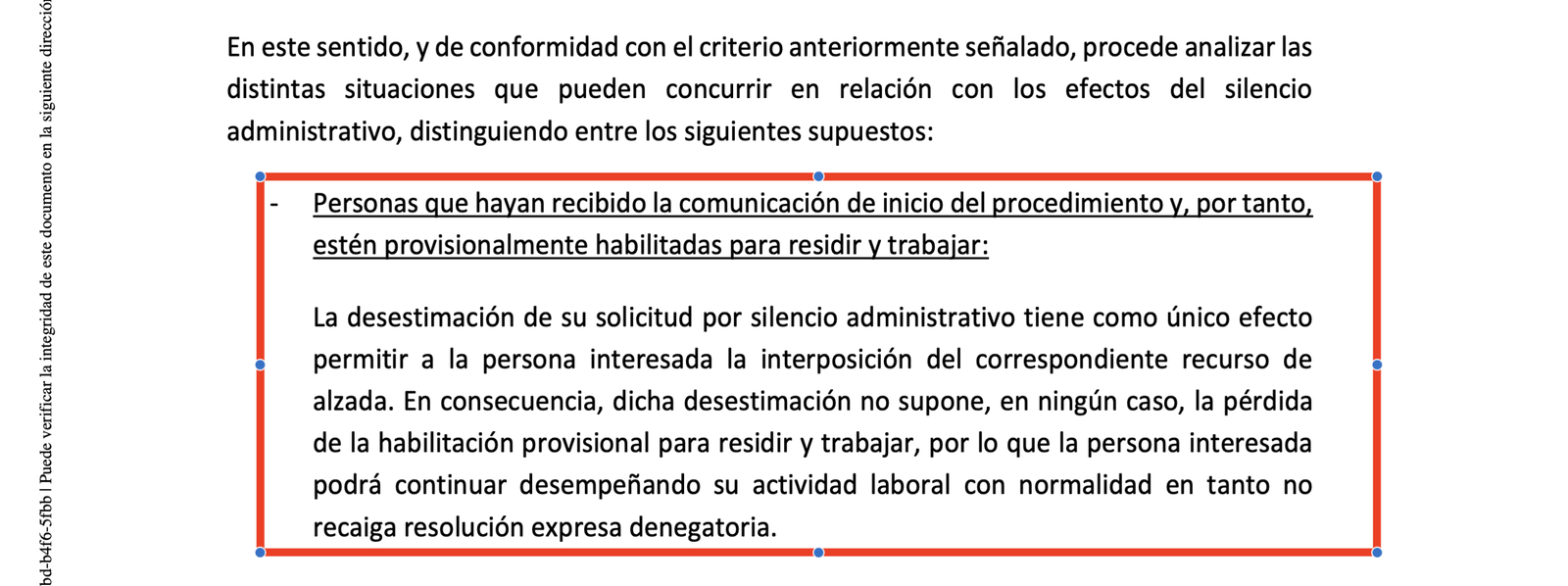
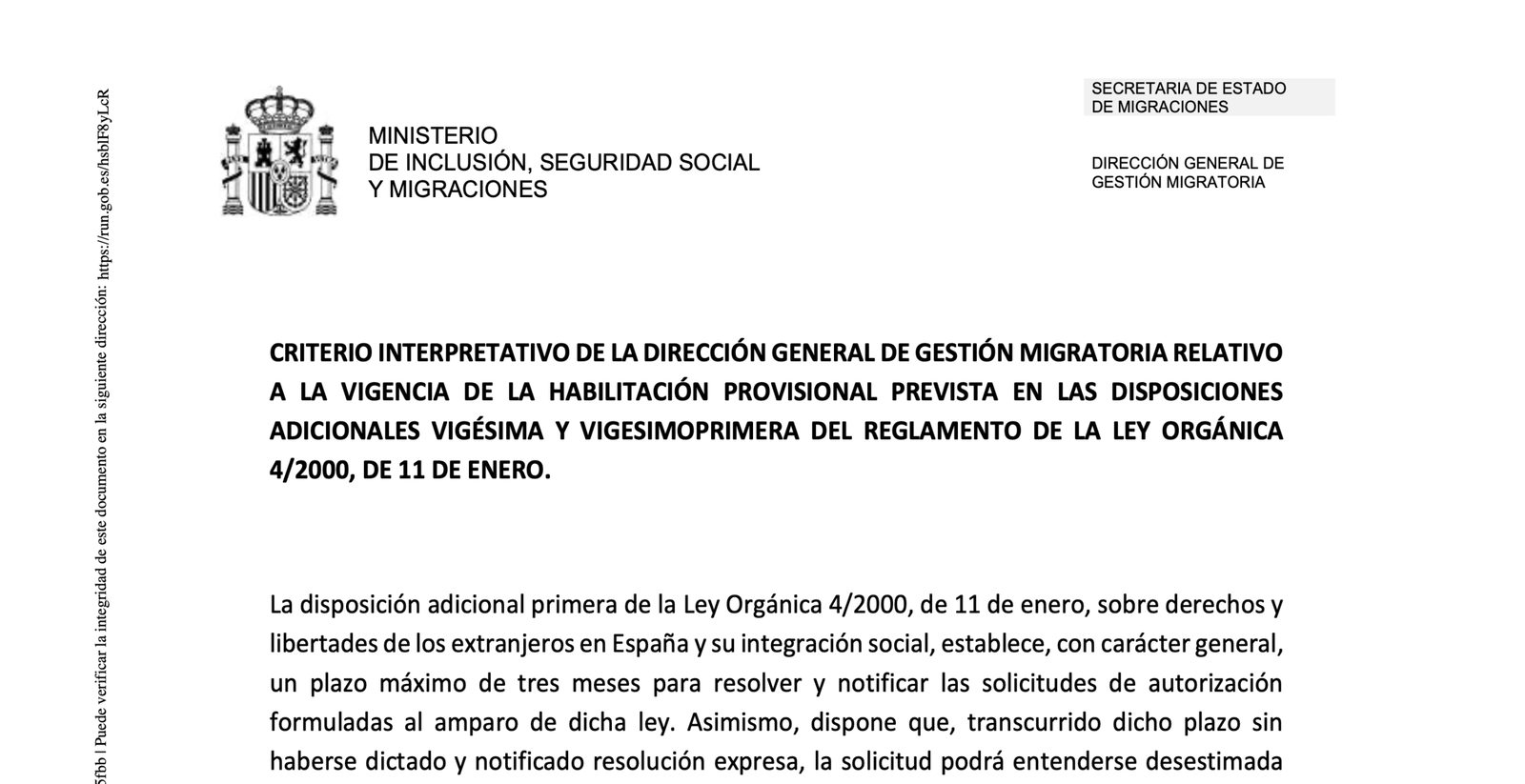
This is the most frequent doubt. If three months elapse and nobody responds, do you lose the right to reside and work? No. The Directorate-General for Migration Management clarified this in an interpretative criterion signed on 22 July 2026, whose conclusion, in our translation, specifies the following.
“The presumed rejection produced by administrative silence does not extinguish the provisional authorisation to reside and work recognised with the notification of commencement of the procedure, which shall remain valid until the notification of the corresponding express decision. Only an express decision of refusal shall produce the automatic loss of that authorisation […]”
In other words: your authorisation does not last three months. It lasts until the decision arrives. And only an express refusal, duly notified, withdraws it.
According to the affiliation report of the Ministry of Inclusion, Social Security and Migration, on 31 August 2026 there were 337,917 persons affiliated to the Social Security under this provisional authorisation.
You may complete your documentation until 30 September
This is the point that most people ignore, and probably the most useful in the entire article. Once the application period concluded, a period for the completion and correction of documentation (subsanación) was opened, which extends until 30 September 2026. It is intended for those who submitted their application in time, and it serves two purposes:
- On your own initiative: if you realise that a document was missing, or that you provided an incomplete or erroneous one, you need not wait until it is requested from you. You may complete your file on your own account.
- In response to a formal request (requerimiento): if the Administration demands documentation from you, this is the channel through which you must provide it.
You may proceed electronically or in person: Correos designated 383 offices for the completion of files until that date, according to the company’s own note of 1 July 2026. Consult the Correos page on the extraordinary regularisation for the offices available each month and the conditions of attention.
A warning that may determine whether you obtain your authorisation or lose it: if you receive a requerimiento, the period for a response is the one specified in the notification itself and will never exceed fifteen days. Note carefully: it may be shorter, so read the notification attentively and do not postpone your response. If that period elapses without a response, you will be deemed to have withdrawn, your file will be closed and you will lose the opportunity to obtain residence through this extraordinary regularisation. Consult frequently the channel through which you submitted the application — and if you acted through a representative, communicate with the person who represents you — because that is where the notifications will arrive.
Two important clarifications
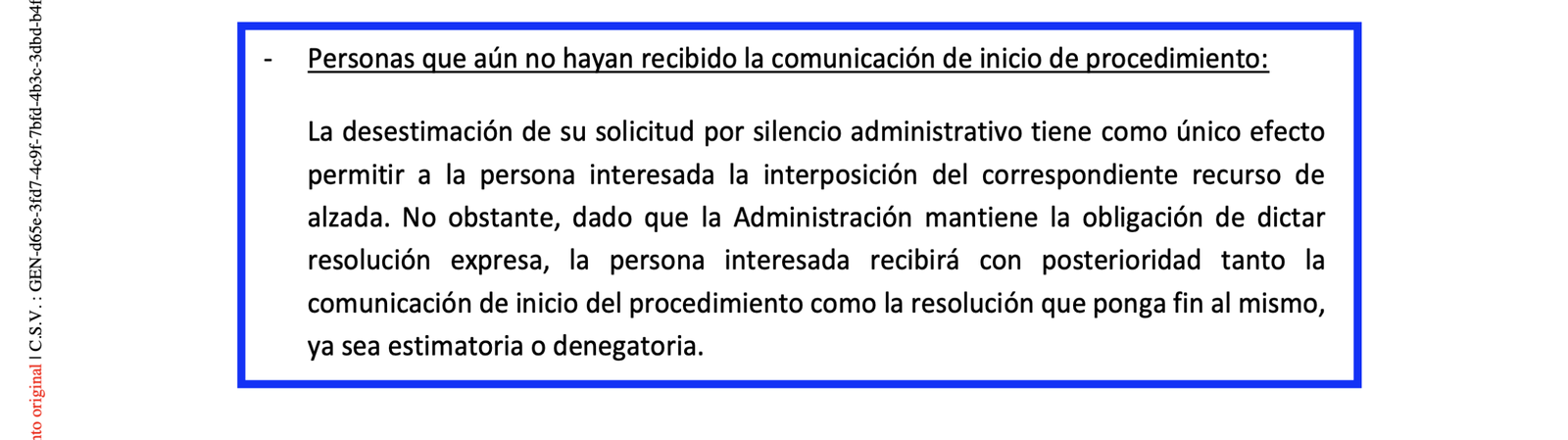
If you are still awaiting the notification of commencement from the UTEX: remain patient. That notification is the document which confirms that your file has commenced, and it is not the same as the receipt of submission (justificante de presentación) which you obtained upon applying. They are two distinct documents: the receipt demonstrates that you submitted the application; the notification of commencement demonstrates that your file is already in progress and that you are authorised to work.
The July criterion also contemplates this situation. If you have not yet received the notification of commencement and three months have already elapsed, the Administration retains the obligation to issue a decision. You will subsequently receive both that notification and the final decision.
In the meantime, examine the channel through which you submitted your application and also your spam folder. Many communications arrive there and pass unnoticed.
If the criminal record certificate from your country of origin is still pending: this is one of the points that causes most concern, but a route is provided. Your application may be sustained by the provision of three items: the receipt evidencing that you have already requested the certificate, a responsible declaration (declaración responsable) stating that one month has elapsed without a response, and the authorisation for the Spanish authorities to obtain it through diplomatic channels. In that case, the UTEX will request the Ministerio de la Presidencia, Justicia y Relaciones con las Cortes to obtain it by that route, and the procedure remains suspended for a maximum of three months. If those three months elapse and the certificate has not arrived, the UTEX will request it from you and you will have fifteen days to provide it. Respond within the period so as not to lose your application. In the meantime, your authorisation to work is preserved.
3. If your application has been refused, or the period has elapsed without a response
The maximum period for a decision is three months. That period commences from the entry of your application in the register of the body competent to process it, not from the day on which you delivered the documents.
If the three months elapse and you receive no response, the law considers that your application has been rejected by administrative silence. However, that silence does not withdraw the provisional authorisation, according to the criterion of the Directorate-General for Migration Management of 22 July 2026. Neither an express refusal nor silence constitutes the end of the road: you are entitled to appeal.
- Against an express refusal, you may submit an administrative appeal (recurso de alzada) within one month from the notification.
- Against administrative silence, the administrative appeal is likewise admissible, in this case without a limitation period that constrains you. And the contentious-administrative jurisdiction always remains available.
A clarification merits attention: an appeal against silence constitutes a right, not an obligation. As no period expires, you may await the express decision without any loss. And if you already possess the notification of commencement, you remain authorised to reside and work during that wait.
Consider, moreover, that those three months may be suspended in certain situations. For example, while a request for documentation is resolved. Some files therefore require more time without this signifying that anything is wrong.
The periods are strict and each case is different, so this is the moment to seek professional assistance. A refusal is frequently attributable to a missing document or to a correctable detail, and not to an absence of entitlement. That is why the previous point merits emphasis: correction in time prevents refusals. If your file remains active and you suspect that something is missing, act before a negative decision arrives.
4. If you were unable to submit the application in time
Not everything concludes with this period. The ordinary routes of arraigo (social, employment-related, family or for training purposes) remain permanently available, independently of this extraordinary process. In the meantime: continue to construct your arraigo. Maintain your empadronamiento (municipal registration) current and preserve any evidence of your presence and of your life in Spain. Every documented month counts. When you satisfy the requirements of an ordinary arraigo, you will be able to apply for it.
If you are in this situation, a collaborating organisation may orient you free of charge and assist you in determining which route corresponds to your case. In our search engine of collaborating organisations you may find the one nearest to your place of residence.
Find an organisation that may assist you
Locate accredited collaborating organisations near you. They orient you free of charge on the route that corresponds to your case and on the steps that remain.
Search for organisations →Whatever happens with your file, you are not alone in this. Obtain information, preserve your documents carefully and, in case of any doubt, consult organisations or professionals with expertise in Immigration law. You will find further information in our Blog and in the Resources section of intercultural.info.
@intercultural-infoWe await you on the channel: video tutorials →Sources
- Royal Decree 316/2026, of 14 April (BOE-A-2026-8284) — authorisation from the notification of commencement, periods for decision and appeal, and the regime applicable to criminal record certificates.
- Ministry of Inclusion / La Moncloa — report of applications registered and period for the correction of documentation until 30 September 2026.
- Correos — Regularización Extraordinaria para Personas Migrantes — phase for the correction of documentation: offices available, timetables and conditions of attention.
- Interpretative criterion of the Directorate-General for Migration Management, of 22 July 2026 — validity of the provisional authorisation in the face of administrative silence.
- Ministry of Inclusion, Social Security and Migration — affiliation report for August 2026 — persons affiliated under the provisional authorisation on 31 August 2026.